
Logo

American Heart Association

  48
  0


Final ID: 067

Exploration Of Glymphatic Function In Subjects With Controlled Hypertension: a Multimodal Study

Abstract Body: Introduction
The Glymphatic System ensures the movement of cerebrospinal fluid, primarily produced by the choroid plexuses, through the perivascular and interstitial spaces of the brain, allowing the clearance of toxic byproducts of cerebral metabolism toward the meningeal and cervical lymphatic system. In humans, although arterial hypertension has been associated with white matter damage, its relationship with glymphatic function remains unknown, especially with respect to the night-time phase, during which the function of the glymphatic system is predominant.
Hypothesis
We hypothesized that arterial hypertension is detrimental for the glymphatic system. Therefore, with this study, we aimed to investigate the relationship between blood pressure, its variability and the glymphatic function measured by MRI (Magnetic Resonance Imaging) indices.
Methods
We used two independent indices of cerebral glymphatic function measured by MRI – the index of diffusivity along the perivascular space (ALPS index), positively associated with glymphatic function, and the choroid plexus volume (ChP volume from T2-FLAIR), negatively associated with it. 134 patients with pharmacologically well-controlled arterial hypertension underwent 24-hour blood pressure monitoring and MRI scans to assess white matter microstructural integrity through tractography.
Results
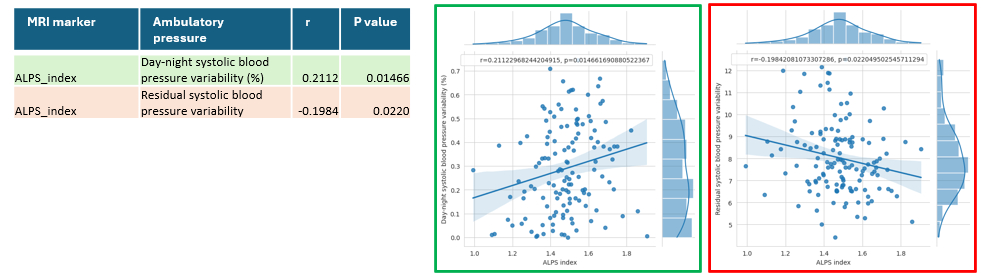
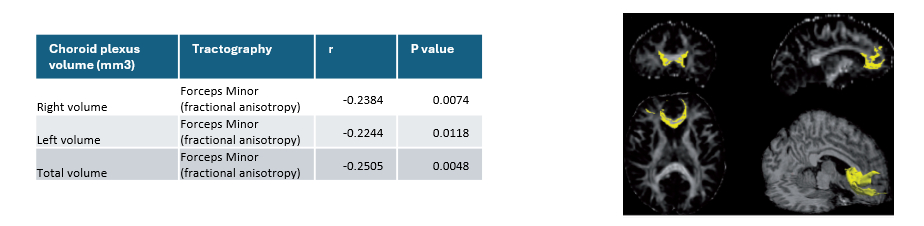
ALPS index and ChP volume parameters show a significant inverse association (r=-0.31, p=0.0004) in the population under study. Moreover, the ALPS index is positively correlated with day–night variability of systolic blood pressure (r=0.211, p=0.015) and negatively correlated with non-circadian variability of systolic blood pressure (r=-0.198, p=0.022) (Figure A). Finally, white matter tractography analysis shows an association between reduced glymphatic function (higher ChP volume) and structural deterioration of white matter (lower fractional anisotropy of the Forceps Minor) (Figure B).
Conclusions
The significant correlation between ALPS index and ChP volume shows that the two indices are complementary metrics of glymphatic function in hypertensive patients. Moreover, our results demonstrate that: i) the day–night component of systolic pressure variability is a protective factor for glymphatic function; ii) the non-circadian component of systolic pressure variability is instead associated with impairment of glymphatic function; iii) microstructural deterioration of white matter leads to reduced glymphatic functionality.
  • La Ferla, Sebastiano  ( IRCCS Neuromed , Venafro , Italy )
  • Carnevale, Daniela  ( Sapienza University Rome - Neuromed , Pozzilli , Italy )
  • Lembo, Giuseppe  ( Sapienza University of Rome , Pozzilli , Italy )
  • Carnevale, Lorenzo  ( I.R.C.C.S. Neuromed , Pozzilli , Italy )
  • Author Disclosures:
    Sebastiano La Ferla: DO NOT have relevant financial relationships | Daniela Carnevale: DO NOT have relevant financial relationships | Giuseppe Lembo: DO NOT have relevant financial relationships | Lorenzo Carnevale: DO NOT have relevant financial relationships
Meeting Info:
Session Info:

Concurrent B: Hypertension and Aging

Saturday, 09/06/2025 , 10:30AM - 12:00PM

Oral Abstract Session

More abstracts on this topic:
3-HKA Promotes the Vascular Remodeling after Stroke by Modulating the Activation of A1/A2 Reactive Astrocytes

Chen Jun-min, Shi Guang, Yu Lulu, Shan Wei, Zhang Xiangjian, Wang Qun

Comparison of Anti-coagulation and anti-Platelet Therapies for Intracranial Vascular Atherostenosis-Magnetic Resonance Imaging (CAPTIVA-MRI)

Wong Ka-ho, De Havenon Adam, Sulken Amy, Knebusch Clara, Reed Rachel, Faraco Carlos, Martin Renee, Amin-hanjani Sepideh, Chatterjee Arindam, Liebeskind David

More abstracts from these authors:
Coupling of Brain Oxygenated Blood Flow and Cerebrospinal Fluid Inflow in Hypertensive Patients: a Dynamic Glymphatic Marker

La Ferla Sebastiano, Carnevale Daniela, Lembo Giuseppe, Carnevale Lorenzo

Lack of CD8+ lymphocytes protects TAC mice from cerebral hypoperfusion and cognitive impairment, independently from their impact on cerebral vascular myogenic tone

Carnevale Lorenzo, Fardella Valentina, Fardella Stefania, Migliaccio Agnese, Pallante Fabio, Carnevale Daniela, Lembo Giuseppe

You have to be authorized to contact abstract author. Please, Login
Not Available