
Logo

American Heart Association

  19
  0


Final ID: MP362

Coupling of Brain Oxygenated Blood Flow and Cerebrospinal Fluid Inflow in Hypertensive Patients: a Dynamic Glymphatic Marker

Abstract Body (Do not enter title and authors here): Introduction
The glymphatic system ensures the clearance of toxic byproducts of cerebral metabolism and relies on the movement of cerebrospinal fluid (CSF) through the perivascular and interstitial spaces of the brain. Although arterial hypertension is associated with white matter damage, its relationship with glymphatic function remains unknown, especially with respect to the night-time phase, during which the function of the glymphatic system is predominant.
Hypothesis
We hypothesized that arterial hypertension is detrimental for the glymphatic system. Therefore, with this study, we aimed to investigate the effect of arterial hypertension on the glymphatic function measured by an MRI (Magnetic Resonance Imaging) functional index, and its relationship with the 24h blood pressure variability in hypertensive subjects.
Methods
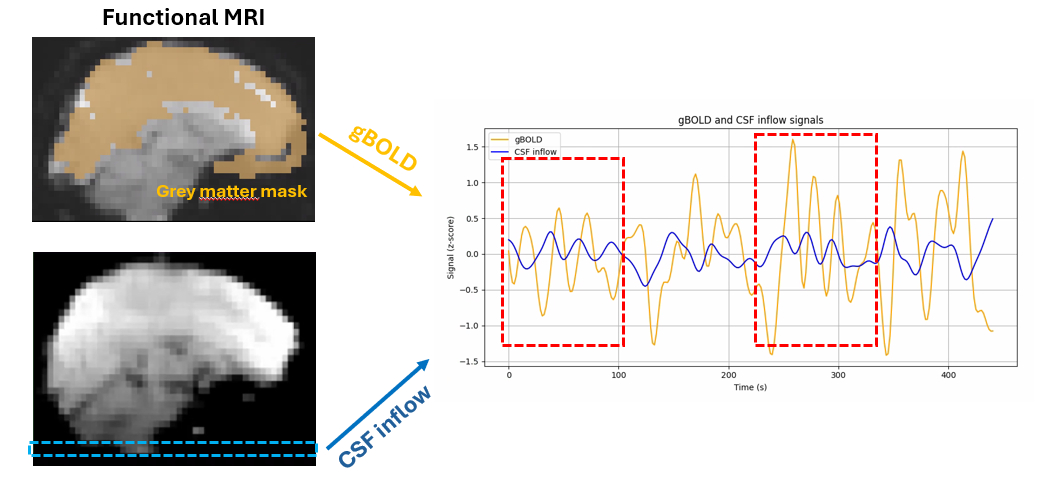
We used a functional index that estimates the coupling between global grey matter BOLD (Blood Oxygenation Level Dependent) signal and the CSF inflow rate at the brainstem level (gBOLD-CSF coupling from functional MRI) (Figure A), which has been positively associated to a functional glymphatic system. We investigated the glymphatic function in 17 normotensives and 45 pharmacologically well-controlled hypertensives. Finally, we explored the relationship between gBOLD-CSF coupling and the 24h blood pressure variability (BPV) in 129 patients with pharmacologically well-controlled arterial hypertension.
Results
Hypertensive subjects (N=45) show a significantly weaker gBOLD-CSF coupling than normotensives (N=17) (p=0.012, Figure B). Moreover, in the hypertensive cohort, the temporal delay of gBOLD-CSF coupling is negatively correlated with the day–night component of diastolic BPV (r=-0.21, p=0.015), while the coupling intensity is negatively correlated with the pre-post prandial component of the systolic (r=-0.21, p=0.014) and diastolic BPV (r=-0.23, p=0.009) and with the residual component of the systolic BPV (r=-0.19, p=0.027) (Figure C).
Conclusions
Our results demonstrate that arterial hypertension impacts the glymphatic system, negatively altering the physiological coupling between cerebral oxygenated blood flow and cerebrospinal fluid inflow into the brain. Moreover, the correlations between gBOLD-CSF coupling and the 24h BPV demonstrate that the day-night BPV component is a protective factor for glymphatic function, while the non-circadian BPV components (pre-post prandial and residual) are associated with impairment of glymphatic function.
  • La Ferla, Sebastiano  ( IRCCS Neuromed , Venafro , Italy )
  • Carnevale, Daniela  ( Sapienza University Rome - Neuromed , Pozzilli , Italy )
  • Lembo, Giuseppe  ( Sapienza University of Rome , Pozzilli , Italy )
  • Carnevale, Lorenzo  ( I.R.C.C.S. Neuromed , Pozzilli , Italy )
  • Author Disclosures:
    Sebastiano La Ferla: DO NOT have relevant financial relationships | Daniela Carnevale: DO NOT have relevant financial relationships | Giuseppe Lembo: No Answer | Lorenzo Carnevale: DO NOT have relevant financial relationships
Meeting Info:

Scientific Sessions 2025

2025

New Orleans, Louisiana

Session Info:

New Discoveries in Clinical Hypertension Research

Saturday, 11/08/2025 , 01:45PM - 02:45PM

Moderated Digital Poster Session

More abstracts on this topic:
Advanced Diffusion and Functional MRI Measures Are Associated with Microstructural Morphology and Cognitive Function in Subacute Ischemic Cerebellar Stroke

Urday Sebastian, Clements Rebecca, Kurani Ajay, Montero Miguel, Grafman Jordan H., Harvey Richard, Ingo Carson

A Study Using Team Based Hypertension Care Focused on Black Patients to Inform a Future Randomized Trial

Manandhar Srista, Taylor Yhenneko, Bosworth Hayden, Pokharel Yashashwi, Chhetri Sunit, Sutton Danielle, Saha Animita, Kaur Suneet, Brown Josh, Moore Justin, Callahan Kate, Williamson Jeff

More abstracts from these authors:
Lack of CD8+ lymphocytes protects TAC mice from cerebral hypoperfusion and cognitive impairment, independently from their impact on cerebral vascular myogenic tone

Carnevale Lorenzo, Fardella Valentina, Fardella Stefania, Migliaccio Agnese, Pallante Fabio, Carnevale Daniela, Lembo Giuseppe

Exploration Of Glymphatic Function In Subjects With Controlled Hypertension: a Multimodal Study

La Ferla Sebastiano, Carnevale Daniela, Lembo Giuseppe, Carnevale Lorenzo

You have to be authorized to contact abstract author. Please, Login
Not Available