
Logo

American Heart Association

  44
  0


Final ID: FR533

Association Between Postprandial Hypotension Determined by Ambulatory Blood Pressure Monitoring and Falls Among Older Adults with Hypertension Who Are Taking Antihypertensive Medication: Results from the AMBROSIA Study

Abstract Body: Background: Postprandial hypotension (PPH), defined as a large decline in blood pressure (BP) after a meal, has typically been assessed using BP measured in a clinic setting. However, evidence regarding PPH evaluated outside the clinic and under usual daily meal conditions is scarce. We evaluated PPH and fall risk using out-of-office BP monitoring, ambulatory BP monitoring (ABPM), among community-dwelling older adults with hypertension who were taking antihypertensive medications.
Hypothesis: PPH determined by ABPM is associated with an increased risk of falls among older adults taking antihypertensive medication.
Methods: The AMBulatoRy blood preSsure In older Adults (AMBROSIA) study enrolled a prospective cohort of adults aged ≥65 years who were taking antihypertensive medication, from an integrated healthcare system in the United States, to examine the utility of ABPM for identifying fall risk. Participants underwent 24-hour ABPM at baseline. Data on falls during the subsequent 12-month follow-up period were prospectively collected each month using falls calendars. Preprandial systolic BP (SBP) was defined as the mean SBP during the 1 hour before a meal, and postprandial SBP as the minimum SBP during the 2 hours after the meal. Systolic PPH was defined as either a decline from preprandial to postprandial SBP of ≥20 mm Hg, or a postprandial SBP of ≤90 mm Hg when preprandial SBP was ≥100 mm Hg for any meal.
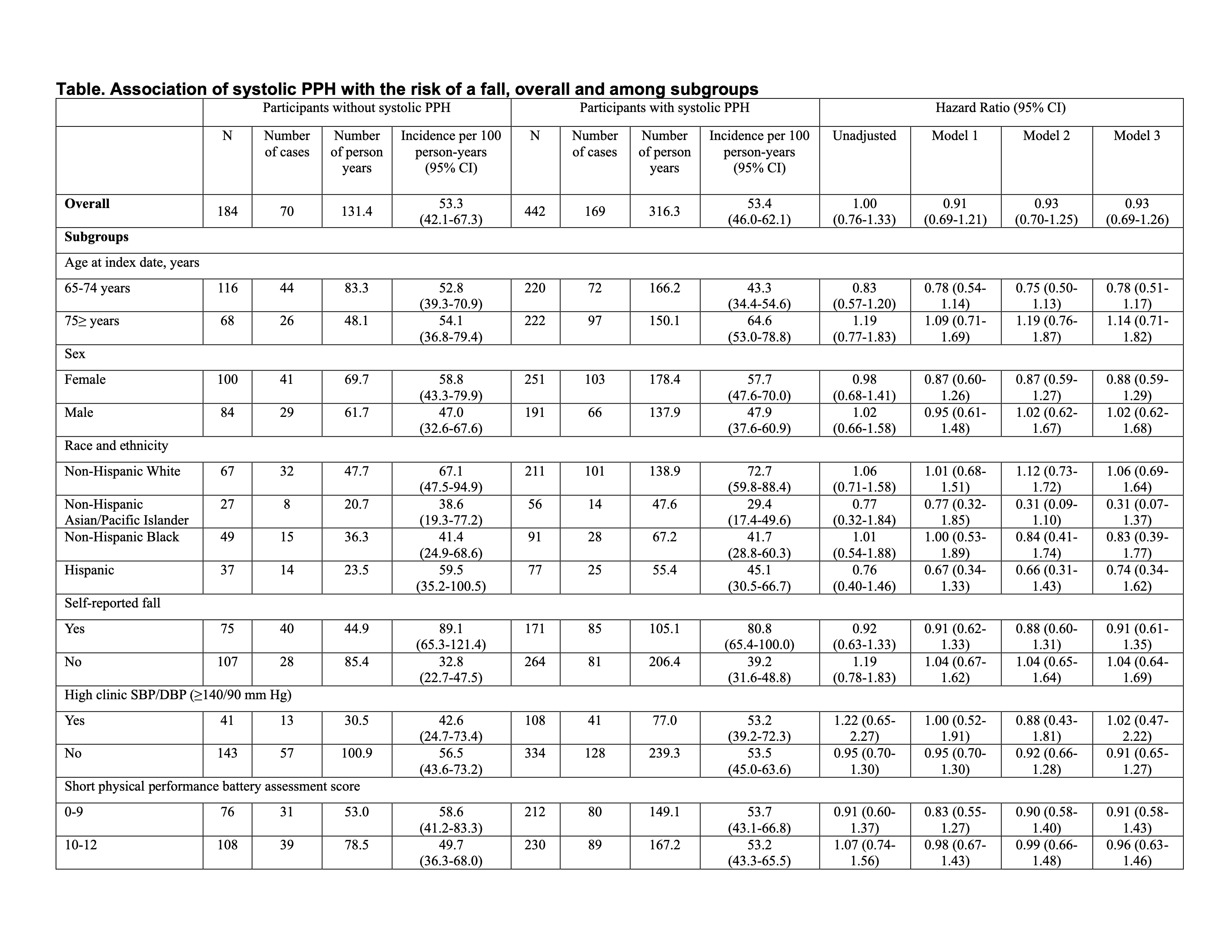
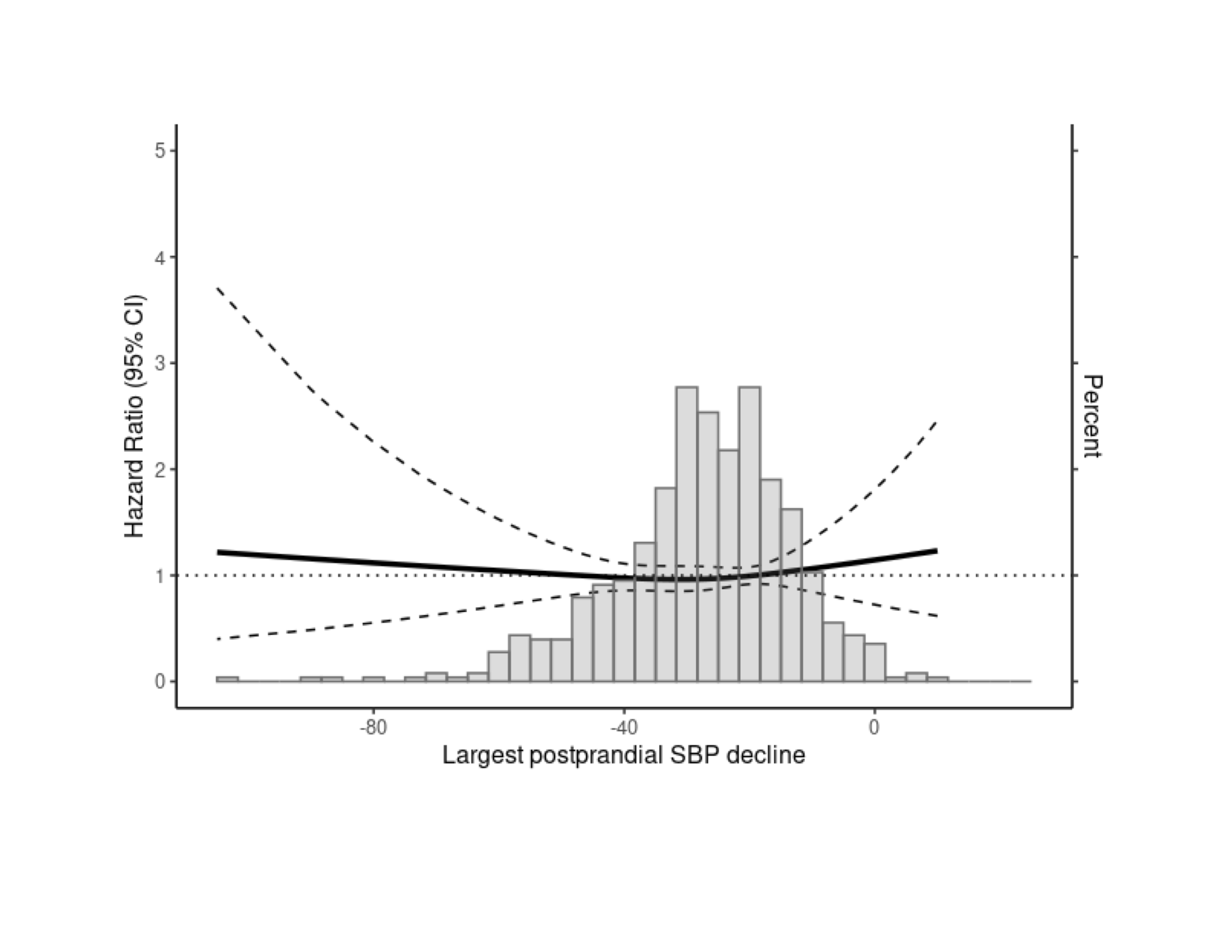
Results: Among 626 participants (mean ± SD age: 74.6 ± 6.2 years; 56.1% female; mean awake SBP: 134.6 ± 13.7 mm Hg), 442 (70.6%) had systolic PPH. During the 12-month follow-up, falls occurred in 38.0% and 38.2% of participants with and without systolic PPH, respectively. In a Cox regression analysis controlling for several potential demographic and clinical risk factors, systolic PPH was not associated with an increased risk of falls compared to those without systolic PPH in the overall study population (adjusted HR: 0.93, 95% CI: 0.69-1.26), nor in subgroups defined by age, sex, race/ethnicity, history of falls, or clinic BP (Table). A restricted cubic spline analysis revealed no association between greater postprandial SBP decline and fall risk (Figure).
Conclusions: Systolic PPH determined using ABPM was common among community-dwelling older adults taking antihypertensive medication, but it was not associated with an increased risk of falls.
  • Narita, Keisuke  ( Columbia University Irving Medical Center , New York , New York , United States )
  • Schwartz, Joseph  ( Columbia University Irving Medical Center , New York , New York , United States )
  • Sim, John  ( Kaiser Permanente Los Angeles , Los Angeles , California , United States )
  • Shimbo, Daichi  ( Columbia University Irving Medical Center , New York , New York , United States )
  • Reynolds, Kristi  ( Kaiser Permanente Southern California , Pasadena , California , United States )
  • Wei, Rong  ( Kaiser Permanente Southern California , Pasadena , California , United States )
  • Harrison, Teresa  ( Kaiser Permanente Southern California , Pasadena , California , United States )
  • Cannavale, Kimberly  ( Kaiser Permanente Southern California , Pasadena , California , United States )
  • Qian, Lei  ( Kaiser Permanente Southern California , Pasadena , California , United States )
  • Bowling, Barrett  ( Duke University , Durham , North Carolina , United States )
  • Fang, Chloe  ( Columbia University Irving Medical Center , New York , New York , United States )
  • Muntner, Paul  ( Perisphere Real World Evidence , Austin , Texas , United States )
  • Author Disclosures:
    Keisuke Narita: DO NOT have relevant financial relationships | Joseph Schwartz: No Answer | John Sim: No Answer | Daichi Shimbo: DO NOT have relevant financial relationships | Kristi Reynolds: DO have relevant financial relationships ; Research Funding (PI or named investigator):Merck & Co:Past (completed) | Rong Wei: DO NOT have relevant financial relationships | Teresa Harrison: DO NOT have relevant financial relationships | Kimberly Cannavale: DO NOT have relevant financial relationships | Lei Qian: DO have relevant financial relationships ; Research Funding (PI or named investigator):GlaxoSmithKline (unrelated to this study):Active (exists now) ; Research Funding (PI or named investigator):AstraZeneca (unrelated to this study):Active (exists now) ; Research Funding (PI or named investigator):Moderna (unrelated to this study):Active (exists now) | Barrett Bowling: No Answer | Chloe Fang: No Answer | Paul Muntner: No Answer
Meeting Info:
Session Info:

Poster Session 2 with Breakfast Reception

Friday, 09/05/2025 , 09:00AM - 10:30AM

Poster Session

More abstracts on this topic:
Absence of Terminal Digit Preference in Blood Pressure Measurements in Primary Care: Results from the LINKED-BP Program

Slone Sarah, Wang Zhixin, Foti Kathryn, Chen Yuling, Dugbartey Janice, Himmelfarb Cheryl, Commodore-mensah Yvonne

A Novel Machine Learning-based Adverse Cardiovascular Events Risk Algorithm For Cancer Patients Treated With Tyrosine Kinase Inhibitors

Wahi Shawn, Cross James, Mora Ruben, Im Yunju, Kwan Jennifer

More abstracts from these authors:
Prevalence, Timing, and Location of Falls in an Older Population with Treated Hypertension

Harrison Teresa, Reynolds Kristi, Wei Rong, Cannavale Kimberly, Qian Lei, Perez Rossy, Calderon Raul, Shimbo Daichi, Schwartz Joseph, Bowling Barrett

Home Blood Pressure Monitoring and Risk of Falls in Older Adults with Hypertension: the AMBROSIA-HOME Cohort Study

Poudel Bharat, Bowling Barrett, Levitan Emily, Shimbo Daichi, Schwartz Joseph, Reynolds Kristi, Wang Zhixin, Harrison Teresa, Cannavale Kimberly, Wei Rong, Muntner Paul

You have to be authorized to contact abstract author. Please, Login
Not Available