Global Burden and Trends in Heart Failure due to Pneumoconiosis From 1990 to 2023: A Comprehensive Benchmarking Analysis
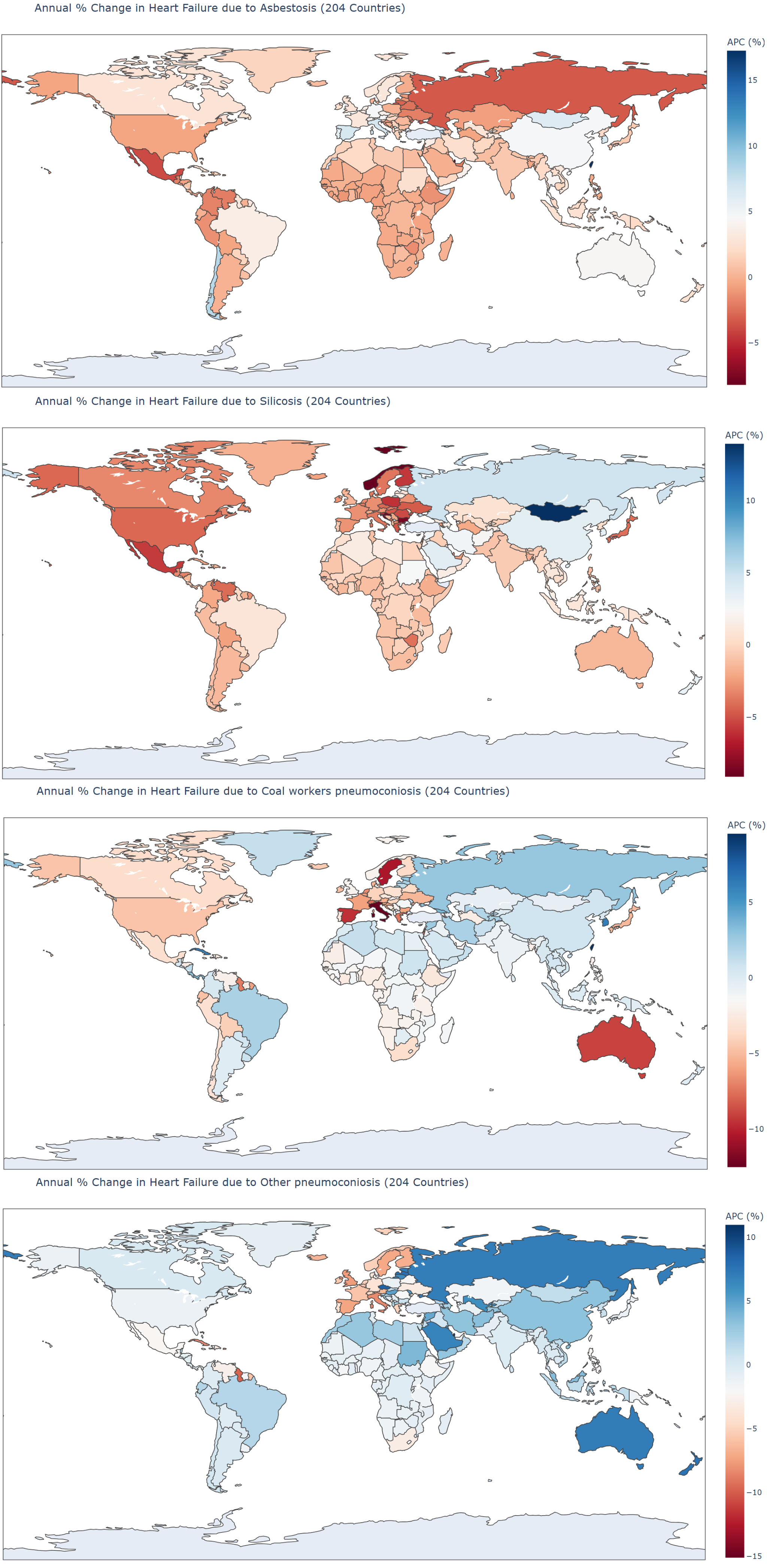
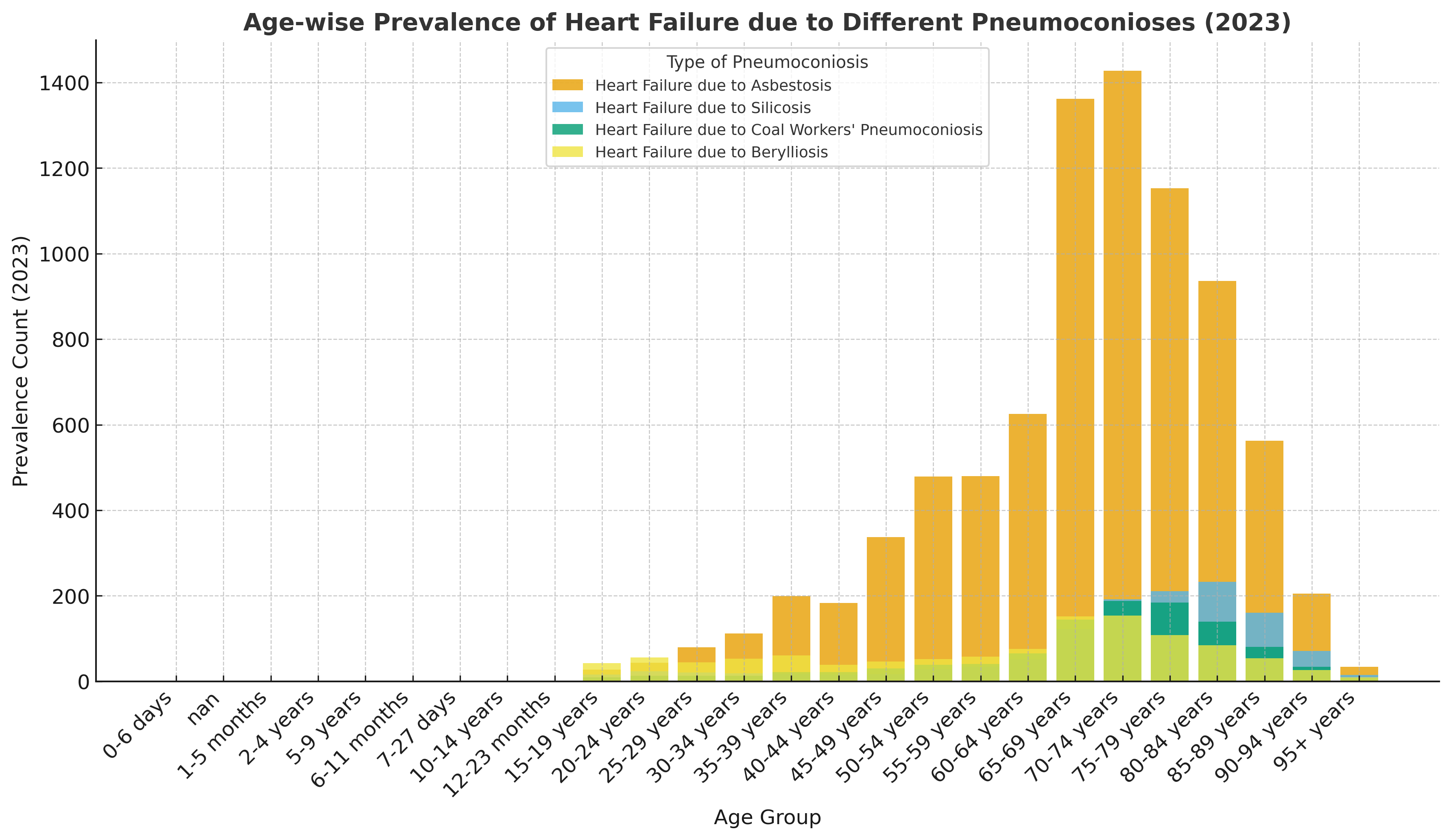
Abstract Body: Background: Pneumoconiosis, a chronic occupational lung disease resulting from prolonged dust exposure, has emerged as a systemic condition with significant cardiovascular consequences, particularly heart failure (HF). Despite advances in workplace safety, the global burden and long-term trends of HF linked to pneumoconiosis remain underexplored. Methods: Temporal trends in HF attributable to asbestosis, silicosis, coal workers’ pneumoconiosis, and berylliosis were analyzed globally from 1990 to 2023 across 204 countries and territories using GBD 2023 tool. Age-standardized prevalence rates (per 100,000 population) were assessed by region, age, sex, and income group, and temporal changes were quantified using the Average Annual Percent Change (AAPC) derived from log-linear regression models. Results: Between 1990 and 2023, the global prevalence of heart failure attributable to pneumoconiosis showed an overall rising trend, increasing from 1,718 to 8,246 cases for asbestosis (AAPC = 4.98%), 364 to 1,246 for silicosis (AAPC = 4.34%), 649 to 1,042 for coal workers’ pneumoconiosis (AAPC = 1.30%), and 363 to 1,114 for berylliosis (AAPC = 3.01%). Regionally, the highest AAPC was observed for silicosis (7.50%) and asbestosis (7.02%) in Southeast Asia, East Asia, and Oceania, followed by coal workers’ pneumoconiosis (4.13%) in the same region and berylliosis (4.10%) in North Africa and the Middle East. Across income levels, the greatest rise occurred in upper-middle-income countries (AAPC = 6.8%), followed by lower-middle-income countries (AAPC = 4.9%), while high-income regions exhibited a comparatively modest increase (AAPC = 2.7%). Age-specific analysis revealed a modest rise in individuals aged <20 years (AAPC = 0.08%), a notable increase among those aged 20–54 years (AAPC = 2.51%), and a substantial elevation in the ≥55-year group (AAPC = 1.52%). By gender, males showed a higher increase in the age-standardized prevalence rate compared with females (AAPC = 2.78% vs. 1.23%). Conclusion: The global burden of heart failure attributable to pneumoconiosis has risen significantly over the past three decades, with sharpest increases in upper-middle-income and industrializing regions, particularly in Asia. The upward trends across all age and sex groups emphasize the need for reinforced occupational health regulations, early cardiovascular monitoring, and integrated preventive strategies to mitigate the growing cardiopulmonary consequences of pneumoconiosis.
Qamar, Abdel Rahman
(
Wellstar Spalding medical center,
, Griffin , Georgia , United States )
Trivedi, Yash
(
Nassau University Medical Center (2201 Hempstead Turnpike,
, East Meadow, , New York , United States )
Gadhiya, Rahil
(
GMERS Patan
, Surat , India )
Patel, Vruti
(
University of Northern Philippines - College of Medicine, Tamag, Vigan,
, Ilocos Sur, , Philippines )
Gopi, Gokul
(
Ascension Sacred Hearts,
, Pensacola , Florida , United States )
Kaur, Mandeep
(
HCA Capital Regional Medical Center
, Tallahassee , Florida , United States )
Amin, Vishrant
(
JFK University Medical Center
, Milltown , New Jersey , United States )
Desai, Hardik
(
Independent Public Health Researcher
, Ahmedabad , Gujarat , India )