
Logo

American Heart Association

  11
  0


Final ID: TU226

SALAM: Study of Arab-American Longitudinal Assessment of Morbidity Cardiometabolic Burden Across Age and Sex in a U.S. Health System

Abstract Body: Background:
Middle Eastern and North African (MENA) populations remain largely invisible in U.S. cardiovascular research due to the absence of ethnicity identifiers in clinical registries and their frequent misclassification under the “Caucasian” category. Consequently, their cardiometabolic disease burden is poorly characterized. Using a validated Arab Name Algorithm1, we developed a deidentified electronic health record registry of individuals within a large healthcare system to describe age- and sex-specific prevalence of major cardiometabolic conditions.
Methods:
We analyzed data from the Houston Methodist Cardiovascular Disease (CVD) Learning Health System Registry (2016–2025), identifying MENA individuals based on surname matching using a validated Arab Name Algorithm (specificity 98.9%, sensitivity 50.3%). Prevalence of diabetes, atherosclerotic cardiovascular disease (ASCVD), hypertension, dyslipidemia, obesity, and chronic kidney disease (CKD) was estimated across age groups and stratified by sex.
Results:
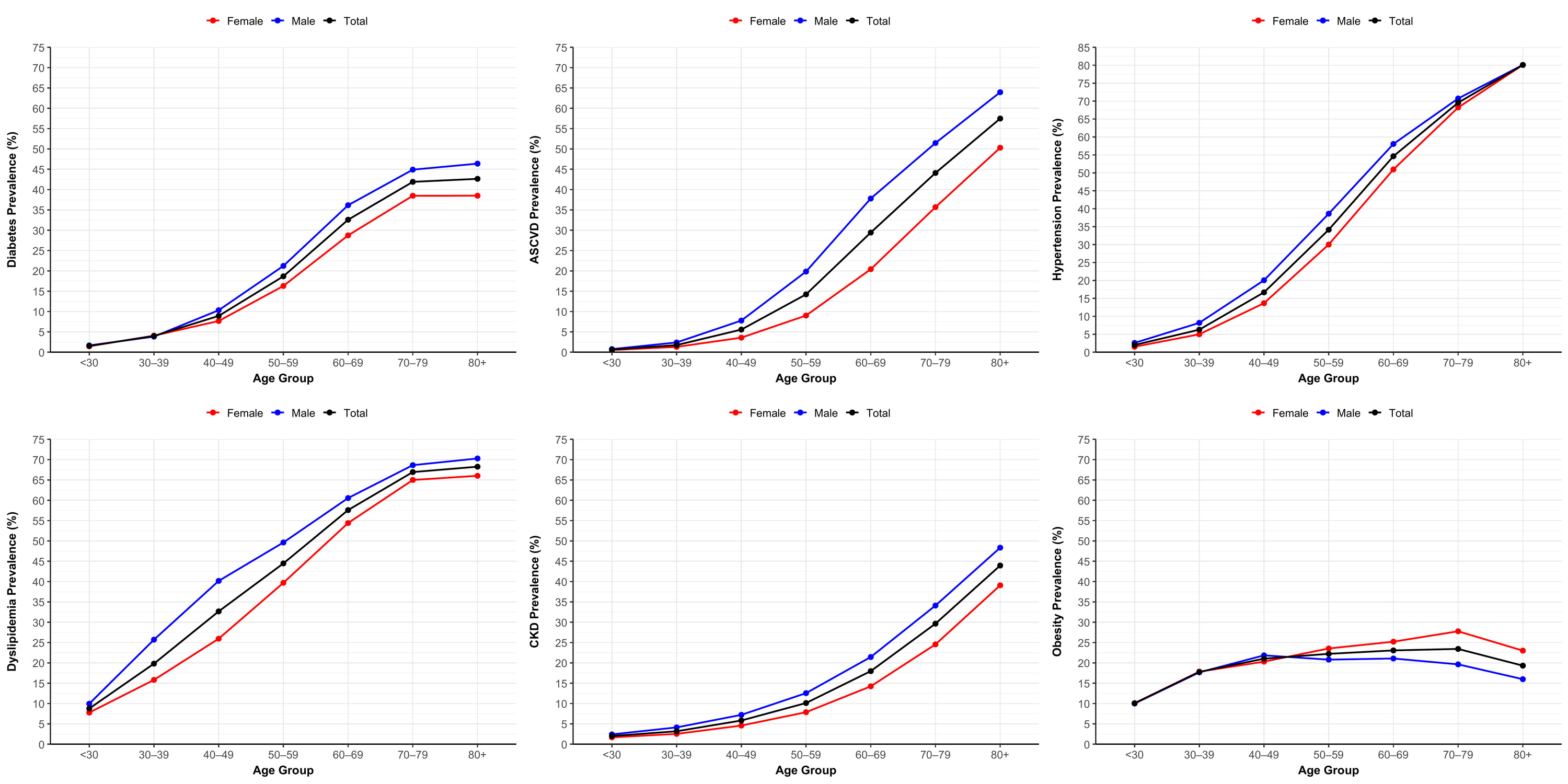
Among 51,013 MENA adults, prevalence of cardiometabolic conditions rose steeply with age across both sexes. Diabetes prevalence increased from <5% under age 40 to >40% among those aged ≥70 years. Hypertension and dyslipidemia exceeded 60% in older adults, while ASCVD affected more than half of men and over one-third of women by age 80. CKD prevalence increased from <5% under age 40 to nearly 45% among those ≥80 years. Obesity peaked between ages 60–70, with higher rates among women. Across all conditions, men consistently exhibited higher prevalence except for obesity.
Conclusions:
Using a validated name-based algorithm, we characterized cardiometabolic disease patterns among MENA adults in the U.S. The high burden observed, particularly among men and older adults, highlights the need for improved ethnicity data collection, rather than collapsing MENA individuals within White categories, and for targeted prevention in this underrecognized population.
  • Ardakani, Jad  ( Houston Methodist Hospital , Houston , Texas , United States )
  • Siddharth, Aditya  ( Houston Methodist Hospital , Houston , Texas , United States )
  • Bose, Budhaditya  ( HOUSTON METHODIST , Houston , Texas , United States )
  • Nicolas, Juan  ( Houston Methodist Research Inst. , Houston , Texas , United States )
  • Nasir, Khurram  ( Houston Methodist , Houston , Texas , United States )
  • Al-kindi, Sadeer  ( Houston Methodist Hospital , Houston , Texas , United States )
  • Author Disclosures:
Meeting Info:

EPI-Lifestyle Scientific Sessions 2026

2026

Boston, Massachusetts

Session Info:

Poster Session 1

Tuesday, 03/17/2026 , 05:00PM - 07:00PM

Poster Session

More abstracts on this topic:
Assessing Health Literacy and the Role of Race and Social Determinants in Cardiac Patients.

Odigwe Celestine, Lakkis Nasser, Mayfield Hanna, Mulyala Rajasekhar, Riad Mariam, Malik Hajira, Ruiz Brent, Mulekar Madhuri, Malozzi Christopher, Omar Bassam

A machine learning approach to examining the associations of minority stressors and physical activity among sexual and gender minority adults

Lopez Veneros David, Ensari Ipek, Bhilegaonkar Riya, Sharma Yashika, Caceres Billy

More abstracts from these authors:
You have to be authorized to contact abstract author. Please, Login
Not Available