Artificial Intelligence-Derived Social Determinants of Health Profiles and Cardiovascular Risk in Asian American Adults
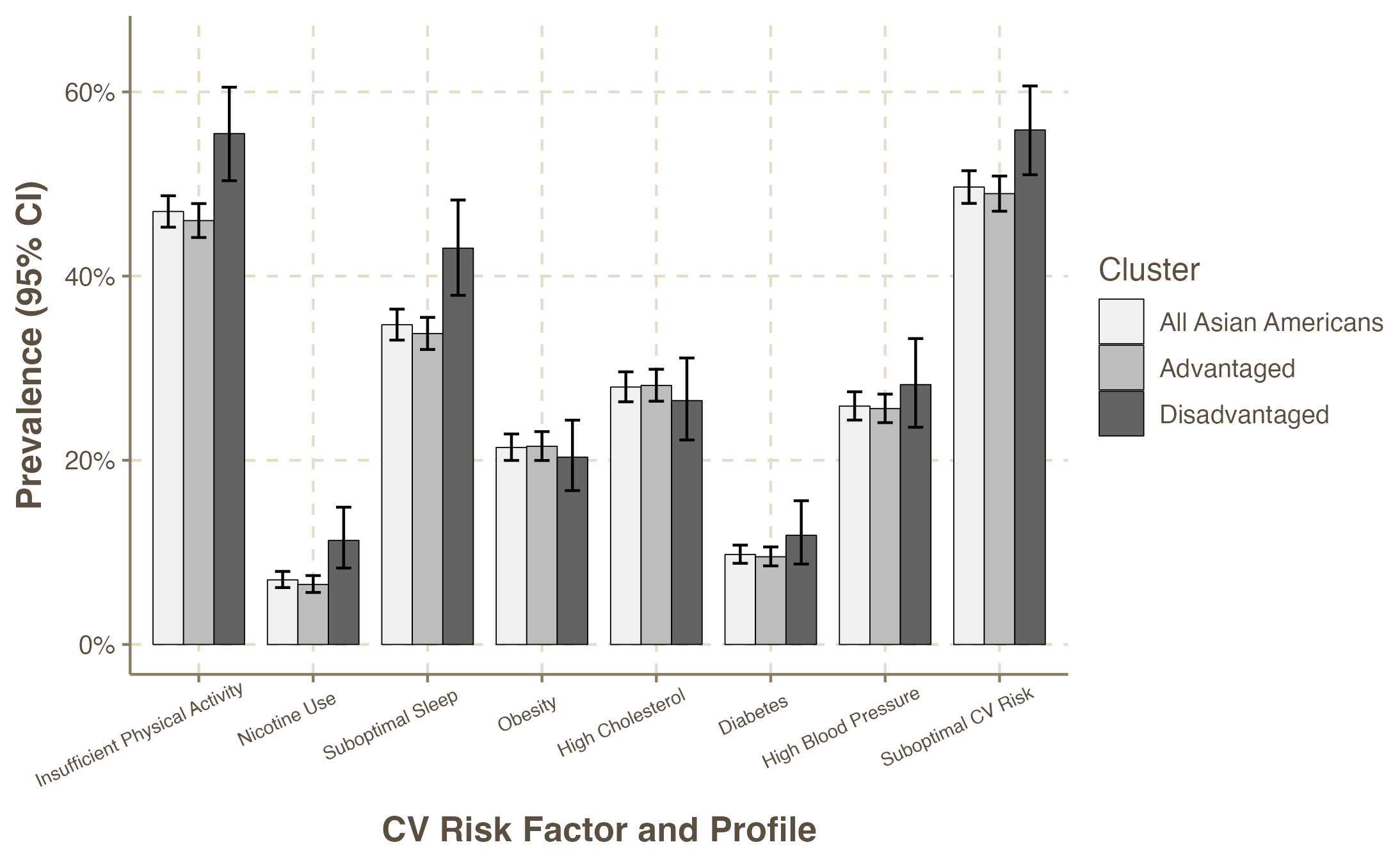
Abstract Body: Introduction: Asian American adults experience diverse social contexts that shape cardiovascular (CV) risk, yet population-based models integrating multidimensional social determinants of health (SDOH) are limited. Hypothesis: An unsupervised machine learning model would identify SDOH patterns linked to CV risk factors, with heterogeneity by Asian subgroup and US region. Methods: We analyzed 6,395 Asian American adults from the 2013-2018 National Health Interview Survey. Hierarchical agglomerative clustering with Ward linkage was used to identify patterns in 27 SDOH; an optimal solution was selected with the Hubert statistic and D-index. Group differences were assessed using Rao–Scott χ2 and Wald tests. Survey-weighted logistic regression assessed associations between SDOH profile and Life’s Essential 8 risk factors (insufficient physical activity, nicotine exposure, suboptimal sleep, obesity, high cholesterol, diabetes, hypertension) and a suboptimal CV risk profile (≥ 2 risk factors) adjusting for age, sex, and remaining risk factors. Results: Two SDOH clusters emerged: a disadvantaged cluster (n=740) with greater economic strain, food insecurity, and low neighborhood cohesion, and an advantaged cluster (n=5,655) (mean SDOH score 9.7 vs 5.3; p<0.05). Compared with the advantaged cluster, disadvantaged SDOH were associated with insufficient physical activity (OR 1.35, 95% CI 1.08–1.70), nicotine exposure (1.84, 1.28–2.63), suboptimal sleep (1.46, 1.17–1.82), and a suboptimal CV risk profile (1.40, 1.11–1.76). Stratified analyses revealed that among Asian Indian adults, disadvantaged SDOH were associated with suboptimal sleep (1.92, 1.13–3.25); among Chinese adults, with diabetes (2.60, 1.18–5.71); among “other Asian” adults, with nicotine exposure (2.07, 1.27–3.35), suboptimal sleep (1.55, 1.06–2.26), and suboptimal CV risk profile (1.84, 1.23–2.74). Disadvantaged SDOH were linked to insufficient physical activity in the West (1.55, 1.14–2.11), nicotine exposure in the Midwest (2.60, 1.09–6.23), suboptimal sleep in the South (1.71, 1.01–2.91) and West (1.37, 1.02–1.84), diabetes in the South (1.86, 1.03–3.36), lower odds of high cholesterol in the South (0.44, 0.25–0.76), and a suboptimal CV risk profile in the Northeast (1.87, 1.12–3.12). Conclusion: A disadvantaged SDOH profile was linked to multiple behavioral and metabolic CV risk factors, underscoring the need for tailored, community-specific prevention strategies across Asian subgroups and US regions.
Le, Austin
(
University of Illinois College of Medicine
, Peoria , Illinois , United States )
Dodani, Sunita
(
UICOM-P
, Peoria , Illinois , United States )
Elfassy, Tali
(
University of Miami
, Miami , Florida , United States )
Yang, Eugene
(
University of Washington
, Seattle , Washington , United States )