
Logo

American Heart Association

  2
  0


Final ID: TH835

REFUSE (REFusal of discharge Under Specialist Encounter): A qualitative study

Abstract Body: Introduction
In Singapore, the rising prevalence of multi-morbidity among a rapidly aging population has led to an exponential increase in demand for cardiology specialist clinic services. Healthcare workers (HCW) frequently encounter patients who refuse discharge from the cardiology clinic to primary care, further exacerbating the workload. This hospital-based, physician-centric model of care is not sustainable. Hence, it is propitious to explore HCW’s perspectives of and experiences with patients who refuse discharge.

Aims
We aim to explore HCW’s perspectives of and experiences with patients who refuse to be discharged from the cardiology clinic, and the resulting impact on clinical services.

Methods
The study used a descriptive qualitative design. Doctors, nurses, patient service associates and medical social workers who worked in the cardiology clinic were invited to participate in individual, semi-structured interviews. Participant recruitment concluded upon data saturation. In total, 15 participants were recruited with an even distribution among the different occupations. The duration of interviews ranged from 21 to 39 minutes.. A thematic analysis was conducted.

Findings
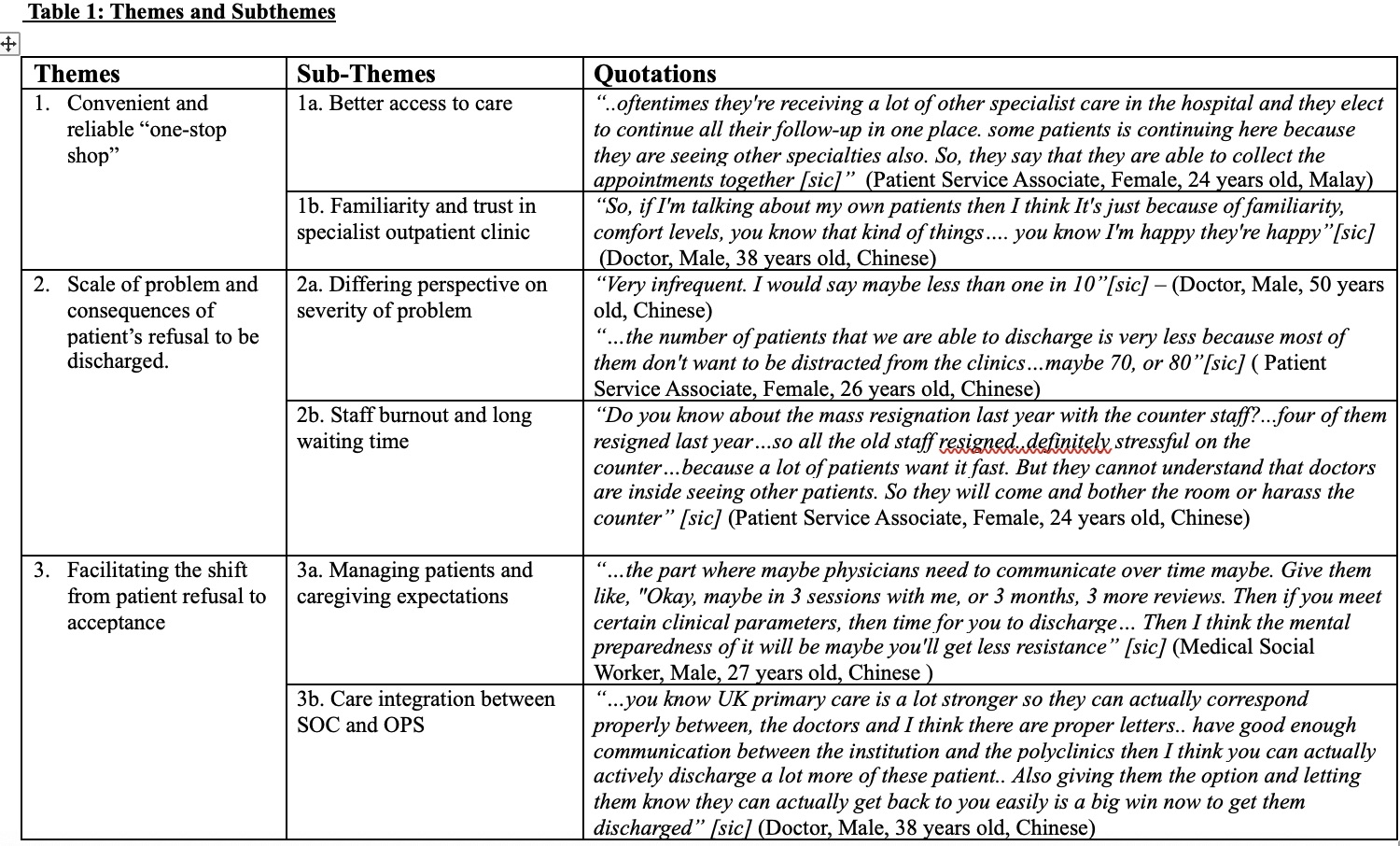
Table 1 depicts the findings of the study. Three main themes emerged: 1) Convenient and reliable “one-stop shop” 2) Scale of problem and consequences of patients’ refusal to be discharged 3) Facilitating the shift from patient refusal to acceptance. Each theme was further supported by two subthemes. Interestingly, there was a marked difference in perspectives between doctors and patient service associates with regards to the severity of the problem.

Conclusion
Patients’ refusal to be discharge stems from the deep trust patients have with HCWs in the cardiology clinic. Comprehensive handover of cases to primary care and seamless access back to cardiology clinic are needed to facilitate patient discharge. This ensures right-siting of care, ensuring specialist services are reserved for patients requiring higher acuity of care.
  • Panday, Vinay  ( National University Health System , Singapore , Singapore )
  • Li, Tony  ( National University Health System , Singapore , Singapore )
  • Soh, Rodney  ( National University Health System , Singapore , Singapore )
  • Woo, Brigitte  ( National University Health System , Singapore , Singapore )
  • Lim, Yee Wei  ( National University Health System , Singapore , Singapore )
  • Lim, Toon Wei  ( National University Health System , Singapore , Singapore )
  • Author Disclosures:
Meeting Info:

EPI-Lifestyle Scientific Sessions 2026

2026

Boston, Massachusetts

Session Info:

Poster Session 3

Thursday, 03/19/2026 , 05:00PM - 07:00PM

Poster Session

More abstracts on this topic:
Patterns of Lifestyle Risk Behaviors for Cardiovascular Disease in Family Caregivers: A Latent Class Analysis

Ahn Soojung, Son Elisa H, Mogos Mulubrhan, Muchira James, Sheng Ying, Park Chorong, Lee Lena

Lifestyle interventions for prevention of cardiovascular disease among mothers of young children: a scoping review

Liu Olivia, Sareen Sinia, Zhu Jiachen, Spruill Tanya, Arabadjian Milla

More abstracts from these authors:
Novel Pharmacist-Led Shared Care Program Improved Lipid Control In Stable Ischemic Heart Disease Patients.

Panday Vinay, Yew Seng Kwan, Sim Marvin, Ong Joo Ler Jireh, Tan Melissa, Tan Wee Hian, Wei Lim Toon

Clinical outcomes in rheumatic mitral stenosis and the novel Yeo’s index

Leow Ryan, Li Tony, Chiu Jackie, Chan Meei-wah, Kong William, Poh Kian-keong, Kuntjoro Ivandito, Sia Ching-hui, Yeo Tiong-cheng

You have to be authorized to contact abstract author. Please, Login
Not Available