
Logo

American Heart Association

  2
  0


Final ID: TH834

Novel Pharmacist-Led Shared Care Program Improved Lipid Control In Stable Ischemic Heart Disease Patients.

Abstract Body: Introduction
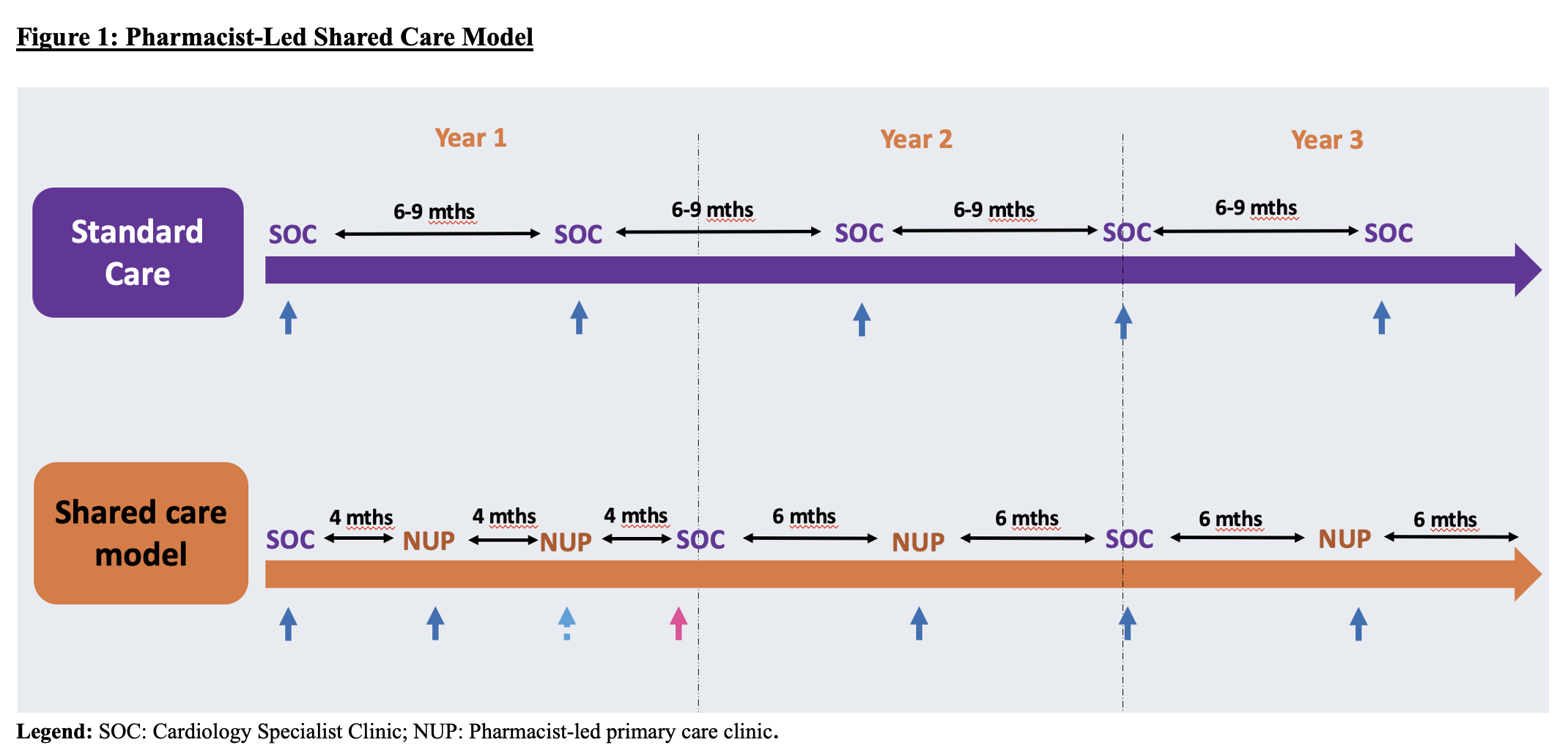
The Ischemic Heart Disease (IHD) Shared Care programme (SC) was conceptualised to facilitate the joint management of patients with stable ischemic heart disease between the cardiac specialist and primary care providers with a focus on aggressive secondary cardiovascular risk reduction. During the first year, patients under the SC programme were reviewed by clinical pharmacists in primary care every 4 months with an annual review by the primary cardiologist.

Aims
We aimed to evaluate the cardiovascular risk factor control (CVRF) of IHD patients under SC as compared with patients under standard care.

Methodology
A retrospective analysis of patients enrolled under SC from 1st July 2024 to 31st March 2025 was conducted with events monitored until 1st October 2025. Participants in SC were compared with other IHD patients undergoing standard care. The primary outcome was control of cardiovascular risk factors.

Results
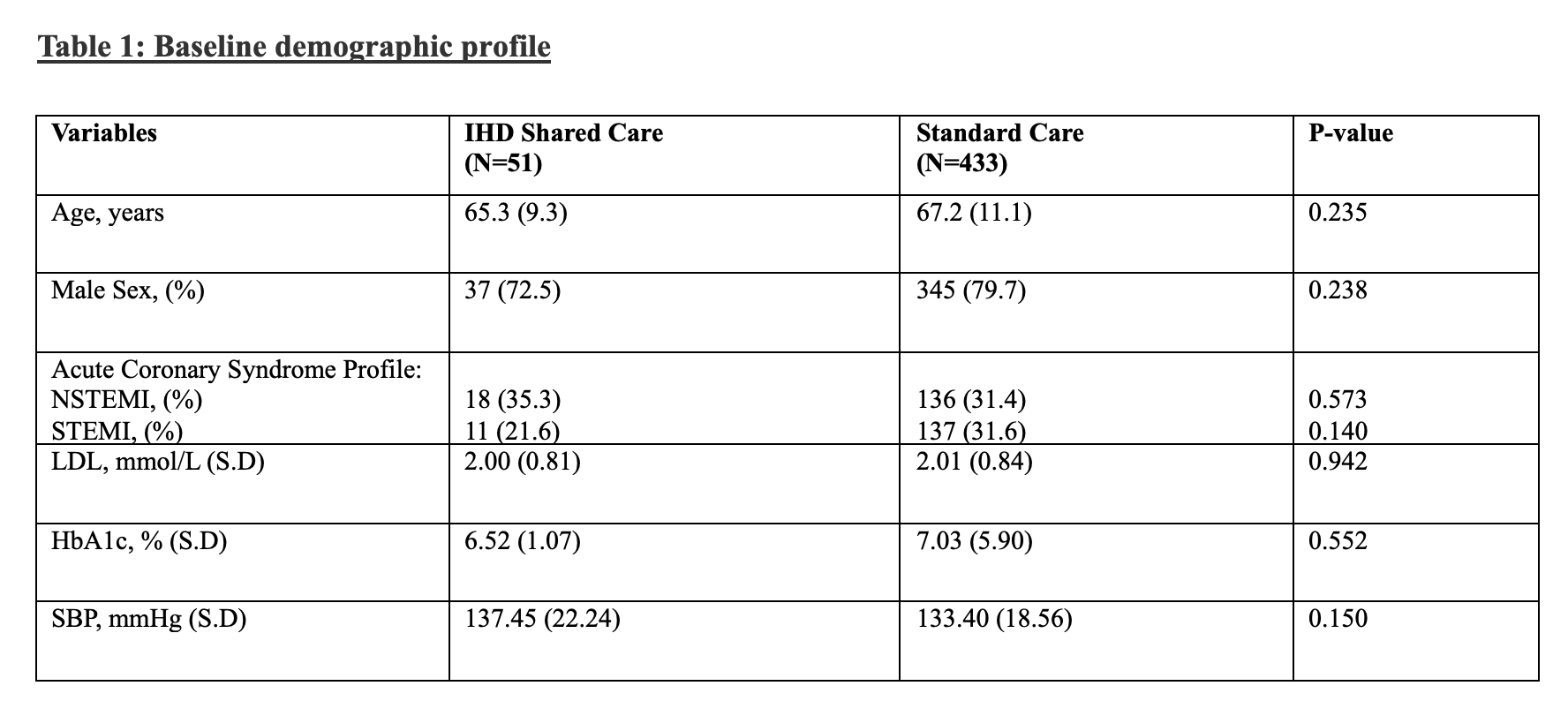
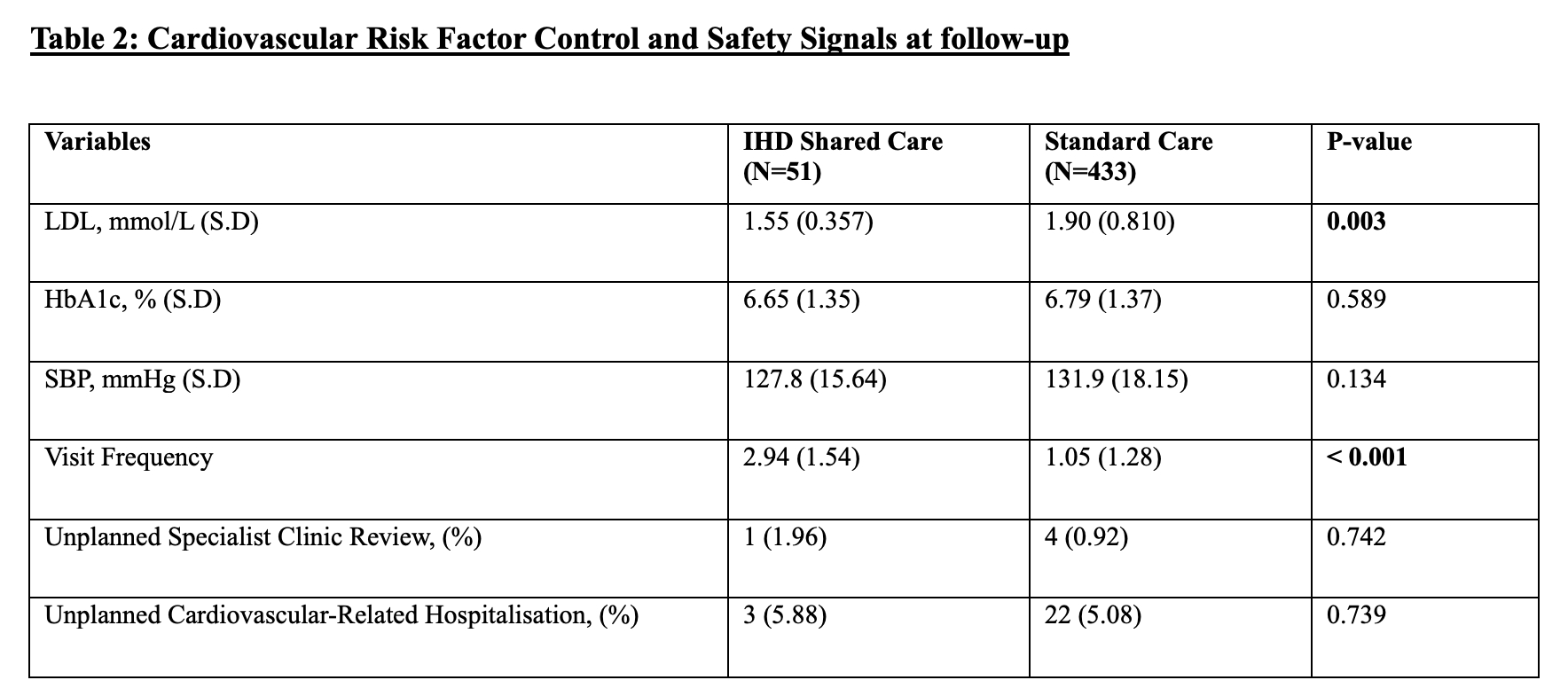
Figure 1 outlines the SC model compared with standard care. A total of 51 patients under the Shared Care programme and 433 patients in the standard care were analysed in the study. Table 1 describes the characteristics of the study populations. Patient in both groups were similarly matched in age, gender, previous acute coronary syndromes and cardiovascular risk factors. Table 2 depicts the CVRF control and safety signals at follow-up. Patients under SC had a significantly lower LDL level (1.55 ± 0.357 mmol/L vs 1.90 ± 0.810mmol/L, p= 0.003) with similar HbA1c levels and blood pressure control. Patients in SC had a higher visit frequency (2.94 ± 1.54 vs 1.05 ± 1.28, p < 0.001). No increase in safety signals of unplanned specialist clinic review or hospitalisation were observed.

Conclusion
Patients under pharmacy-led shared care programme had better management lipid management compared with standard care with no safety signals observed.
  • Panday, Vinay  ( National University Health System , Singapore , Singapore )
  • Yew Seng, Kwan  ( National University Health System , Singapore , Singapore )
  • Sim, Marvin  ( National University Health System , Singapore , Singapore )
  • Ong, Joo Ler Jireh  ( National University Health System , Singapore , Singapore )
  • Tan, Melissa  ( National University Health System , Singapore , Singapore )
  • Tan, Wee Hian  ( National University Health System , Singapore , Singapore )
  • Wei Lim, Toon  ( National University Health System , Singapore , Singapore )
  • Author Disclosures:
Meeting Info:

EPI-Lifestyle Scientific Sessions 2026

2026

Boston, Massachusetts

Session Info:

Poster Session 3

Thursday, 03/19/2026 , 05:00PM - 07:00PM

Poster Session

More abstracts on this topic:
Applying a comprehensive cardiometabolic risk prediction model to real-world primary care patient data

Howell Carrie, Tanaka Shiori, Burkholder Greer, Mehta Tapan, Herald Larry, Garvey William, Cherrington Andrea

Advancing towards the development of an AI application for angina diagnosis through medical interviews

Fujita Kosuke, Shoda Yudai, Kanno Honoka, Handa Hisashi, Nakazawa Gaku

More abstracts from these authors:
REFUSE (REFusal of discharge Under Specialist Encounter): A qualitative study

Panday Vinay, Li Tony, Soh Rodney, Woo Brigitte, Lim Yee Wei, Lim Toon Wei

You have to be authorized to contact abstract author. Please, Login
Not Available