Trends and Disparities in Influenza Vaccination Among Adults with Atherosclerotic Cardiovascular Disease in the United States, 2005-2024
Abstract Body: Background: Individuals with atherosclerotic cardiovascular disease (ASCVD) have an increased risk of cardiovascular morbidity, mortality, and hospitalization from influenza infection. Despite current guidelines recommending the annual influenza vaccine in those with established ASCVD, national estimates of contemporary trends and disparities in this high-risk group remain understudied.
Methods: Using 20 years (2005-2024) of serial, cross-sectional data from the National Health Interview Survey (NHIS), we included adults aged ≥18 years with a self-reported history of ASCVD (including prior myocardial infarction, stroke, angina, or coronary heart disease) and complete data on receipt of influenza vaccination (yes/no) within the past year. We used multivariable logistic regression to examine the association between influenza vaccination status and selected sociodemographic characteristics and produced adjusted odds ratios (aOR) with 95% confidence intervals (CI). Survey weights were applied to ascertain nationally representative estimates.
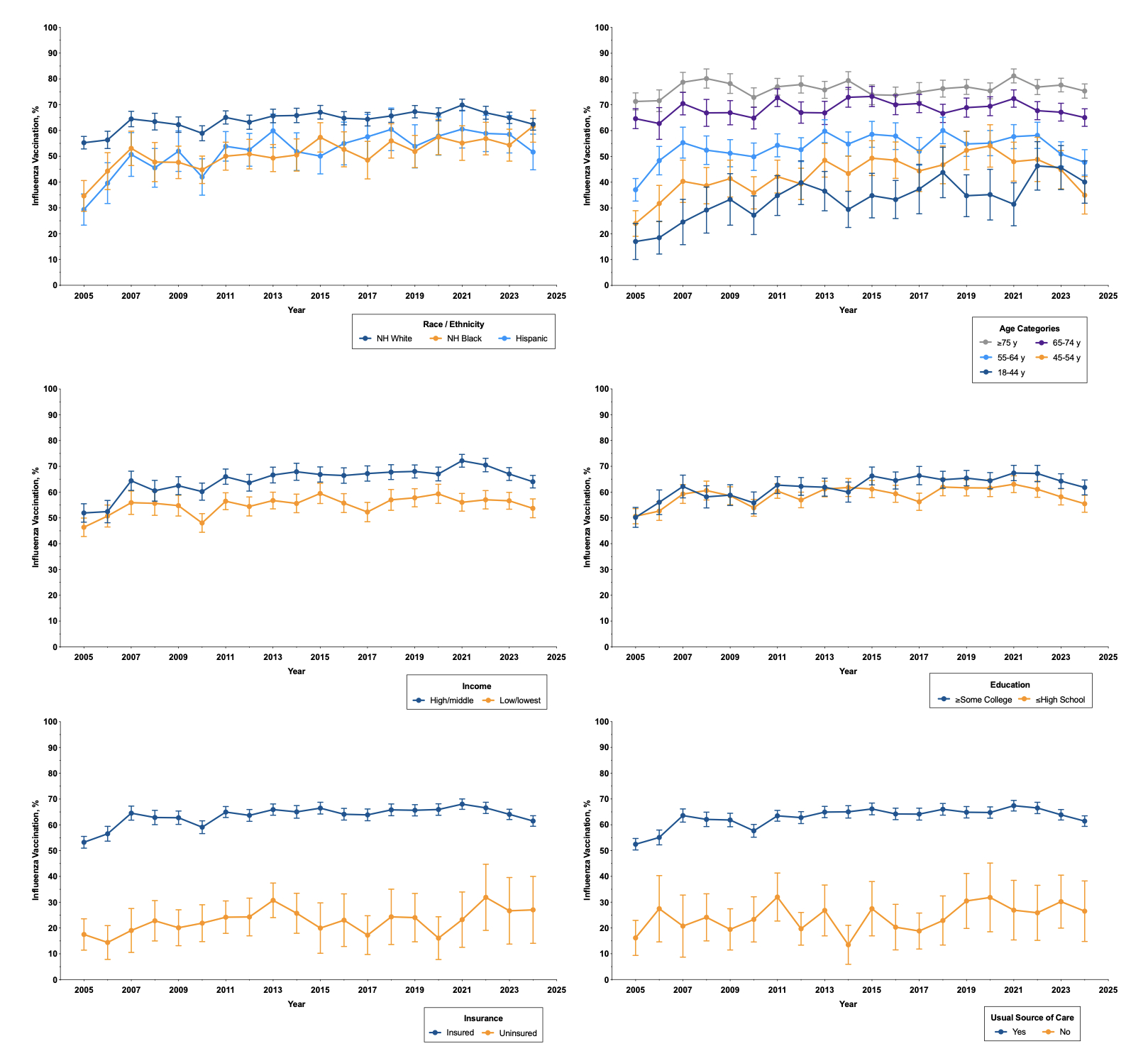
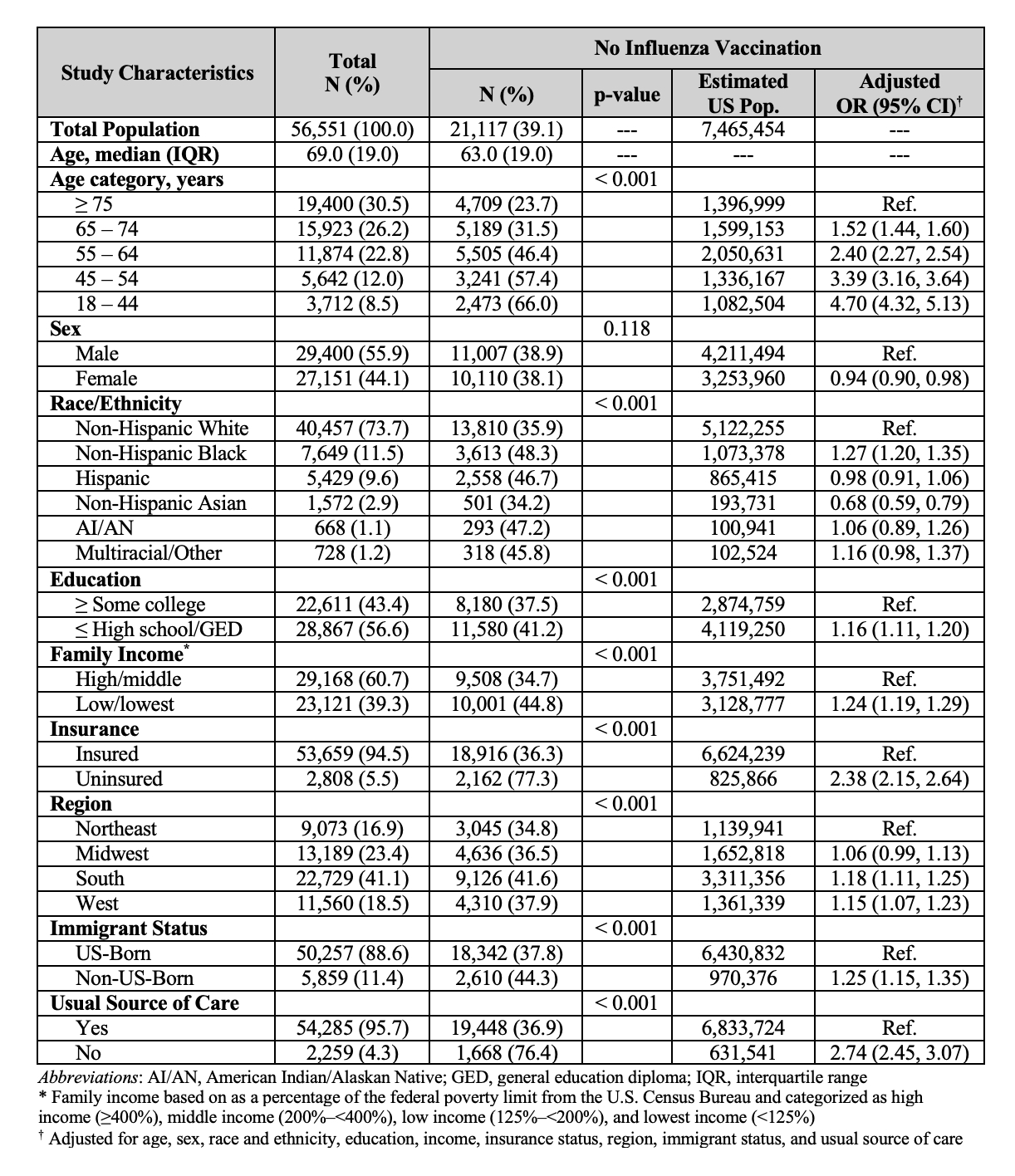
Results: The sample included 56,551 adults with ASCVD (median age: 69.0 years; 44.1% female), of which 39.1% lacked influenza vaccination, representing approximately 7.5 million individuals annually. While vaccination rates increased 9.5 percentage points (from 50.8% to 60.3%) during the 20-year study period, significant disparities persisted over time. Specifically, non-Hispanic Black individuals (aOR, 1.27 [95% CI, 1.20-1.35]), those with a lower level of education (aOR, 1.16 [95% CI, 1.11-1.20]), low income (aOR, 1.24 [95% CI, 1.19-1.29]), no insurance (aOR, 2.38 [95% CI, 2.15-2.64]), non-US-born immigrant status (aOR, 1.25 [95% CI, 1.15-1.35]), and without a usual source of care (aOR, 2.74 [95% CI, 2.45-3.07]) had an increased adjusted odds of lacking influenza vaccination compared to the respective reference groups. In 2024, the groups with the highest proportion of individuals lacking the influenza vaccine were adults aged 45-54 years (65.0%), those without insurance coverage (73.0%), and without a usual source of care (73.5%).
Conclusions: Despite modest progress over the last two decades, more than 1 in 3 adults with ASCVD lack influenza vaccination with significant disparities persisting over time. Further public health policies and interventions are needed to improve equitable access to influenza vaccines and enhance the implementation of vaccination programs among high-risk populations experiencing disparities.
Mszar, Reed
(
Yale School of Public Health
, New York , New York , United States )
Katz, Miriam
(
Yale School of Medicine
, New Haven , Connecticut , United States )
Grandhi, Gowtham
(
Virginia Commonwealth University
, Richmond , Virginia , United States )
Mahajan, Shiwani
(
Yale School of Medicine
, New Haven , Connecticut , United States )
Lu, Yuan
(
Yale University
, New Haven , Connecticut , United States )
Spatz, Erica
(
YALE UNIVERSITY SCHOOL MEDICINE
, New Haven , Connecticut , United States )
Sharma, Garima
(
Inova Fairfax Medical Campus
, Falls Church , Virginia , United States )
Parekh, Tarang
(
University of Delaware
, Newark , Delaware , United States )
Nasir, Khurram
(
Houston Methodist
, Houston , Texas , United States )
Eltawansy Sherif, Khan Muhammad, Iqbal Asad, Sharif Aleena, Hossain Mohammad, Ali Muhammad Faizan, Ahmad Husnain, Faizan Muhammad, Ahmed Ashraf, Abdul Malik Mohammad Hamza Bin, Pahwani Ritesh, Patel Rahul, Mehdi Hassan