Awareness of and Response to Myocardial Infarction and Stroke Symptoms Among Cancer Survivors in the United States
Abstract Body: Background: Cancer survivors are at greater risk of cardiovascular disease compared to individuals without cancer in the general population. Despite this increased risk, it is unknown the extent to which this population is aware of symptoms of myocardial infarction (MI) and stroke, and whether disparities in awareness exist.
Methods: We used data from the cross-sectional 2014 and 2017 National Health Interview Surveys and included individuals aged ≥18 years with self-reported cancer and complete data on awareness of MI and stroke symptoms. The MI symptoms included 1) chest pain/discomfort, 2) shortness of breath, 3) pain/discomfort in arms/shoulders, 4) feeling weak, lightheaded, or faint, and 5) jaw, neck, or back pain. Stroke symptoms included 1) numbness of face/arm/leg, 2) confusion/trouble speaking, 3) difficulty walking/dizziness/loss of balance, 4) trouble seeing in one/both eyes, and 5) severe headache. Awareness of and response to symptoms (i.e., calling 9-1-1 or emergency medical services [EMS]) were assessed using multivariable logistic regression with adjustment for sociodemographic characteristics.
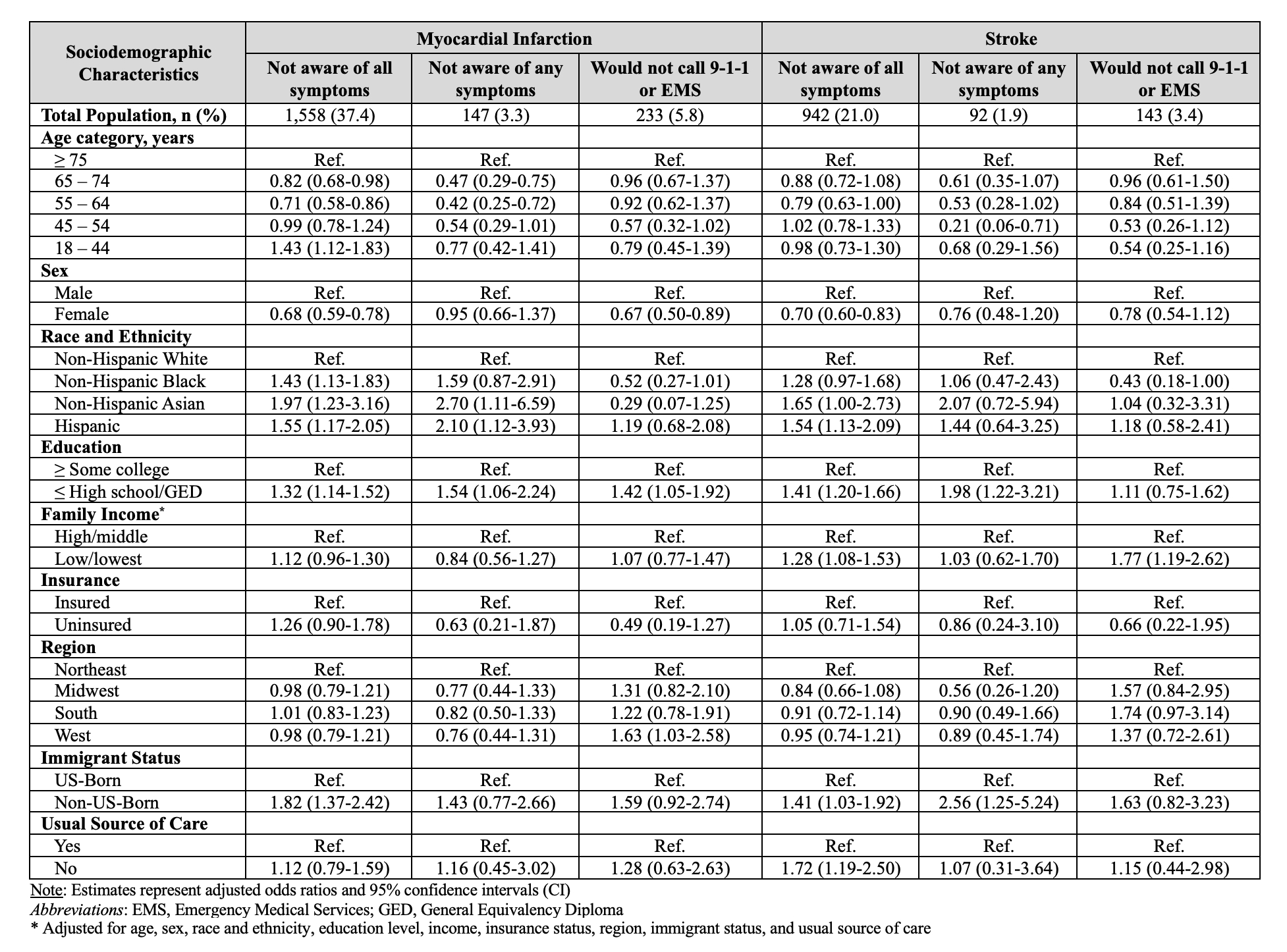
Results: Among 4,312 cancer survivors (median age: 67.0 years), representing 14.3 million survivors annually, 37.4% and 21.0% were unaware of all MI and stroke symptoms, respectively. Those who were of Hispanic ethnicity (MI: aOR [adjusted odds ratio], 1.55 [95% CI, 1.17-2.05]; stroke: 1.54 [95% CI, 1.13-2.09]), had lower level of education (MI: aOR, 1.32 [95% CI, 1.14-1.52]; stroke: aOR, 1.41 [95% CI, 1.20-1.66]), and were of non-US-born immigrant status (MI: aOR, 1.82 [95% CI, 1.37-2.42]; stroke: aOR, 1.41 [95% CI, 1.03-1.92]) had an increased likelihood of being unaware of all MI and stroke symptoms. Hispanic (MI: aOR, 2.10 [95% CI, 1.12-3.93]) and non-Hispanic Asian individuals (MI: aOR, 2.70 [95% CI, 1.11-6.59]) and those with a lower level of education (MI: aOR, 1.54 [95% CI, 1.06-2.24]) were more likely to not be aware of any MI symptoms. Adults with a lower level of education (MI: aOR, 1.42 [95% CI, 1.05-1.92]) and those with a lower income (stroke: aOR, 1.77 [95% CI, 1.19-2.62]) were significantly more likely not to call EMS in response to MI and stroke symptoms, respectively.
Conclusions: Despite having an increased cardiovascular risk, many cancer survivors are not aware of MI and stroke symptoms. Increasing education of common symptoms, particularly among cancer survivors experiencing disparities, could potentially reduce these inequities.
Mendoza Cueva, Gabriela
(
Yale School of Public Health
, New York , New York , United States )
Mszar, Reed
(
Yale School of Public Health
, New York , New York , United States )
Chang, Tiffany
(
Yale School of Medicine
, New Haven , Connecticut , United States )
Mahajan, Shiwani
(
Yale School of Medicine
, New Haven , Connecticut , United States )
Lu, Yuan
(
Yale University
, New Haven , Connecticut , United States )
Spatz, Erica
(
YALE UNIVERSITY SCHOOL MEDICINE
, New Haven , Connecticut , United States )
Irwin, Melinda
(
Yale School of Public Health
, New York , New York , United States )
Ferrucci, Leah
(
Yale School of Public Health
, New York , New York , United States )
Nasir, Khurram
(
Houston Methodist
, Houston , Texas , United States )