Sex Discordance in a Novel Electrocardiographic Sex Index is Associated with Incident Cognitive Disorder
Abstract Body: Background: Sex is a well-known modifier of risk for cognitive disorders including dementia in older adults. However, sex is a complex phenomenon with hormonal and genetic components. Therefore, a binary classification of sex may fail to capture the true heterogeneity of risk for various conditions.
Objective: Evaluate the association of sex discordance, the discrepancy between binary sex and a novel electrocardiogram (ECG)-AI sex identification index (ESI), with incident age-related cognitive disorder.
Methods: A convolutional neural network for detection of sex from 10-s 12-lead ECG was developed with very high accuracy (AUC=0.96) in >1 million ECGs from Wake Forest Baptist Health (Winston-Salem, NC). The ESI is a scalar value between 0 and 1, with 0=100% model confidence in female and 1=100% confidence in male sex detection per ECG. The sex discordance index (SDI; range 0 to 0.5) was defined as 0.5 minus the absolute value of ESI-0.5, such that values nearer to 0.5 indicate lower model certainty in sex identification. We applied the ESI model to index ECGs in sinus rhythm from 19,793 unique patients in an independent validation cohort and evaluated the association of the SDI with 5- and 10-year incidence of all-cause age-related cognitive disorder based on ICD-10 codes using age-adjusted hazard ratios (HR) from Cox regression models.
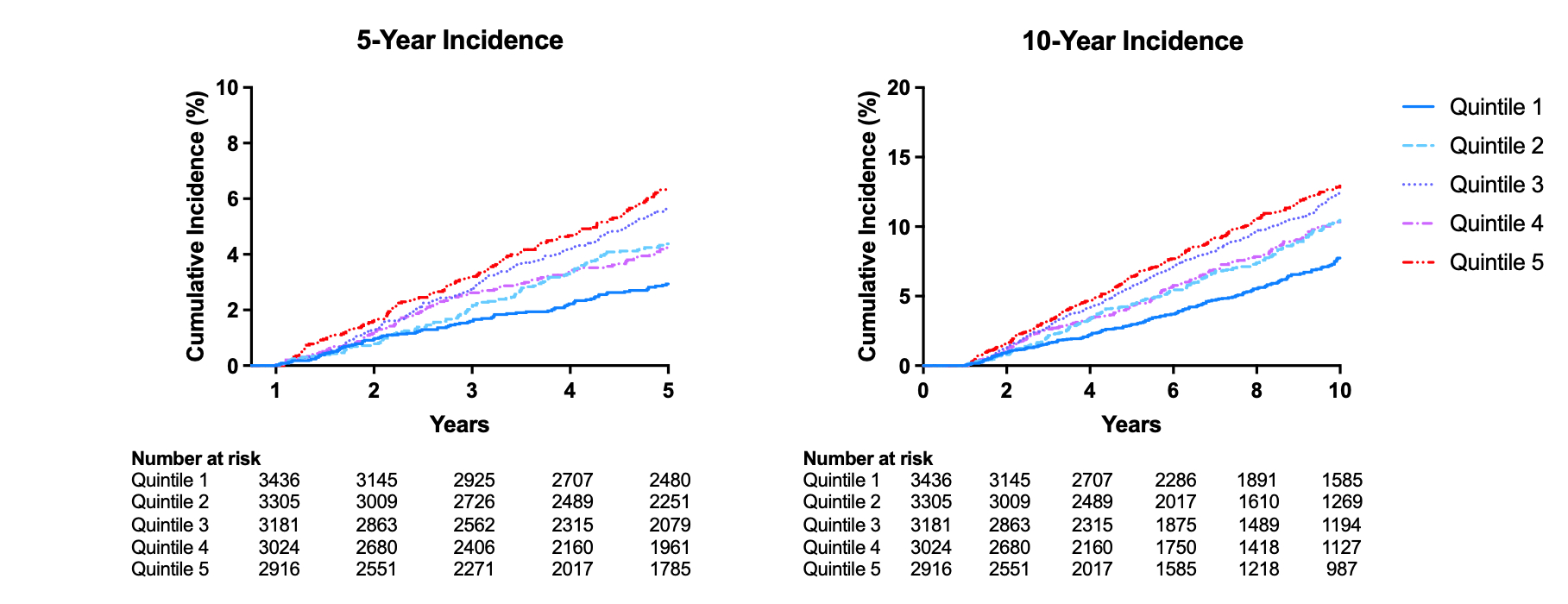
Results: Patients with <1 year of follow-up time, pre-baseline diagnosis, or with time to event <1 year of the index ECG were excluded, yielding a total sample size of 15,862 (mean [SD] age 54.7 [14.9] years, 54% female). A total of 619 (3.9%; 4.2% female, 3.5% male) cases occurred within 5 years and 1,144 (7.2%; 7.7% female, 6.7% male) occurred within 10 years. Higher SDI was associated with significantly greater incidence of cognitive disorder over 5 years (highest quintile vs. lowest: HR=1.71 [95% CI: 1.31, 2.22]; per 20% increment: HR=1.10 [95% CI: 1.04, 1.17]) and over 10 years (highest quintile vs. lowest: HR=1.45 [95% CI: 1.20, 1.76]; per 20% increment: HR=1.07 [95% CI: 1.03, 1.12]). Associations were similar in male and female sex (all interaction p>0.05). In contrast to SDI, binary sex was not significantly associated with 5-year (female HR=1.16 [95% CI: 0.98, 1.36]) or 10-year (female HR=1.10 [95% CI: 0.97, 1.23]) cognitive disorder incidence.
Conclusions: Higher sex discordance in an ECG-AI sex detection model was associated with up to 10-year incidence of age-related cognitive disorder, whereas binary sex was not.
Schaich, Christopher
( Wake Forest University
, Winston-Salem
, North Carolina
, United States
)
Karabayir, Ibrahim
( Wake Forest Baptist Health
, Winston Salem
, North Carolina
, United States
)
Seals, Austin
( Wake Forest Baptist Health
, Winston Salem
, North Carolina
, United States
)
Herrington, David
( WAKE FOREST UNIV SCHOOL MEDICI
, Winston Salem
, North Carolina
, United States
)
Akbilgic, Oguz
( Wake Forest School of Medicine
, Lewisville
, North Carolina
, United States
)