Association Between Circadian Rest/Activity Rhythms and Incident Dementia in Older Adults: The Atherosclerosis Risk in Communities (ARIC) Study
Abstract Body (Do not enter title and authors here): Introduction: Alterations in circadian rest/activity rhythms (RARs) are common among older adults. RARs can be derived from accelerometry data and are routinely used as proxy measures. Evidence suggests that altered (e.g., fragmented, delayed) RARs may be risk factors for dementia. However, results have been mixed. Using data from the ARIC Study, a community-based cohort, we assessed the association between RARs and incident dementia.
Methods: ARIC participants without dementia who wore the Zio XT ECG Patch in 2016-17 for >3 days were included. RARs were obtained from an accelerometer within the Zio XT ECG Patch and measures of interdaily stability (IS; consistency), intradaily variability (IV; fragmentation), and relative amplitude (RA; strength) were derived. Dementia cases were identified through 2020 using in-person and phone-based cognitive assessments, hospitalization discharge codes, or death certificates. Cox proportional hazards models were used.
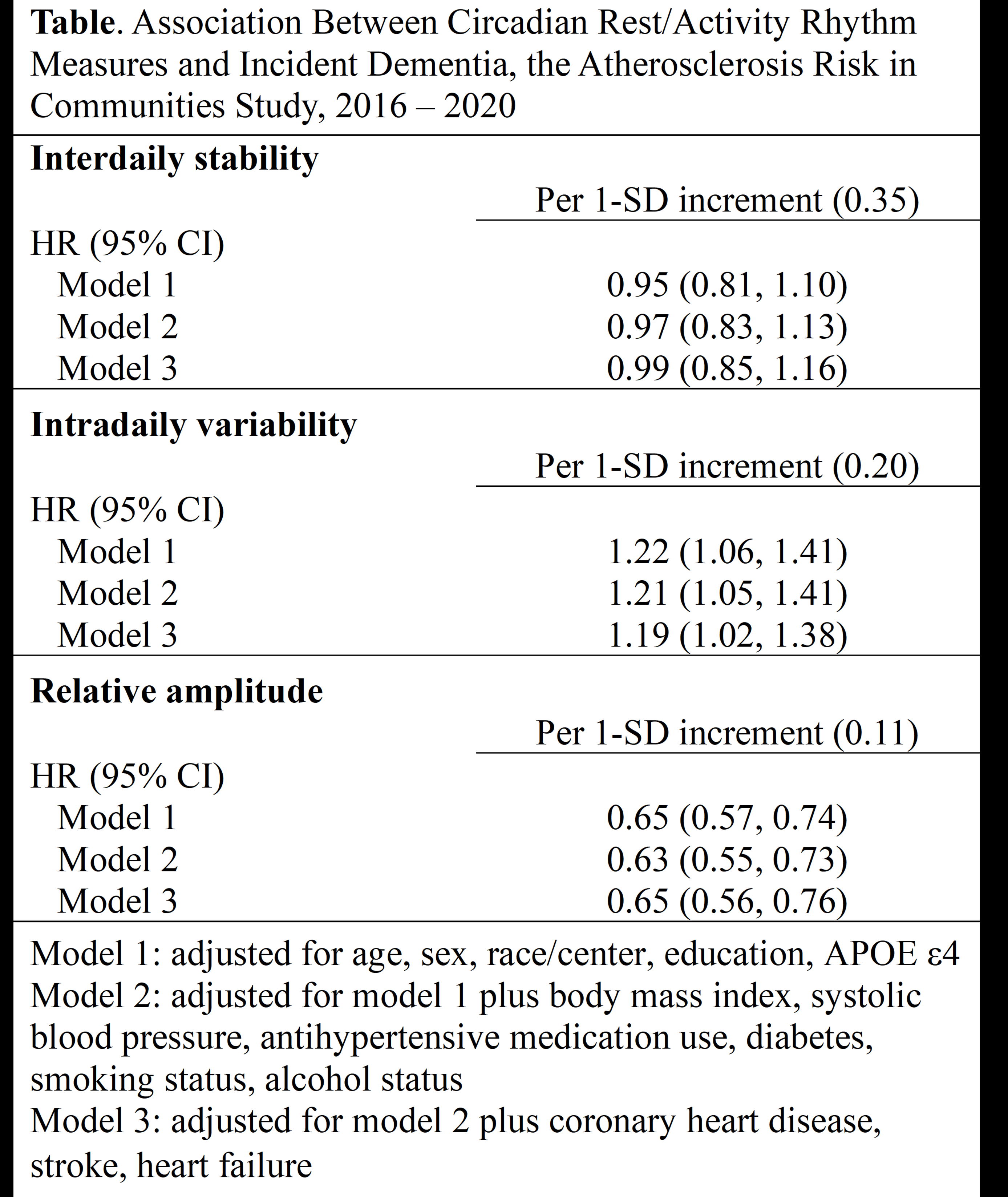
Results: Of the 2,183 participants (mean [SD] age 79 [4.5] years, 58% female, 24% identified as Black), 176 (8%) developed dementia. Median follow-up time was 3 years and mean Zio XT ECG Patch wear time was 12 days. After multivariable adjustment, lower RA and higher IV were associated with incident dementia (HRs [95% CIs] per 1-SD increment: 0.65 [0.56-0.76], 1.19 [1.02-1.38]). No significant association between IS and dementia was noted; however, there was an interaction by race (p=0.03). Stratified results were not significant, but effect estimates were in opposite directions: (HRs [95% CIs] per 1-SD increment in IS: 0.78 [0.59-1.02] in Black participants and 1.17 [0.96-1.41] in white participants, respectively). No interactions by sex or APOEε4 were noted (p>0.10).
Conclusion: In this community-based cohort of older adults, weaker circadian rhythm strength and fragmentation were associated with dementia risk. The association between IS and dementia may differ by race; however, this needs to be further examined in future research. Overall, measures of circadian RARs may be risk factors for dementia. Additional research is warranted to determine whether they can be novel targets for dementia prevention.
Wang, Wendy
(
University of Minnesota
, Minneapolis , Minnesota , United States )
Wanigatunga, Amal
(
Johns Hopkins University
, Chapel Hill , North Carolina , United States )
Etzkorn, Lacey
(
Johns Hopkins University
, Chapel Hill , North Carolina , United States )
Rabinowitz, Jill
(
Rutgers University
, Piscataway , New Jersey , United States )
Palta, Priya
(
UNC Chapel Hill
, Chapel Hill , North Carolina , United States )
Pike, James
(
Johns Hopkins University
, Chapel Hill , North Carolina , United States )
Dougherty, Ryan
(
Johns Hopkins University
, Baltimore , Maryland , United States )
Zipunnikov, Vadim
(
Johns Hopkins University
, Chapel Hill , North Carolina , United States )
Marino, Francesca
(
Johns Hopkins University
, Chapel Hill , North Carolina , United States )
Crainiceanu, Ciprian
(
Johns Hopkins University
, Baltimore , Maryland , United States )
Spira, Adam
(
Johns Hopkins University
, Baltimore , Maryland , United States )
Schrack, Jennifer
(
Johns Hopkins University
, Baltimore , Maryland , United States )
Chen, Lin
(
UNIVERSITY OF MINNESOTA
, Minneapolis , Minnesota , United States )
Author Disclosures:
Wendy Wang:DO NOT have relevant financial relationships
| Ciprian Crainiceanu:No Answer
| Adam Spira:DO have relevant financial relationships
;
Consultant:Sequoia Neurovitality:Active (exists now)
; Consultant:BellSant, Inc.:Active (exists now)
; Consultant:Amissa, Inc.:Active (exists now)
| Jennifer Schrack:No Answer
| Lin Chen:DO NOT have relevant financial relationships
| Amal Wanigatunga:DO NOT have relevant financial relationships
| Lacey Etzkorn:No Answer
| Jill Rabinowitz:No Answer
| Priya Palta:DO NOT have relevant financial relationships
| James Pike:DO NOT have relevant financial relationships
| Ryan Dougherty:No Answer
| Vadim Zipunnikov:No Answer
| Francesca Marino:No Answer