Dietary Conjugated Linoleic Acid Shapes the Host Plasma Metabolome and Gut Microbiome and Is Associated with Coronary Heart Disease in U.S. Individuals
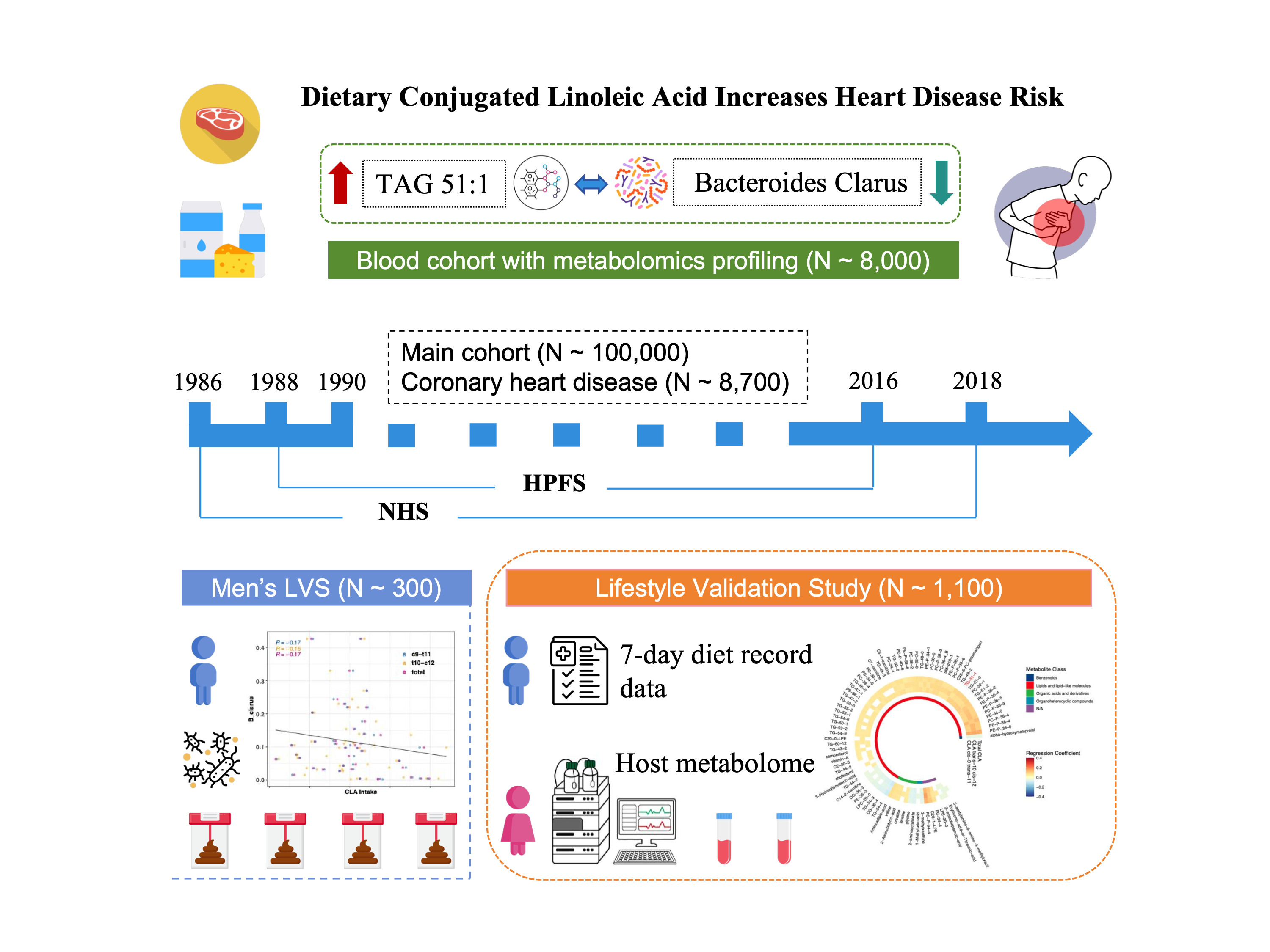
Abstract Body: Introduction: Conjugated linoleic acid (CLA), a ruminant-derived fatty acid abundant in dairy and red meat, has been consumed as a dietary supplement for its purported health benefits. We aimed to prospectively investigate the association of CLA intake with coronary heart disease (CHD) risk in U.S. individuals and to explore the synergistic roles of host metabolome and gut microbiome.
Methods: We followed 64,090 women from the Nurses’ Health Study (1986–2018) and 42,659 men from the Health Professionals Follow-Up Study (1986–2016) for incident CHD. Intake of CLA was assessed using 7-day diet records in the Lifestyle Validation Study (LVS) and validated food frequency questionnaires administrated quadrennially in the cohorts. Plasma metabolomic signatures responsive to CLA were derived using elastic net regression in the LVS (n=1,143). The gut microbiome was profiled in the Men’s LVS (n=307) and in a CHD case–control substudy (n=152).
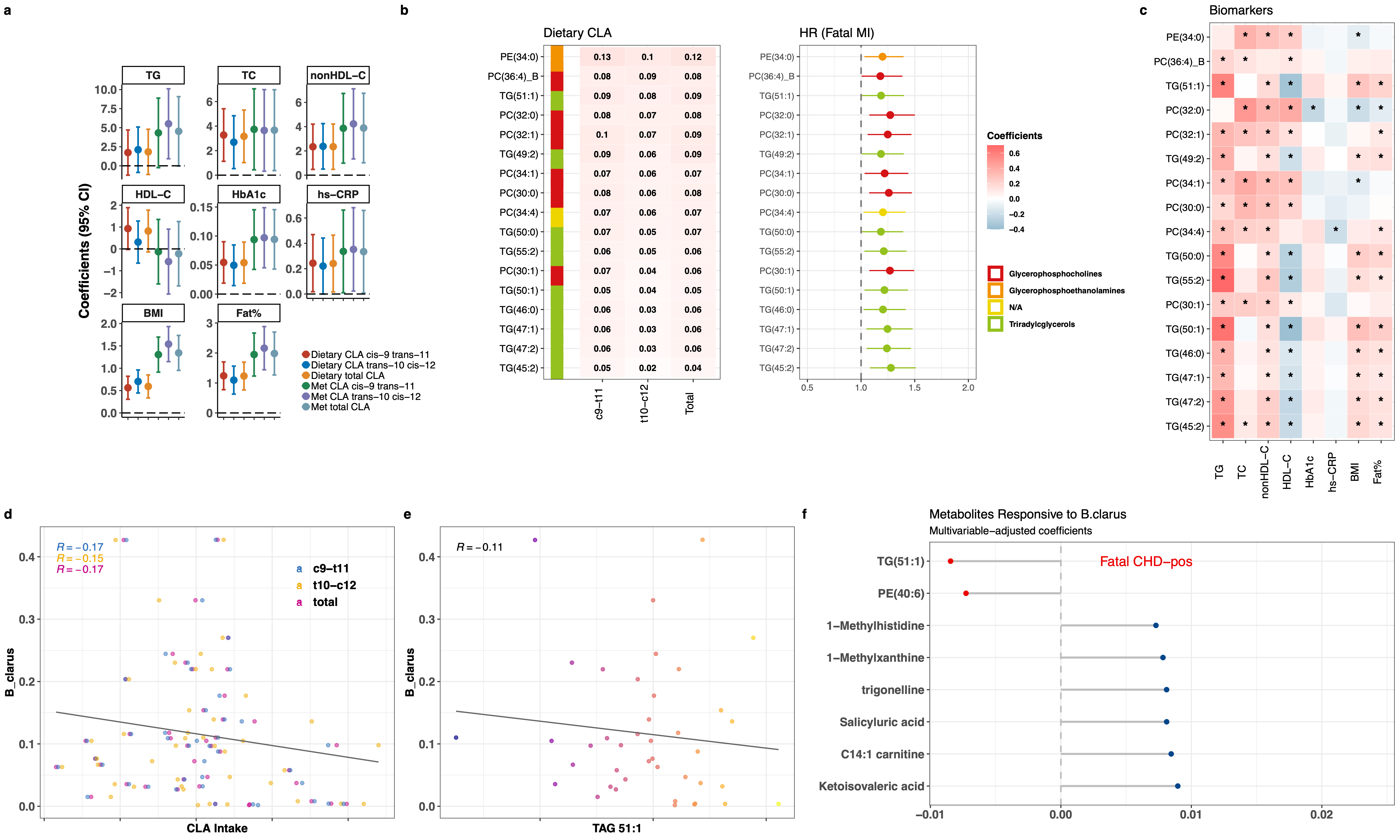
Results: Dietary CLA intake was associated with distinct alterations in the plasma metabolome and gut microbiome. Higher CLA intake was linked to elevated phospholipids, primarily phosphatidylethanolamine (PE 34:0) and phosphatidylcholine (PC 34:4, 36:4), and triacylglycerols with 0-2 double bonds (TAGs 49:2, 50:0, 50:1, 51:1), all positively linked to CHD risk. Conversely, CLA intake was related to lower levels of TAGs with more double bonds (54:3, 54:4). Higher CLA intake was associated with reduced Bacteroides clarus abundance (FDR = 0.03), which was inversely linked to ruminant fat–derived TAG 51:1. In the case–control substudy, higher B. clarus abundance predicted lower CHD risk (P < 0.25). A multi-metabolite signature for cis-9, trans-11 CLA, composing 86 metabolites, showed a strong correlation with dietary intake (Spearman r = 0.73) and predicted higher fatal CHD risk (HR 1.82, 95% CI 1.11–2.99). In contrast, the metabolomic signature for trans-10, cis-12 CLA showed no significant association. In the two cohorts, higher cis-9, trans-11 CLA intake was also consistently associated with a greater risk of CHD (pooled HR for highest vs lowest quintile: 1.27, 95% CI 1.11–1.45), driven by fatal CHD (HR 1.50, 95% CI 1.24–1.81).
Conclusions: Higher intake of conjugated linoleic acid, particularly cis-9, trans-11 isomer, was associated with increased risk of fatal CHD and unfavorable plasma metabolomic profiles. These associations were potentially modulated by specific gut microbial taxa, such as Bacteroides clarus.
Wu, Zhiyuan
(
Harvard School of Public Health
, Boston , Massachusetts , United States )
Liu, Binkai
(
Harvard School of Public Health
, Boston , Massachusetts , United States )
Wang, Xiaowen
(
Harvard School of Public Health
, Boston , Massachusetts , United States )
Zeleznik, Oana
(
Brigham & Women's Hospital and Harvard Medical School
, Boston , Massachusetts , United States )
Eliassen, A Heather
(
Harvard School of Public Health
, Boston , Massachusetts , United States )
Wittenbecher, Clemens
(
German Institute of Human Nutrition Potsdam-Rehbruecke
, Nuthetal , Germany )
Clish, Clary
(
Broad Institute of MIT and Harvard
, Cambridge , Massachusetts , United States )
Rimm, Eric
(
Harvard School of Public Health
, Boston , Massachusetts , United States )
Zhang, Cuilin
(
National University of Singapore
, Singapore , Singapore )
Hu, Yang
(
Harvard School of Public Health
, Boston , Massachusetts , United States )
Hu, Frank
(
Harvard School of Public Health
, Boston , Massachusetts , United States )
Sun, Qi
(
Harvard School of Public Health
, Boston , Massachusetts , United States )
Wang Xiaowen, Willett Walter, Sun Qi, Xia Pengfei, Wang Fenglei, Wu Zhiyuan, Hu Yang, Eliassen A Heather, Zeleznik Oana, Bhupathiraju Shilpa, Mousavi Seyed
4432115_File000000.jpg
4432115_File000001.jpg
You have to be authorized to contact abstract author. Please, Login