Annual Change in High-Sensitivity Cardiac Troponin T and Risk of Cardiovascular Disease and Mortality: The Atherosclerosis Risk in Communities (ARIC) Study
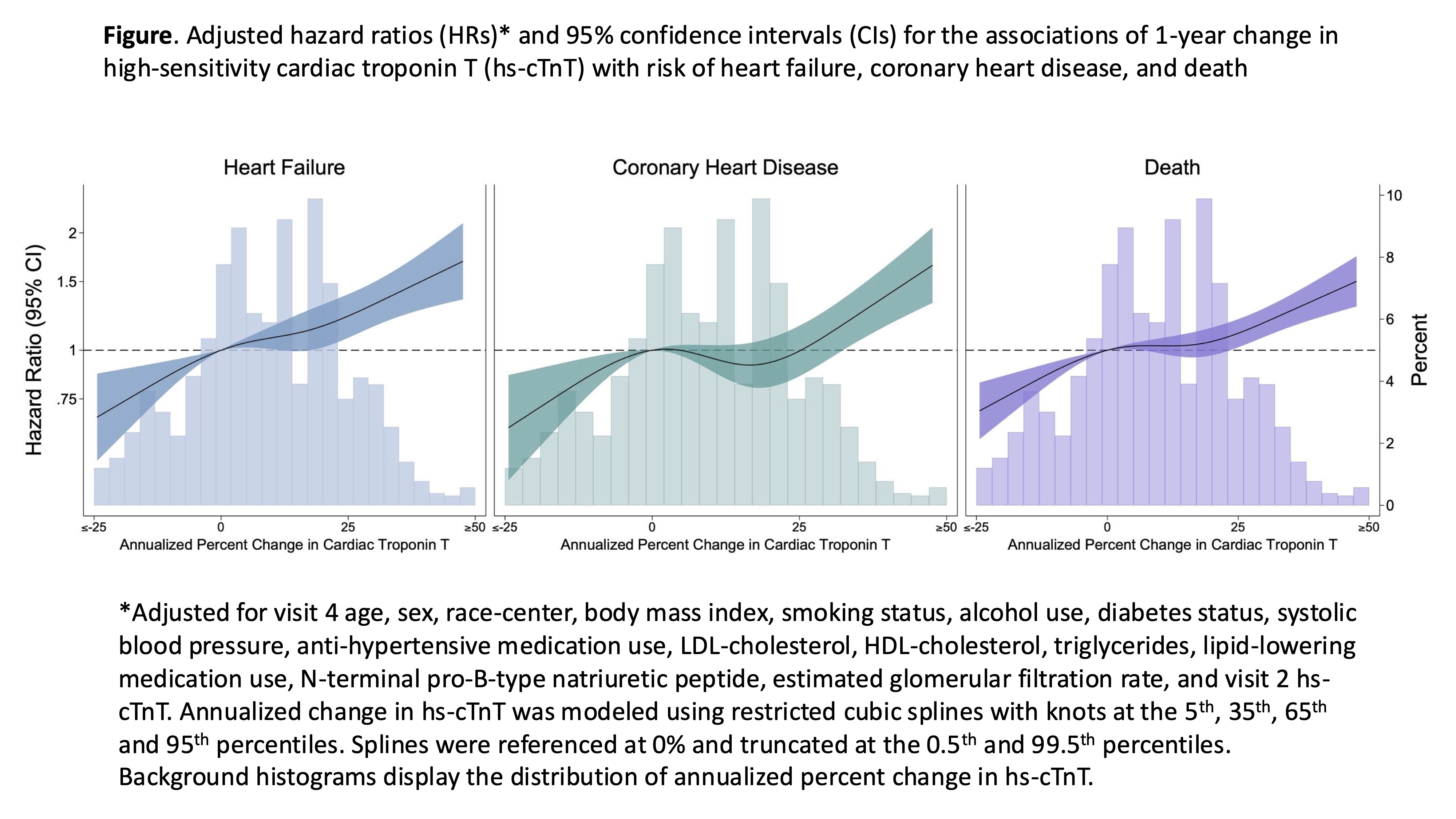
Abstract Body: Background: Measurable concentrations of high-sensitivity cardiac troponins (hs-cTn; hs-cTnT and hs-cTnI) reflect subclinical myocardial damage, define stage B heart failure (HF) when persistently high, and are prognostic of cardiovascular disease (CVD). A recent consensus report recommended annual hs-cTn testing among persons with diabetes to inform treatment and promote early HF detection. However, data supporting annual testing in the general population are sparse. Methods: We evaluated 6,411 Black and White adults who attended ARIC visits 2 (V2; 1990 – 92) and 4 (V4; 1996 – 98) and were free of CVD. Hs-cTnT change over the approximate 6-year interval was annualized and modeled in absolute ([V4 hs-cTnT – V2 hs-cTnT]/years between visits) and percent scales ([[V4 hs-cTnT/V2 hs-cTnT](1/years between visits) – 1] * 100). Hs-cTnT concentrations < 3 ng/L were imputed as 1.5 ng/L. Using Cox regression, we evaluated the associations of annualized hs-cTnT change (modeled linearly and using restricted cubic splines) with incident HF hospitalization or death, adjudicated coronary heart disease (CHD), and all-cause mortality after V4. Results: The mean age was 63 years (51% women, 22% Black adults). On average, participants experienced an annual 0.4 ng/L increase (9% relative increase) in hs-cTnT. Over 28 years of follow-up, there were 1,744 HF events, 1,303 CHD events, and 4,236 deaths. After adjustment for demographic and CVD risk factors, a 0.5 ng/L annual increase in hs-cTnT was associated with significantly greater risk of HF (HR 1.04, 95% CI: 1.03, 1.05), CHD (HR 1.03, 95% CI: 1.02, 1.05), and death (HR 1.03, 95% CI: 1.02, 1.04). When modeled flexibly using restricted cubic splines, annualized percent change in hs-cTnT was robustly associated with risk of HF, CHD, and death in a dose-response fashion (Figure). Conclusion: One-year increases in hs-cTnT were associated with increased risk of HF, CHD, and death, suggesting that annual hs-cTnT changes are clinically relevant. Routine hs-cTnT screening in the general middle-aged population may be useful for identifying persons at high risk for developing CVD.
Aryee, Ebenezer
(
Johns Hopkins University
, Baltimore , Maryland , United States )
Mcevoy, John
(
University of Galway
, Galway , Ireland )
Hoogeveen, Ron
(
BAYLOR COLLEGE MEDICINE
, Houston , Texas , United States )
Ballantyne, Christie
(
BAYLOR COLLEGE MEDICINE
, Houston , Texas , United States )
Shah, Amil
(
UT Southwestern Medical Center
, Dallas , Texas , United States )
Fang, Michael
(
Johns Hopkins University
, Baltimore , Maryland , United States )
Ndumele, Chiadi
(
JOHNS HOPKINS HOSPITAL
, Silver Spring , Maryland , United States )
Selvin, Elizabeth
(
JOHNS HOPKINS UNIVERSITY
, Baltimore , Maryland , United States )
Yang Yimin, Selvin Elizabeth, Yu Bing, Shah Amil, Ky Bonnie, Lamberson Victoria, Hoogeveen Ron, Ballantyne Christie, Ndumele Chiadi, Joshu Corinne, Coresh Josef, Platz Elizabeth