Logo

American Heart Association

  2
  0


Final ID: WE524

Metabolomic Analysis in Three US Cohorts With 40 Years of Follow-Up Identifies Metabolomic Profiles Reflecting Metabolic States Associated with Long-Term Obesity Trajectory and Its Related Chronic Disease Risk.

Abstract Body: Background
Obesity, a leading risk factor for coronary artery disease (CHD) and other chronic diseases, is a multifactorial condition with heterogenous etiologies and comorbidity profiles.
Hypothesis
Circulating metabolome can capture metabolic states associated with obesity trajectory and inter-person variation in obesity-related disease risk.
Methods
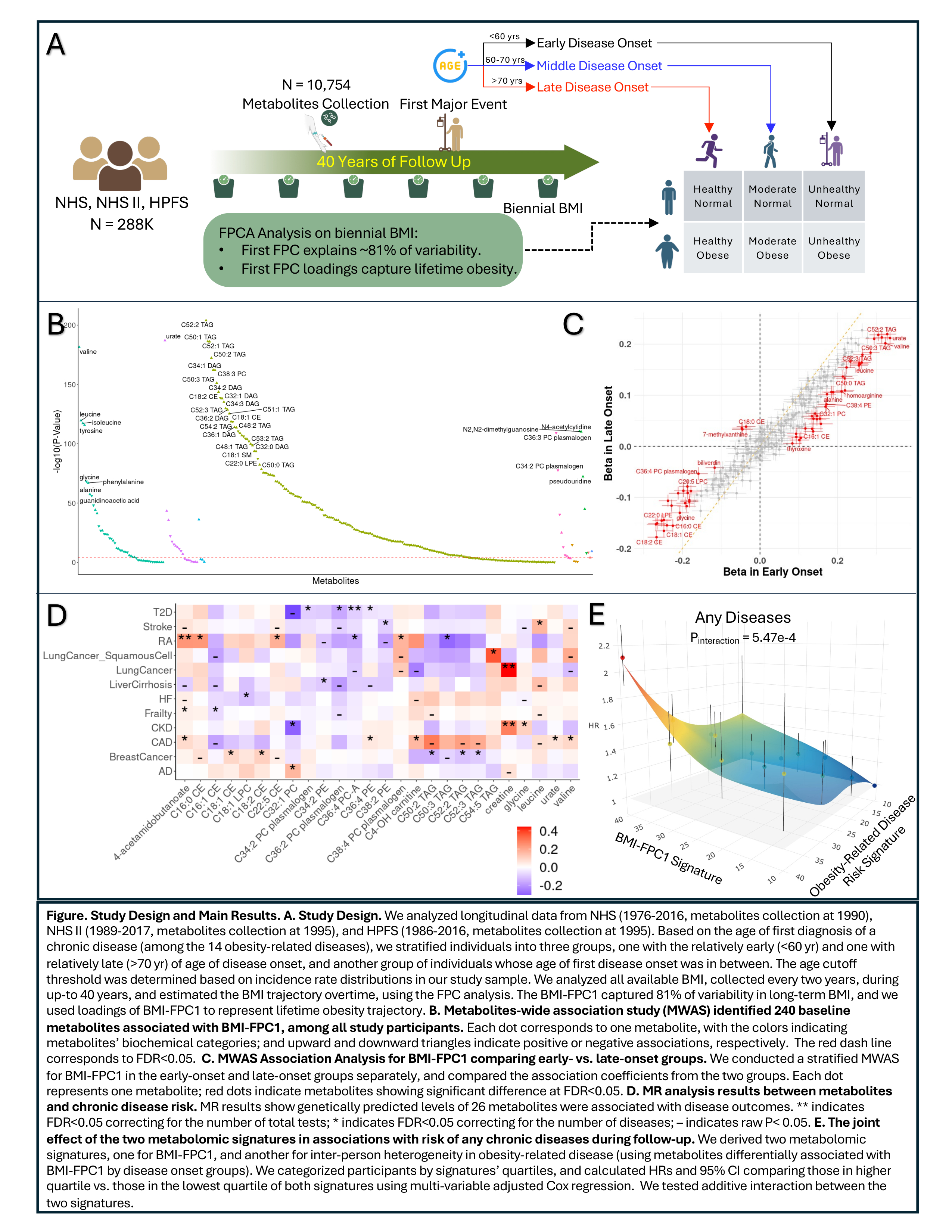
We analyzed up to 40-yr of longitudinal data of 10754 participants from the Nurses’ Health Studies and Health Professionals Follow-Up Study. Baseline plasma levels of 288 metabolites were profiled using LC-MS. Body mass index (BMI) was collected biennially, and its trajectory was estimated using function principal component (FPC) analysis. We categorize participants as having early- (<60y) or late-onset (>70y) obesity-related diseases based on age of first onset of 14 chronic diseases (Fig A). Linear regression was used to examine metabolites-BMI trajectory associations; elastic net regression to derive metabolomic signatures for BMI trajectory; Cox model to examine association with disease risk; and Mendelian randomization (MR) analysis to infer potential causal relationships.
Results
The FPC1 of BMI trajectory accounted 81% of variation. We identified extensive associations between baseline metabolites with BMI-FPC1 (240 at FDR<0.05; Fig B). Further stratified analysis identified 63 metabolites, including glycine, alanine and C52:2 TAG, showing stronger associations with BMI-FPC1 among participants with early-onset vs late-onset of obesity-related diseases (Fig C). In MR analysis, genetically predicted levels of 26 metabolites were associated with at least one of these diseases (e.g., C4-OH carnitine with CHD; Fig D).
We identified a metabolomic signature for BMI-FPC1, which was associated with risk of any chronic disease in multivariable-adjusted analysis (HR=1.99, p=4e-47). A second metabolomic signature, derived from the 63 metabolites differentially associated with BMI-FPC1 between two disease groups, was associated with disease risk after adjusting for the BMI-FPC1 signature (HR=1.2, p=5e-10). The two signatures showed an additive effect (p-interaction=6e-4), with participants in the highest vs. lowest quartiles of both signatures having a 11.3-fold higher disease risk (p=3e-50; Fig E).
Conclusions
We identified metabolomic profiles reflecting metabolic states related to long-term BMI trajectory and inter-individual variation in obesity-related disease risk, which may facilitate personalized intervention.
  • Wang, Xingyan  ( Harvard T.H. Chan School of Public , Boston , Massachusetts , United States )
  • Liang, Liming  ( Harvard University , Boston , Massachusetts , United States )
  • Li, Jun  ( Harvard Medical School, BWH , Boston , Massachusetts , United States )
  • Yun, Huan  ( Harvard T.H. Chan School of Public , Boston , Massachusetts , United States )
  • Hu, Jie  ( Massachusetts General Hospital , Boston , Massachusetts , United States )
  • Mei, Zhendong  ( Brigham and Women's Hospital , Boston , Massachusetts , United States )
  • Bhupathiraju, Shilpa  ( Harvard T.H. Chan School of Public , Boston , Massachusetts , United States )
  • Tobias, Deirdre  ( Brigham and Women's Hospital , Boston , Massachusetts , United States )
  • Giovannucci, Edward  ( Harvard School of Public Health , Boston , Massachusetts , United States )
  • Zhang, Xuehong  ( Harvard T.H. Chan School of Public , Boston , Massachusetts , United States )
  • Hu, Frank  ( HARVARD SCHOOL OF PUBLIC HEALTH , Boston , Massachusetts , United States )
  • Author Disclosures:
Meeting Info:

EPI-Lifestyle Scientific Sessions 2026

2026

Boston, Massachusetts

Session Info:

Poster Session 2

Wednesday, 03/18/2026 , 05:00PM - 07:00PM

Poster Session

More abstracts from these authors:
Genetic Drivers of Comorbid Heterogeneity in Obesity: Genome-Wide Association Analysis in Three Cohorts with 40 Years of Follow-up

Wang Xingyan, Liang Liming, Li Jun, Hu Jie, Yun Huan, Mei Zhendong, Bhupathiraju Shilpa, Giovannucci Edward, Tobias Deirdre, Zhang Xuehong, Hu Frank

Carbohydrate Quality, Pathway-specific Polygenic Risk Scores, and Risk of Type 2 Diabetes among US Men and Women

Mei Zhendong, Stampfer Meir, Willett Walter, Liang Liming, Hu Frank, Li Jun, Alessa Hala, Wang Xingyan, Mousavi Seyed, Sevilla-gonzalez Magdalena, Yun Huan, Hu Jie, Bhupathiraju Shilpa, Sun Qi

You have to be authorized to contact abstract author. Please, Login
Not Available