Carbohydrate Quality, Pathway-specific Polygenic Risk Scores, and Risk of Type 2 Diabetes among US Men and Women
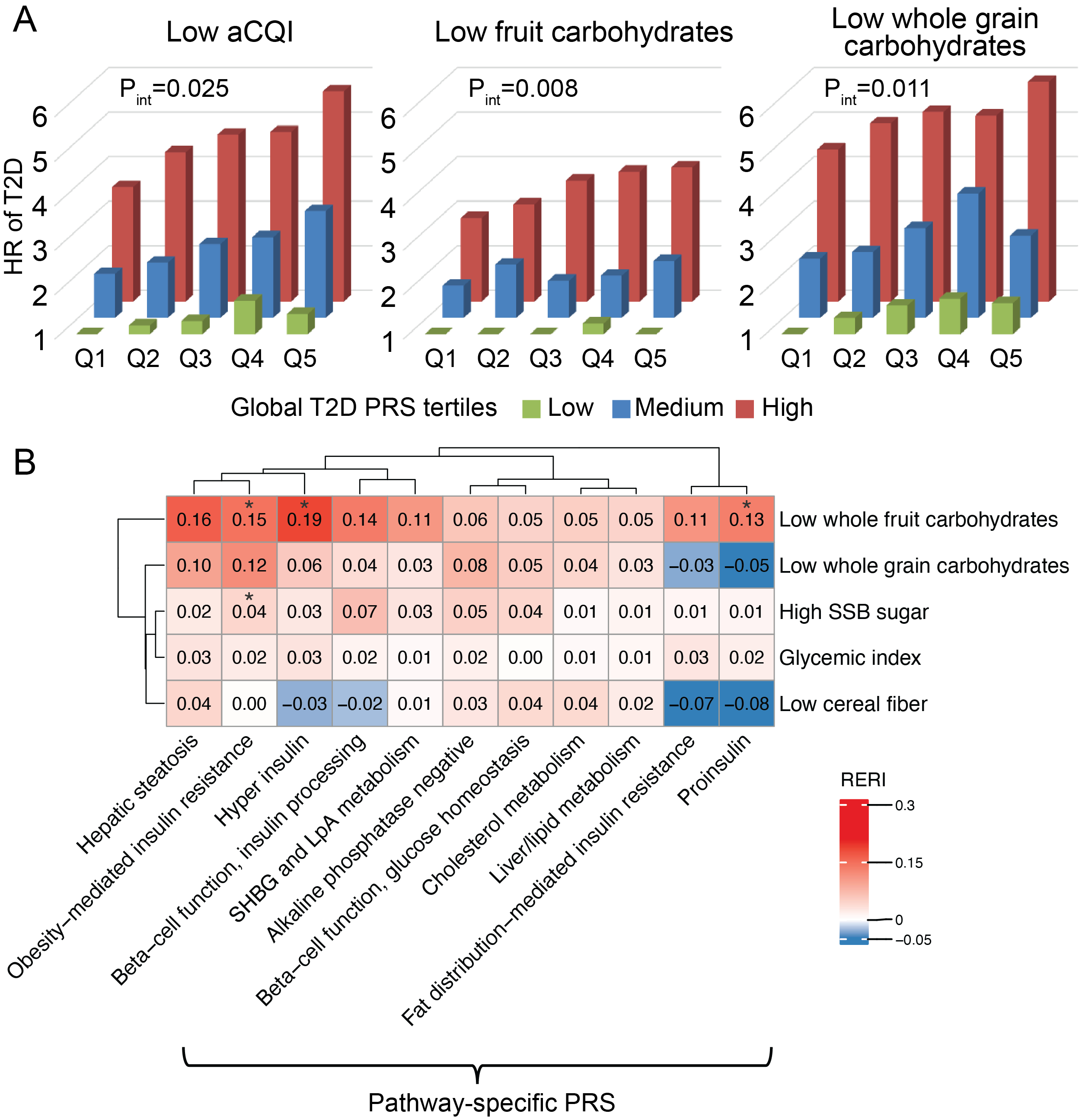
Abstract Body: Introduction Carbohydrate quality is associated with type 2 diabetes (T2D) risk, but whether intakes of specific carbohydrates interact with genetic susceptibility remains unclear. Hypothesis The associations between lower carbohydrate quality and higher T2D risk may be modified by global and pathway-specific polygenic risk scores (PRS). Methods We analyzed up to 36 years of longitudinal data from 39,540 participants in the Nurses’ Health Studies and Health Professionals Follow-Up Study, free of diabetes, cardiovascular disease, and cancer at baseline. Diet was assessed every 4 years using validated food frequency questionnaires. We calculated cumulatively averaged alternative Carbohydrate Quality Index (aCQI; based on cereal fiber, whole fruit carbohydrates, glycemic index, sugar from sugar-sweetened beverages [SSB], and whole grain carbohydrates), with a lower score indicating poorer long-term carbohydrate quality. We calculated global and 12 pathway-specific PRS based on 650 genetic variants reflecting distinct T2D mechanisms. Cox regression was used to examine associations between aCQI (and secondarily, its components), PRS, and their interactions with T2D risk. Results We identified 5,116 incident T2D cases. The global-PRS, and 11 out of 12 pathway-specific PRS (except for bilirubin metabolism) robustly predicted T2D risk. In multivariable analysis, a lower aCQI was associated with higher T2D risk (HR per IQR: 1.20, 95% CI: 1.14-1.26, P<0.001). A significant additive interaction was observed, among participants older than 65 yrs but not younger, between global-PRS and aCQI, with T2D risk (relative excess risk due to interaction =0.21, Pint=0.025, Fig. A). In secondary analysis of aCQI components in those ≥65 yrs, nominally significant interactions were noted between global-PRS with low whole fruit carbohydrates and low whole grain carbohydrates for T2D risk (Pint≤0.011; Fig. A). Further analysis on pathway-specific PRS suggested potential additive interactions between whole fruit carbohydrates and PRS reflecting proinsulin, hyper insulin, and obesity-mediated insulin resistance pathways, and between sugar from SSB and PRS for obesity-mediated insulin resistance (Pint≤0.038; Fig. B). Conclusions Our data suggest that the association between lower carbohydrate quality and T2D risk may be stronger in older adults with higher genetic risk. Replication studies are needed to examine how specific carbohydrates may interact with genetic risk through specific pathways.
Mei, Zhendong
(
Brigham and Women's Hospital
, Boston , Massachusetts , United States )
Alessa, Hala
(
Harvard T.H. Chan School of Public
, Boston , Massachusetts , United States )
Wang, Xingyan
(
Harvard T.H. Chan School of Public
, Boston , Massachusetts , United States )
Mousavi, Seyed
(
Harvard T.H. Chan School of Public
, Boston , Massachusetts , United States )
Sevilla-gonzalez, Magdalena
(
Massachusetts General Hospital
, Cambridge , Massachusetts , United States )
Yun, Huan
(
Harvard T.H. Chan School of Public
, Boston , Massachusetts , United States )
Hu, Jie
(
Massachusetts General Hospital
, Cambridge , Massachusetts , United States )
Bhupathiraju, Shilpa
(
CHANNING DIV NETWORK MEDICINE
, Boston , Massachusetts , United States )
Sun, Qi
(
HARVARD SCHOOL OF PUBLIC HEALTH
, Boston , Massachusetts , United States )
Stampfer, Meir
(
CHANNING DIV NETWORK MEDICINE
, Boston , Massachusetts , United States )
Willett, Walter
(
Harvard university
, Cambridge , Massachusetts , United States )
Liang, Liming
(
Harvard University
, Boston , Massachusetts , United States )
Hu, Frank
(
HARVARD SCHOOL OF PUBLIC HEALTH
, Boston , Massachusetts , United States )
Li, Jun
(
Harvard Medical School, BWH
, Boston , Massachusetts , United States )
Eltawansy Sherif, Khan Muhammad, Iqbal Asad, Sharif Aleena, Hossain Mohammad, Ali Muhammad Faizan, Ahmad Husnain, Faizan Muhammad, Ahmed Ashraf, Abdul Malik Mohammad Hamza Bin, Pahwani Ritesh, Patel Rahul, Mehdi Hassan
Mei Zhendong, Liang Liming, Hu Frank, Li Jun, Wang Xingyan, Yun Huan, Sevilla-gonzalez Magdalena, Hu Jie, Bhupathiraju Shilpa, Sun Qi, Stampfer Meir, Willett Walter