
Guideline-Based Pharmacotherapy Eligibility Among Older Adults with Stage I Hypertension
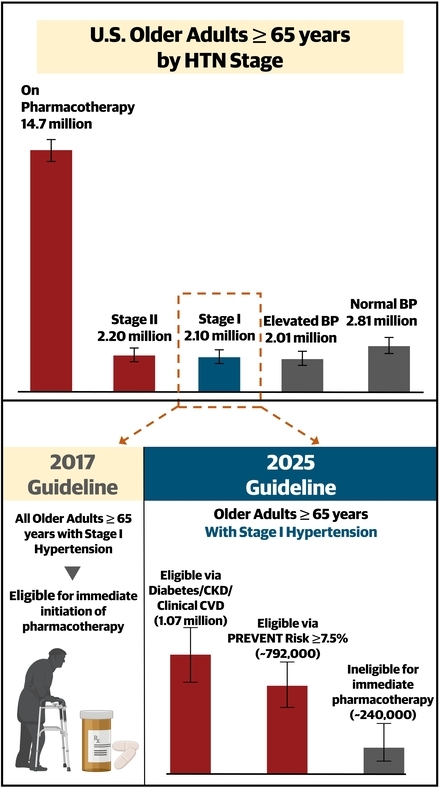
Abstract Body: Background The 2025 AHA/ACC hypertension guideline removes the age ≥ 65 years route to immediate pharmacotherapy in stage I hypertension and introduces a risk-guided approach using PREVENT ≥ 7.5%. Population-level estimates on treatment eligibility changes at this age inflection point are limited. We used nationally representative data to quantify reclassification in immediate pharmacotherapy eligibility among older adults ≥ 65 years. Methods We included non-pregnant adults aged 40-79 from NHANES (2013-2020) with available data to compute PREVENT and pooled cohort equation (PCE) based 10-year risk. Blood pressure was the average of two final readings or a single available value. Comorbidities including diabetes, CKD, and clinical CVD were measured following standard survey definitions and lab parameters. We compared eligibility for immediate pharmacotherapy under 2017 (diabetes, CKD, ASCVD, age ≥65 years, or PCE ≥10%) versus 2025 (diabetes, CKD, clinical CVD, or PREVENT ≥7.5%) guidelines among untreated stage I hypertension overall and in older adults. Survey weights were utilized to obtain nationally representative estimates. Results A total of 5,688 (weighted 71.4 million) adults were analyzed, where older adults comprised 33.3% (23.8 million). Untreated stage I hypertension was present in 8.61 million, among whom 2.10 million were older adults. Per 2017 guidelines, 3.88 million with untreated stage I hypertension were eligible for immediate pharmacotherapy – all older adults ≥65 years (2.10 million; 54.1%) in this group were pharmacotherapy eligible by default. Under 2025 guidelines, 1.03 million stage I older adults were reclassified with the removal of the ≥65 years criterion. Among this group, ~790,000 still qualified for immediate pharmacotherapy due to PREVENT risk ≥ 7.5%. A total of 11.4% (~240,000) stage I older adults initially eligible for immediate pharmacotherapy were reclassified as ineligible, warranting reassessment at 3-6 months per new guidelines. Conclusion Contemporary guidelines would defer immediate antihypertensive pharmacotherapy in about 11% of older adults with stage I hypertension. Targeting the ≥65 year threshold where recommendations diverge, these findings quantify the guideline shift toward individualized care for older adults, aligning pharmacotherapy with an updated risk-based framework.
Mangalesh, Sridhar
(
Jacobi Medical Center, Albert Einstein College of Medicine
, Bronx , New York , United States )
Rossi, Raiza
(
Yale School of Medicine
, New Haven , Connecticut , United States )
Nouri, Armin
(
Yale School of Medicine
, New Haven , Connecticut , United States )
Damluji, Abdulla
(
Cleveland Clinic Foundation
, Cleveland , Ohio , United States )
Nanna, Michael
(
Yale School of Medicine
, New Haven , Connecticut , United States )