
Logo

American Heart Association

  18
  0


Final ID: MP2180

Accelerated Biological Aging, Early-Life Exposure to Tobacco, and Incident Aortic Aneurysm: A Large-Scale Prospective Cohort Study in UK Biobank

Abstract Body (Do not enter title and authors here): Background: Aortic aneurysm (AA) is a fatal vascular disease that affects life expectancy. Theory predicts that biological processes of aging may better capture vascular aging than chronological age. Early-life tobacco exposure may induce lasting vascular injury and accelerate aging trajectories. However, the independent contributions of accelerated biological aging and early tobacco exposure to AA risk, as well as their potential synergistic interaction, remain fundamentally unknown.
Methods: A total of 268,491 participants from the UK Biobank study were included. We measured biological age from clinical traits using the KDM-BA and PhenoAge algorithms. Early-life tobacco exposure was assessed using self-reported questionnaires that included questions on utero tobacco exposure and age of smoking initiation. Cox proportional hazards models were used to analyse the association between biological ageing, early-life tobacco exposure and incident aortic aneurysm. Furthermore, multiplicative and additive interactions between accelerated biological aging and early-life tobacco exposure were formally tested. Disease subtype-specific analyses were conducted separately for incident thoracic aortic aneurysm (TAA) and abdominal aortic aneurysm (AAA).
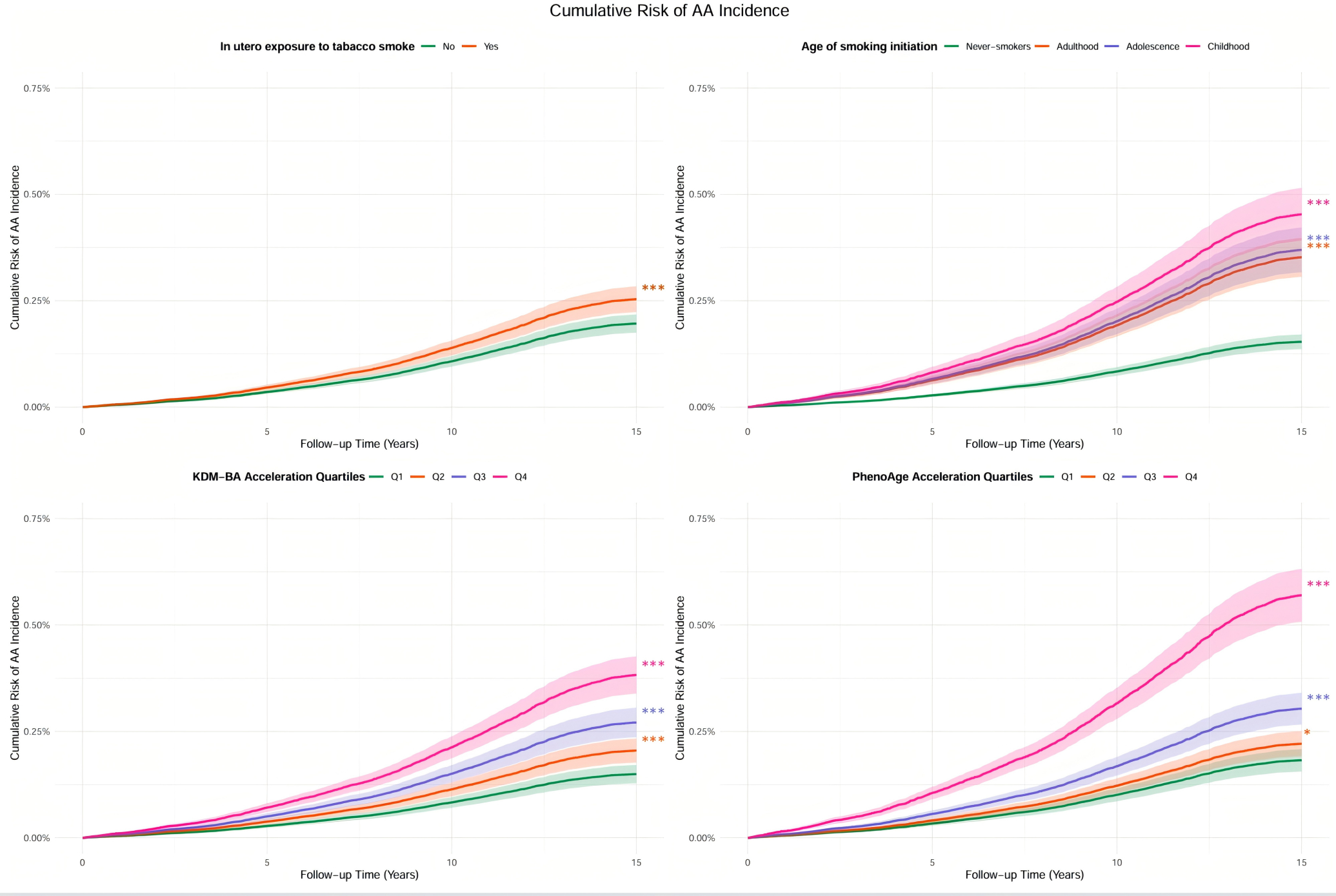
Results: Accelerated biological aging and early-life tobacco exposure were both significantly associated with increased risk of incident AA. Per standard deviation increase, PhenoAge and KDM-BA accelerations were associated with 26-35% and 27-41% higher AA risk, respectively. Participants in the highest quartile of aging acceleration showed markedly higher cumulative incidence of AA (P-trend <0.001). In utero smoke exposure increased AA risk by 21%. Compared to never-smokers, smoking initiation in adulthood, adolescence, and childhood was associated with progressively elevated AA risk (HRs=2.23, 2.26, and 2.57, respectively). Individuals with both highest quartile of biological aging and early-life exposure had markedly elevated AA risk, peaking for childhood smoking combined with high KDM-BA [5.65 (4.52-7.07) or PhenoAge [4.46 (3.61-5.52)]. Effects were stronger for AAA than TAA.
Conclusions: Exposure to tobacco smoke in early life markedly heightens the risk of AA when combined with accelerated biological aging. These findings underscore the need for early-life tobacco control policies and interventions targeting biological aging pathways to reduce AA burden across the lifespan.
  • Yang, Miaomiao  ( Fuwai Hospital, CAMS and PUMC , Beijing , China )
  • Feng, Weijing  ( Southern Medical University , Guangzhou , China )
  • Dang, Aimin  ( Fuwai Hospital, CAMS and PUMC , Beijing , China )
  • Gu, Yingzhen  ( Fuwai Hospital, CAMS and PUMC , Beijing , China )
  • Author Disclosures:
    miaomiao Yang: DO NOT have relevant financial relationships | Weijing Feng: No Answer | Aimin Dang: No Answer | Yingzhen Gu: DO NOT have relevant financial relationships
Meeting Info:

Scientific Sessions 2025

2025

New Orleans, Louisiana

Session Info:

Aging, Biological Age & Cardiovascular Risk

Monday, 11/10/2025 , 10:45AM - 11:45AM

Moderated Digital Poster Session

More abstracts on this topic:
A Multimodal Artificial Intelligence Signature of Advanced Cardiac and Vascular Aging Defines Elevated Risk of Cardiovascular Disease

Perera Sudheesha, Biswas Dhruva, Dhingra Lovedeep, Aminorroaya Arya, Coppi Andreas, Khera Rohan

3-Mercaptopyruvate Sulfurtransferase is a Critical Regulator of Branched-Chain Amino Acid Catabolism in Cardiometabolic HFpEF

Li Zhen, Doiron Jake, Xia Huijing, Lapenna Kyle, Sharp Thomas, Yu Xiaoman, Nagahara Noriyuki, Goodchild Traci, Lefer David

You have to be authorized to contact abstract author. Please, Login
Not Available