Association of Body Size and Shape Metrics with Atherosclerotic Cardiovascular Disease and Mortality: Ethnic Differences in a Nationally Representative Cohort of U.S. Adults
Abstract Body (Do not enter title and authors here): Background BMI is widely used to assess adiposity and cardiometabolic risk, yet its utility varies by race/ethnicity. Alternative indices such as Body Roundness Index (BRI) and A Body Shape Index (ABSI) may offer improved risk stratification, but their utility remains unclear in the ethnically diverse U.S. population.
Research Question We evaluated associations of BMI, BRI, and ABSI with prevalent ASCVD and all-cause mortality, and determine whether these associations vary by race/ethnicity.
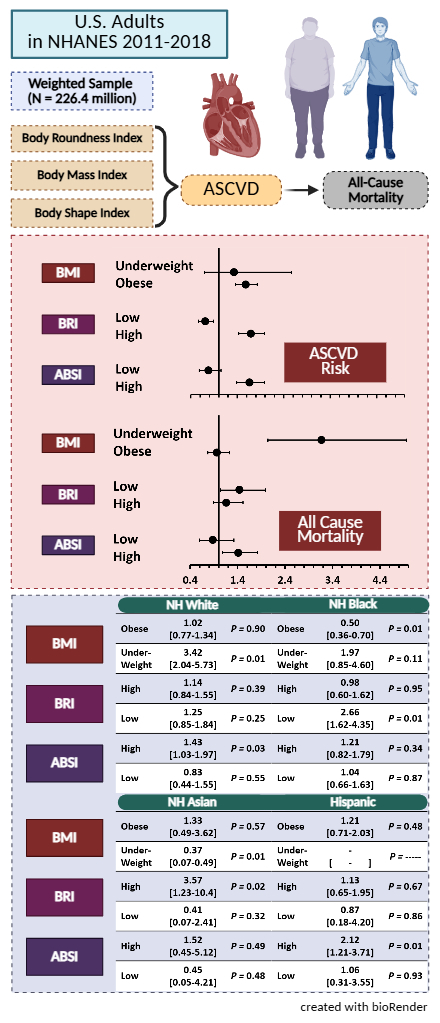
Methods Adults from the National Health and Nutrition Examination Survey cycles 2011-2018 (N = 21,294; weighted 226.4 million) were analyzed. BMI was categorized per WHO cutoffs (obesity ≥30 kg/m2, underweight <18.5 kg/m2, ≥27.5 kg/m2 for obese Asian adults). BRI and ABSI were divided into quartiles, and the interquartile range was set as reference. Survey weighted regression models were employed to estimate the odds of prevalent ASCVD and the hazards of mortality. Subgroup analyses tested for racial/ethnic differences.
Results Obesity as defined by BMI, BRI, and ABSI were all associated with higher odds of ASCVD (aOR 1.58 [1.36-1.83]; 1.69 [1.43-1.99]; 1.66 [1.39-1.98] respectively). Underweight BMI was associated with increased mortality risk (aHR 3.18 [2.04-4.95]), while obesity showed no significant association. However, a high ABSI 1.41 [1.08-1.82] and low BRI 1.44 [1.04-1.98] were associated with mortality in the overall population. Subgroup analyses revealed significant ethnic differences that persisted after comprehensive multivariable adjustment (Figure). Among White adults, underweight BMI and high ABSI predicted mortality. In Asian adults, high BRI conferred greatest risk, while underweight BMI was inversely associated with mortality. In Black adults, higher BMI was associated with lower mortality, and a low BRI was associated with higher risk. For Hispanic adults, high ABSI was the only significant mortality predictor.
Conclusion Our findings suggest that BMI, BRI, and ABSI have differential predictive value for mortality across racial/ethnic groups. While BMI alone may underestimate risk, BRI and ABSI offer nuanced risk stratification, particularly in non-White populations. These results underscore the need for racial/ethnic conscious anthropometric risk assessments in clinical and public health settings.
Mangalesh, Sridhar
(
Jacobi Medical Center, Albert Einstein College of Medicine
, Bronx , New York , United States )
Shah, Priyansh
(
Jacobi Medical Center, Albert Einstein College of Medicine
, Bronx , New York , United States )
Chi, Kuan Yu
(
Jacobi Medical Center, Albert Einstein College of Medicine
, Bronx , New York , United States )
Nouri, Armin
(
Yale School of Medicine
, New Haven , Connecticut , United States )
Rossi, Raiza
(
Yale School of Medicine
, New Haven , Connecticut , United States )
Borkowski, Pawel
(
Jacobi Medical Center, Albert Einstein College of Medicine
, Bronx , New York , United States )
Faillace, Robert
(
Jacobi Medical Center, Albert Einstein College of Medicine
, Bronx , New York , United States )
Nanna, Michael
(
Yale School of Medicine
, New Haven , Connecticut , United States )
Author Disclosures:
Sridhar Mangalesh:DO NOT have relevant financial relationships
| Priyansh Shah:DO NOT have relevant financial relationships
| Kuan Yu Chi:DO NOT have relevant financial relationships
| Armin Nouri:DO NOT have relevant financial relationships
| Raiza Rossi:DO NOT have relevant financial relationships
| Pawel Borkowski:DO NOT have relevant financial relationships
| Robert Faillace:No Answer
| Michael Nanna:DO have relevant financial relationships
;
Consultant:HeartFlow, Inc.:Active (exists now)
; Consultant:Merck:Active (exists now)
; Consultant:Novo Nordisk:Active (exists now)