Neighborhood Socioeconomic Conditions Classify Patients with Variable Recovery Trajectories After Similar Initial Treatments for Myocardial Infarction
Abstract Body: Introduction: Healthy Places Index (HPI) is a California-based, neighborhood-level index comprising 8 domains and 23 socioeconomic metrics on local conditions (e.g., access to education, job opportunities, and clean air/water). HPI is used as a social marker for health drivers and helps guide resource allocation and program development. The independent association of these neighborhood conditions with clinical outcomes after acute myocardial infarction (AMI) is hypothesized but unknown. This study aims to cluster AMI patients based on neighborhood characteristics only and measure their association with clinical recovery post-AMI revascularization.
Methods: This is a single-center retrospective review of 974 AMI adult patients (28% female) who received appropriate medical therapy at hospital discharge. Recovery was defined as survival free of heart failure or recurrent AMI (MACE) years post-event. Kaplan-Meier curves and Cox regression with and without co-variates compared outcomes per cluster. HPI metrics (23), linked to patients’ neighborhoods by zip code and normalized as percentiles, were clustered using VillageNet. This approach is based on the premise that while global cluster boundaries may be non-linear, they can be approximated as locally linear when examined at sufficiently small scales.
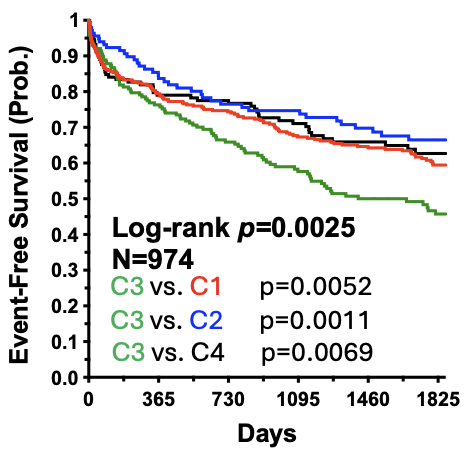
Results: Four patient clusters were identified (C1-4). Survival curves showed variable recovery trajectories among the 4 clusters (p=0.0025). Pairwise comparison between clusters revealed a significantly higher recovery rate in C1 (p=0.0052), C2 (p=0.0011) and C4 (p=0.0069) when compared to C3.
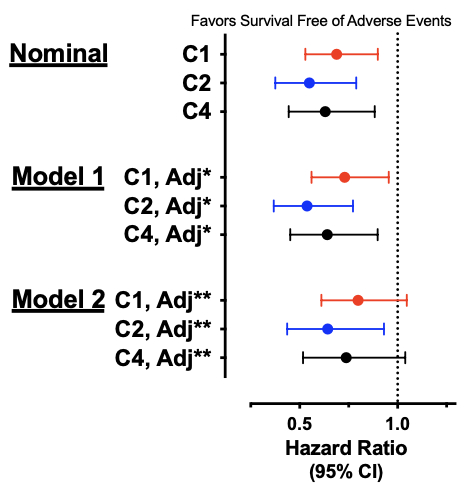
Using C3 as reference, Cox regression without covariates showed a significantly lower MACE risk (i.e., recovery) in C1 (HR:0.68, 95% CI:0.52-0.89), C2 (HR:0.54, 95% CI:0.37-0.78), and C4 (HR:0.63, 95% CI:0.44-0.88). Model 1 revealed a significant reduction in MACE risk in C1 (HR:0.73, 95% CI:0.56-0.95), C2 (HR:0.53, 95% CI:0.36-0.77), and C4 (HR:0.64, 95% CI:0.45-0.89). Model 2 revealed a significantly lower MACE risk only in C2 (HR:0.64, 95% CI:0.43-0.93).
Conclusion: Following culprit vessel revascularization and appropriate medical therapies, neighborhood conditions measured by HPI metrics were significantly associated with less recovery post-AMI (Cluster 3) after adjustment for demographics and medical histories. These social conditions will need future evaluation as possible targets for community-based interventions proposed to amplify resilience when recovering from AMI.
Borromeo, Taliyah
(
UC Davis Health
, Sacramento , California , United States )
Calumpang, Neon
(
Indiana University School of Medicine
, Indianapolis , California , United States )
Ballal, Aditya
(
UC Davis
, Davis , California , United States )
Awolope, Anna
(
UC Davis Health
, Sacramento , California , United States )
Izu, Leighton
(
UC Davis
, Davis , California , United States )
Lopez, Javier
(
UC Davis Health
, Sacramento , California , United States )