
Logo

American Heart Association

  13
  0


Final ID: TU152

Excluding Pseudohypertension to Improve Hypertension Management Through Blood Pressure Device Validations in Cardiac Rehabilitation

Abstract Body: Background: The prevalence of pseudo- or missed- hypertension (HTN) due to inaccurate blood pressure (BP) devices during Cardiac Rehabilitation (CR) is unknown. The first step in the workflow of a home-based BP management program is to validate home BP devices for those who already own a device. The goal of this study is to quantitate the proportion of already-owned inaccurate devices on patients starting CR. Devices that do not validate at the time of this screening would need to be replaced before engaging in medication management; this would prevent BP undertreatment and/or overmedicating patients while also engaging in lifestyle modifications in CR.

Methods: Based on the American Medical Association self-measured BP device calibration test, we retrospectively reviewed 188 consecutive devices for validations in 160 CR patients enrolled in a single center. Validations consist of i) confirming use of an arm cuff device, ii) use of appropriately sized cuff, and iii) accuracy of home device readings. Once the arm with the highest BP is determined, the patients rest for 5 minutes quietly, and the arm is properly positioned before obtaining a total of 5 BP readings using the home device (readings #1, #2 and #4) and the office device as ground truth (readings #3 and #5). Devices were classified as validated based on a two-step formula to determine that the difference between the average BPs from both devices is ≤5 mmHg in the first step or ≤10 mmHg in the second step.

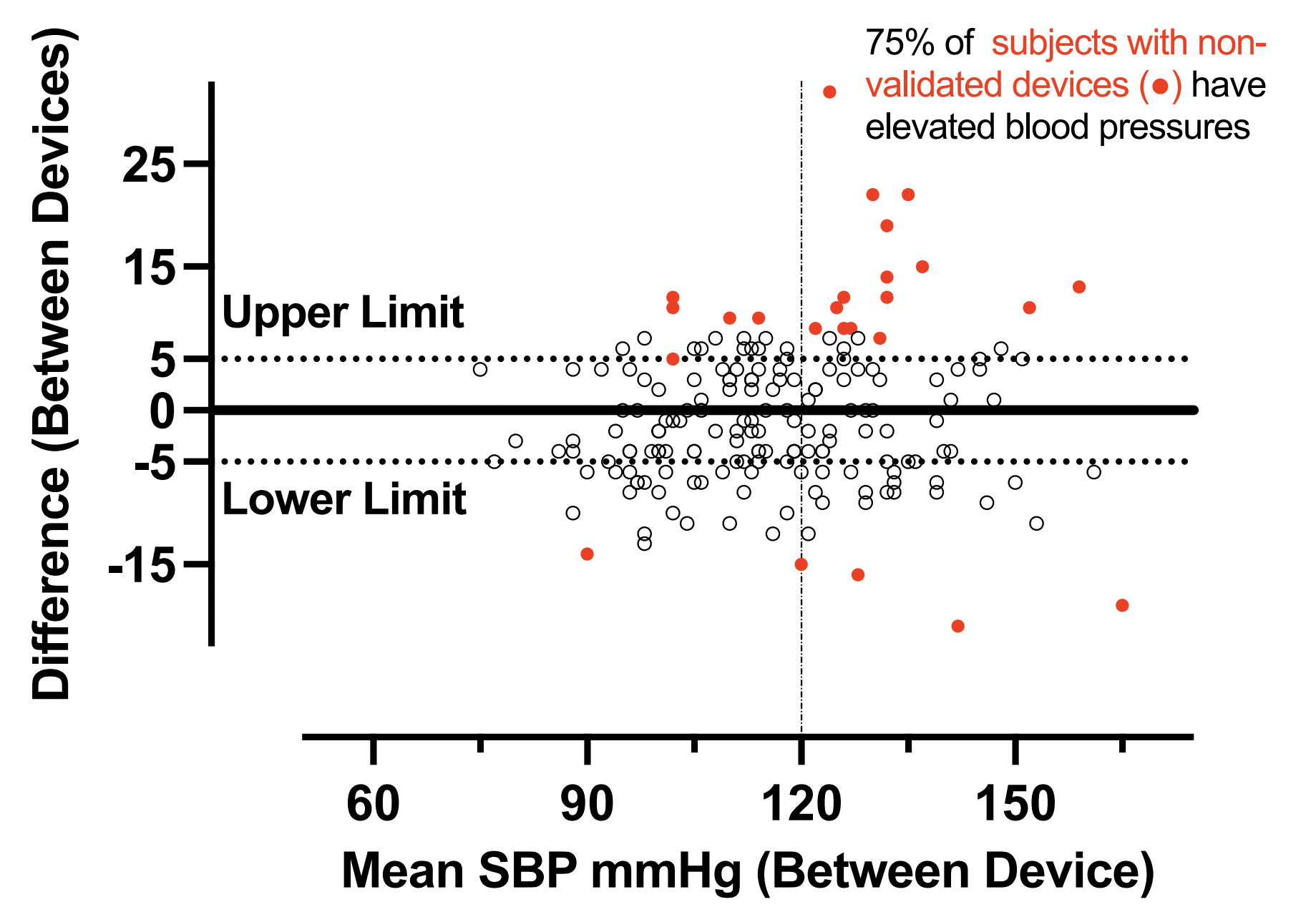
Results: Thirty-two of the 188 (17%) tested devices failed to validate. Of these, 1 (3%) had the wrong cuff size, 4 (13%) were wrist devices, and 2 (6%) gave erratic measurements. Thirty-one of 160 (19%) patients had their validations failed. Twenty-four of them had their devices not valid based on differences between device measurements; 18 (75%) had elevated BP that would have been over or under- estimated by their home devices.

Conclusion: High BP at home is a treatable risk factor that is often missed when performing initial assessments of high-risk CR patients. Our data, 19% of patients with inaccurate home devices, supports that the first step in a home-based BP management program ought to confirm that already-owned devices are accurate before they are used. Furthermore, we propose that home BP devices are routinely validated upon CR enrollment to minimize inappropriate medication management of pseudo- or missed- HTN among these high risk patients.
  • Andrade, Humberto  ( UC Davis Health , Sacramento , California , United States )
  • Borromeo, Taliyah  ( UC Davis Health , Sacramento , California , United States )
  • Moon, Sydney  ( UC Davis Health , Sacramento , California , United States )
  • Ha, Frederick  ( UC Davis Health , Sacramento , California , United States )
  • Ali, Omnia  ( UC Davis Health , Sacramento , California , United States )
  • Arani, Satvik  ( UC Davis Health , Sacramento , California , United States )
  • Labiak, Rachel  ( UC Davis Health , Sacramento , California , United States )
  • Gonzalez Tinoco, Jose  ( UC Davis Health , Sacramento , California , United States )
  • Lopez, Javier  ( UC Davis Health , Sacramento , California , United States )
  • Author Disclosures:
Meeting Info:

EPI-Lifestyle Scientific Sessions 2026

2026

Boston, Massachusetts

Session Info:

Poster Session 1

Tuesday, 03/17/2026 , 05:00PM - 07:00PM

Poster Session

More abstracts on this topic:
A Finding of Unique Peak Exercise Level in Respiratory Exchange Ratio during Bicycle Ergometric Cardiopulmonary Exercise Testing in Healthy Subjects

Nakayama Atsuko, Sakuma Hiroki, Iwata Tomoharu, Kashino Kunio, Isobe Mitsuaki, Tomoike Hitonobu

A comparison of outpatient cardiac rehabilitation access between rural and urban counties in Tennessee

Tran Phoebe, Fogelson Benjamin, Sorey Andrew, Heidel Robert, Baljepally Raj

More abstracts from these authors:
Neighborhood Socioeconomic Conditions Classify Patients with Variable Recovery Trajectories After Similar Initial Treatments for Myocardial Infarction

Borromeo Taliyah, Calumpang Neon, Ballal Aditya, Awolope Anna, Izu Leighton, Lopez Javier

Self-monitoring of Home Blood Pressures Identifies a High Prevalence of White Coat and Masked Hypertension in Cardiac Rehabilitation Patients

Yang Jady, Andrade Humberto, Diaz Alexandra, Ramirez Anthony, Borromeo Taliyah, Grubbs John, Lopez Javier

You have to be authorized to contact abstract author. Please, Login
Not Available