Logo

American Heart Association

  7
  0


Final ID: TU108

Orthostatic Blood Pressure Phenotypes are Associated with Night-Time Blood Pressure Non-Dipping in Older Adults: The Atherosclerosis Risk in Communities (ARIC) Study

Abstract Body: Introduction: Nighttime blood pressure (BP) non-dipping (i.e., a blunted reduction in BP during sleep) is associated with higher risk of cardiovascular disease, stroke, cognitive decline and early death among older adults. Orthostatic hypotension (OH) may share a related physiological pattern, marked by higher supine and lower standing BP (resembling night- and daytime BP respectively). Whether measured or symptomatic OH or orthostatic symptoms could identify people with nighttime non-dipping is unknown.
Hypothesis: Very old adults with OH would be more likely to have nighttime non-dipping.
Methods: Participants in the ARIC study (2021-23) underwent in-office OH assessments (3 supine followed by 6 standing BP measurements, 1 minute apart) and ABPM monitoring (≥20 daytime and ≥7 nighttime BP measurements over 24 hours). Non-dipping was defined as night/day BP ratio >0.9 (reduction in BP of <10%). OH was defined as a drop in average systolic BP (SBP) of ≥20 mm Hg or diastolic BP (DBP) of ≥10 mm Hg from supine to standing, at 1, 3, or 6 minutes after standing (SBP or DBP OH were examined with corresponding non-dipping). Orthostatic symptoms included lightheadedness, dizziness, imbalance, or fainting during the standing maneuver or while in the standing position. We used logistic regression to examine associations of OH and orthostatic symptoms with non-dipping, adjusting for age, sex, race-study center, and antihypertensive medication use.
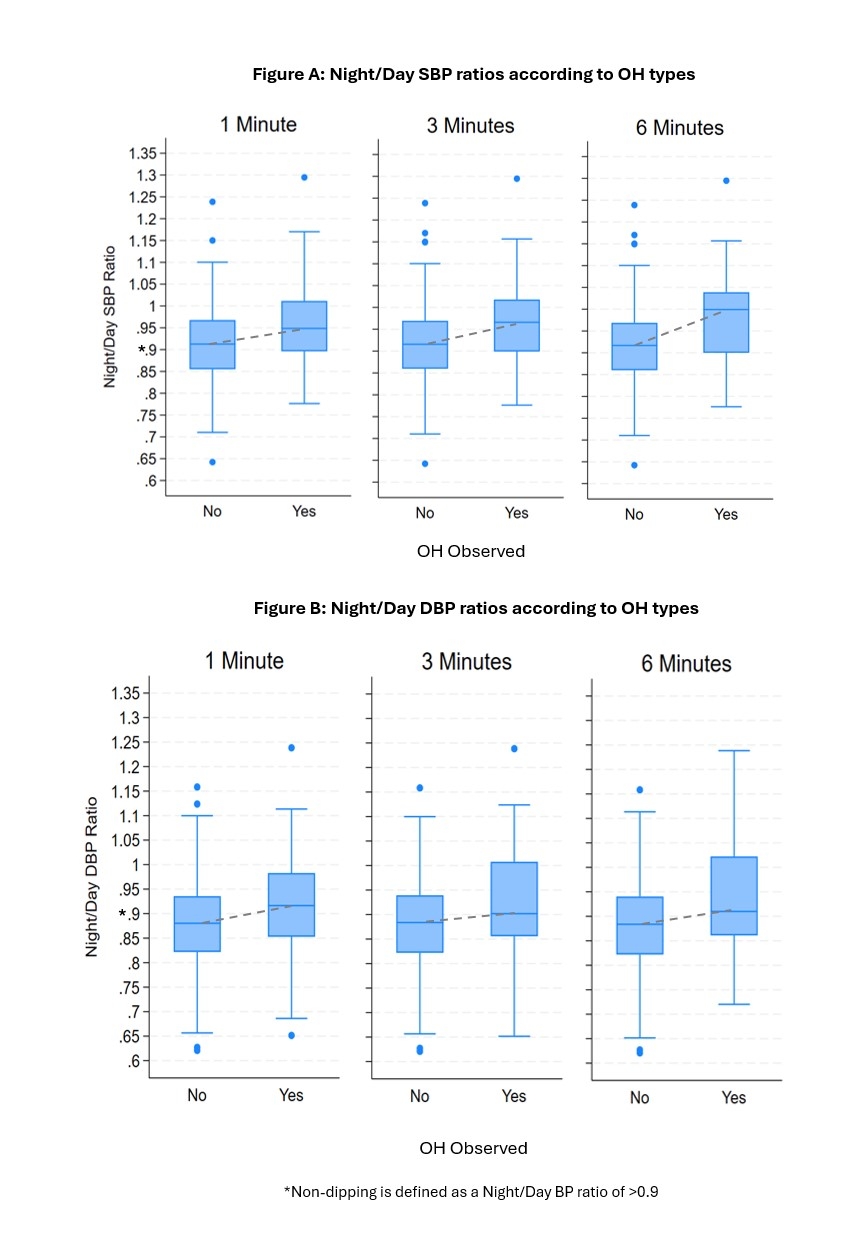
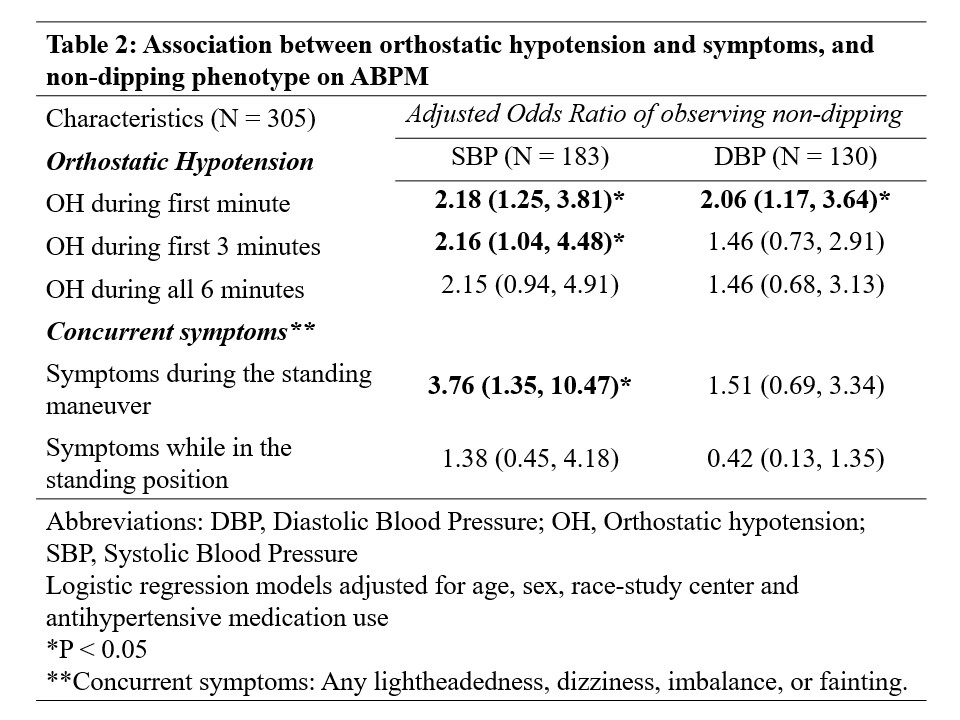
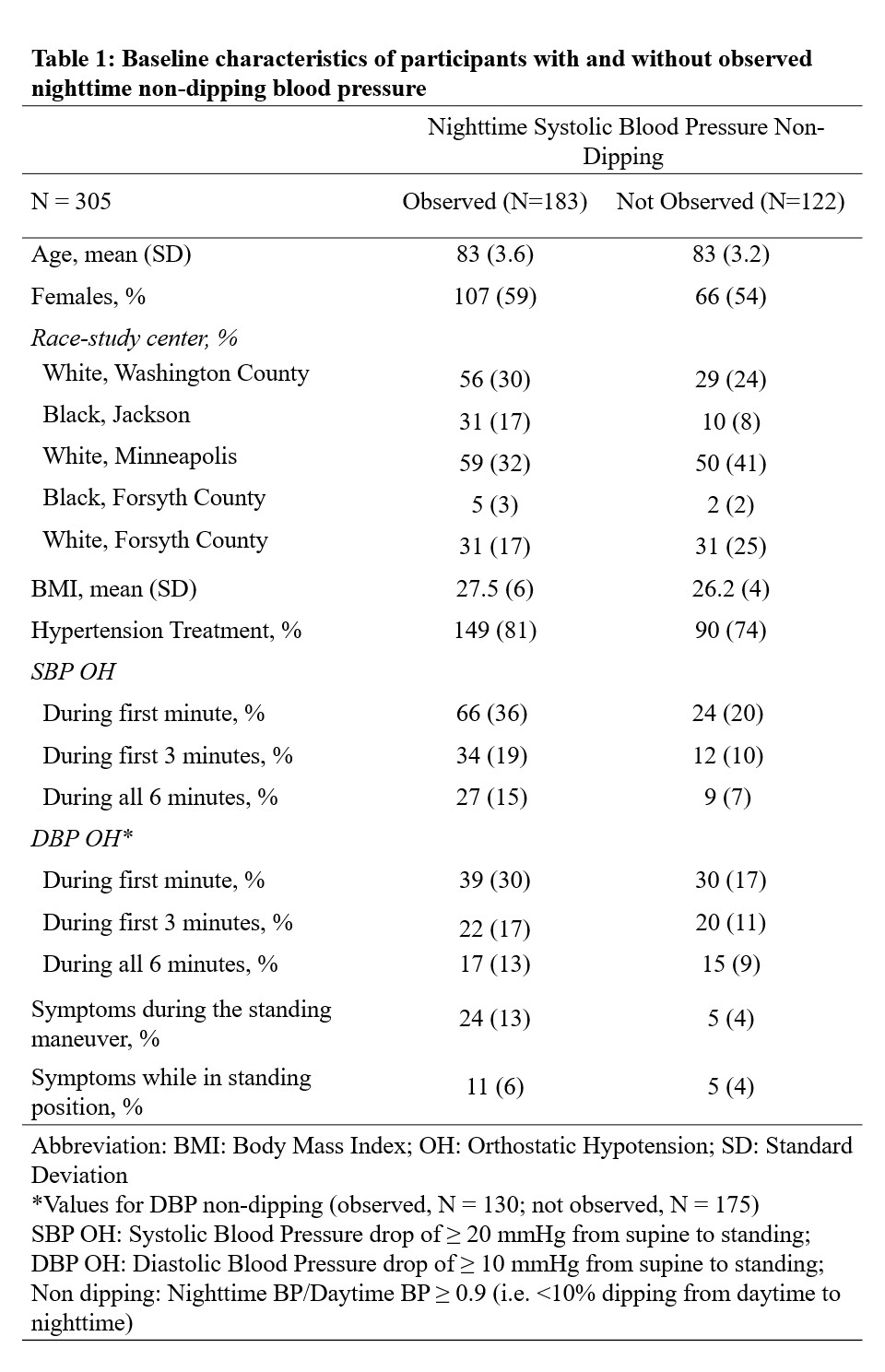
Results: Of the 305 study participants (57% female, mean age 83.3 [SD: 3.5] years), 60% had non-dipping based on SBP and 43% had non-dipping based on DBP. Mean ABPM daytime SBP was 129.7 (SD: 13.3) mm Hg and nighttime SBP was 119.5 (SD: 15.5) mm Hg; 78% used antihypertensive medications (Table 1). People with OH had higher mean night/day BP ratio compared to people without OH for SBP (0.96 vs 0.91) and DBP (0.92 vs 0.88) (Figure). OH during the first minute was associated with non-dipping for both SBP (OR: 2.18 [CI: 1.25, 3.81]) and DBP (2.06 [1.17, 3.64]), whereas OH during the first 3 minutes was associated with SBP non-dipping (2.16 [1.04, 4.48]). Symptoms during the standing maneuver were associated with SBP non-dipping (3.76 [1.35, 10.47]) (Table 2).
Conclusion: In this population of very old, community-dwelling adults, OH soon after standing up (both measured and symptomatic) was associated with nighttime non-dipping on ABPM. Performing ABPM could be valuable in patients with early OH to identify nighttime non-dipping.
  • Patil, Dhrumil  ( BIDMC, Harvard Medical School , Boston , Massachusetts , United States )
  • Khan, Md Marufuzzaman  ( Beth Israel Deaconess Medical Cente , Brookline , Massachusetts , United States )
  • Col, Hannah  ( BIDMC, Harvard Medical School , Boston , Massachusetts , United States )
  • Wang, Frances  ( Beth Israel Deaconess Med Center , Diamond Bar , California , United States )
  • Larbi, Fredrick  ( Beth Israel Deaconess Medical Ctr , Boston , Massachusetts , United States )
  • Zhang, Mingyu  ( Harvard Medical School , Boston , Massachusetts , United States )
  • Ngo, Long  ( Harvard Medical School , Boston , Massachusetts , United States )
  • Cluett, Jennifer  ( BIDMC-Harvard Medical School , Boston , Massachusetts , United States )
  • Selvin, Elizabeth  ( JOHNS HOPKINS UNIVERSITY , Baltimore , Maryland , United States )
  • Wagenknecht, Lynne  ( Wake Forest University School of Medicine , Winston-Salem , North Carolina , United States )
  • Hughes, Timothy  ( Wake Forest University School of Medicine , Winston-Salem , North Carolina , United States )
  • Windham, B Gwen  ( UMMC, The MIND Center , Jackson , Mississippi , United States )
  • Mosley, Thomas  ( UNIV MS MEDICAL CTR , Jackson , Mississippi , United States )
  • Lutsey, Pamela  ( University of Minnesota , Minneapolis , Minnesota , United States )
  • Ring, Kimberly  ( UNC - Biostatistics , Chapel Hill , North Carolina , United States )
  • Lipsitz, Lewis  ( HEBREW REHAB-IFAR , Roslindale , Massachusetts , United States )
  • Valint, Arielle  ( UNC- Chapel Hill , Chapel Hill , North Carolina , United States )
  • Juraschek, Stephen  ( BIDMC-Harvard Medical School , Boston , Massachusetts , United States )
  • Author Disclosures:
Meeting Info:

EPI-Lifestyle Scientific Sessions 2026

2026

Boston, Massachusetts

Session Info:

Poster Session 1

Tuesday, 03/17/2026 , 05:00PM - 07:00PM

Poster Session

More abstracts on this topic:
More abstracts from these authors:
Optimizing the Number of Measurements Needed for Reliable Home Blood Pressure Assessment: The Atherosclerosis Risk in Communities (ARIC) Study

Wang Frances, Hughes Timothy, Windham B Gwen, Mosley Thomas, Lutsey Pamela, Ring Kimberly, Valint Arielle, Zhang Mingyu, Juraschek Stephen, Col Hannah, Larbi Fredrick, Patil Dhrumil, Khan Md Marufuzzaman, Ngo Long, Cluett Jennifer, Selvin Elizabeth, Wagenknecht Lynne

Prevalence and Correlates of White Coat and Masked Hypertension in Older Adults: The Atherosclerosis Risk in Communities Study

Wang Frances, Lutsey Pamela, Windham B Gwen, Mosley Thomas, Wagenknecht Lynne, Ring Kimberly, Valint Arielle, Hughes Timothy, Coresh Joe, Juraschek Stephen, Zhang Mingyu, Larbi Fredrick, Col Hannah, Khan Md Marufuzzaman, Turkson-ocran Ruth-alma, Ngo Long, Cluett Jennifer, Mukamal Kenneth, Selvin Elizabeth

You have to be authorized to contact abstract author. Please, Login
Not Available