Logo

American Heart Association

  20
  0


Final ID: 57

Optimizing the Number of Measurements Needed for Reliable Home Blood Pressure Assessment: The Atherosclerosis Risk in Communities (ARIC) Study

Abstract Body: Introduction: The 2025 AHA/ACC High Blood Pressure (BP) Guidelines recommend home BP monitoring (HBPM) to confirm hypertension diagnosis, guide therapy, and support long-term control. However, the optimal number of HBPM measurements needed for accurate and reliable assessment is not established.

Hypothesis: We hypothesized that repeated HBPM, when based on multiple readings per session, would plateau within 3 days.

Methods: At ARIC study visit 10 (2021-23) participants completed 8 days of HBPM with two daily sessions (morning and evening) each consisting of 3 readings taken at 1-minute intervals after 5-minutes of rest using an Omron Series 10 BP7450 monitor. We assessed agreement between the 8-day mean (reference) and shorter protocols (fewer days, <3 readings per session, or only morning or evening measurements) using concordance correlation coefficients (CCC) and the proportion of participants with a <10 mm Hg difference from the reference. We then evaluated whether the number of days to reach BP stability (average systolic BP [SBP] and diastolic BP [DBP] <5 mm Hg from reference) differed by age, sex, and anti-hypertensive medication use.

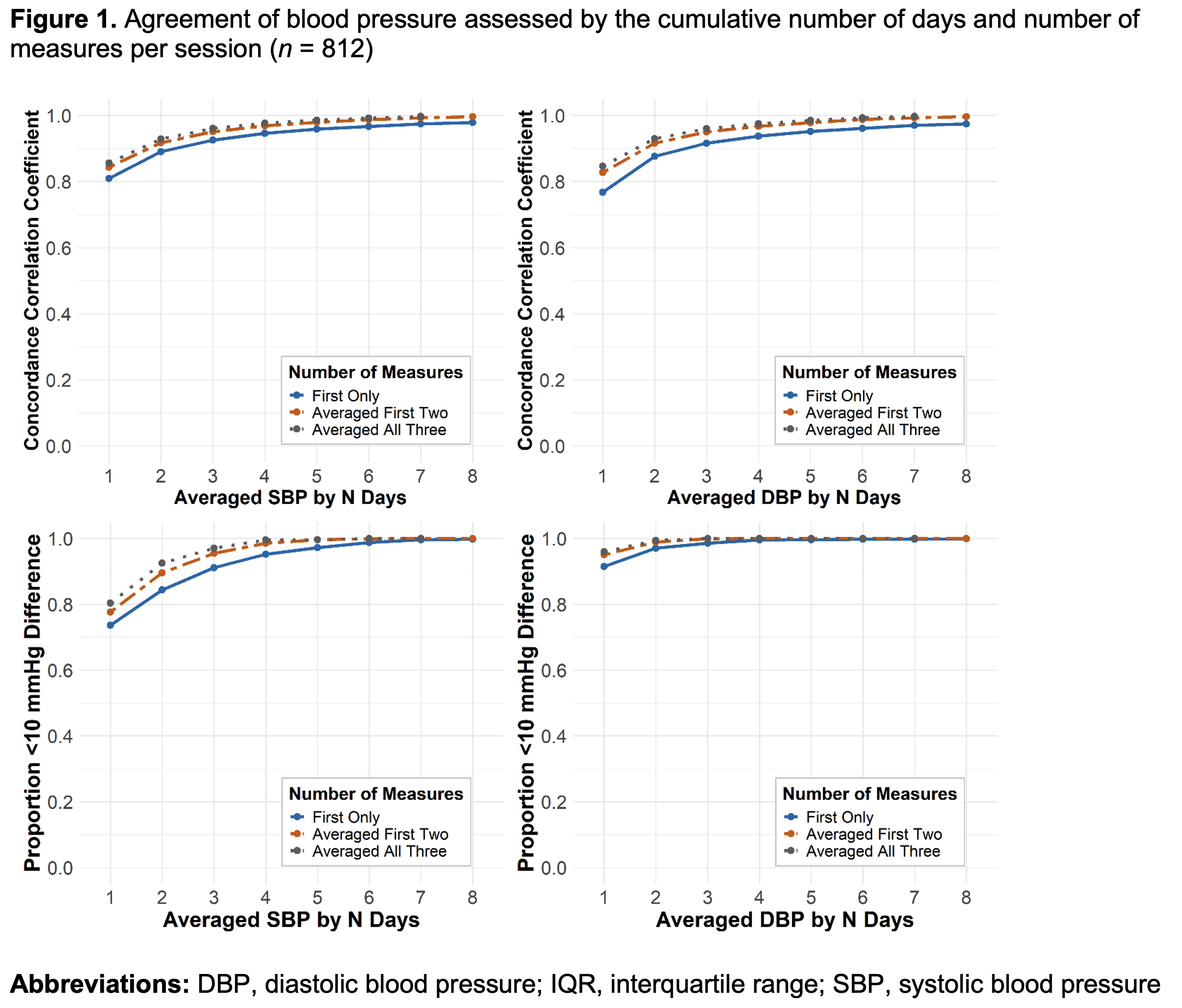
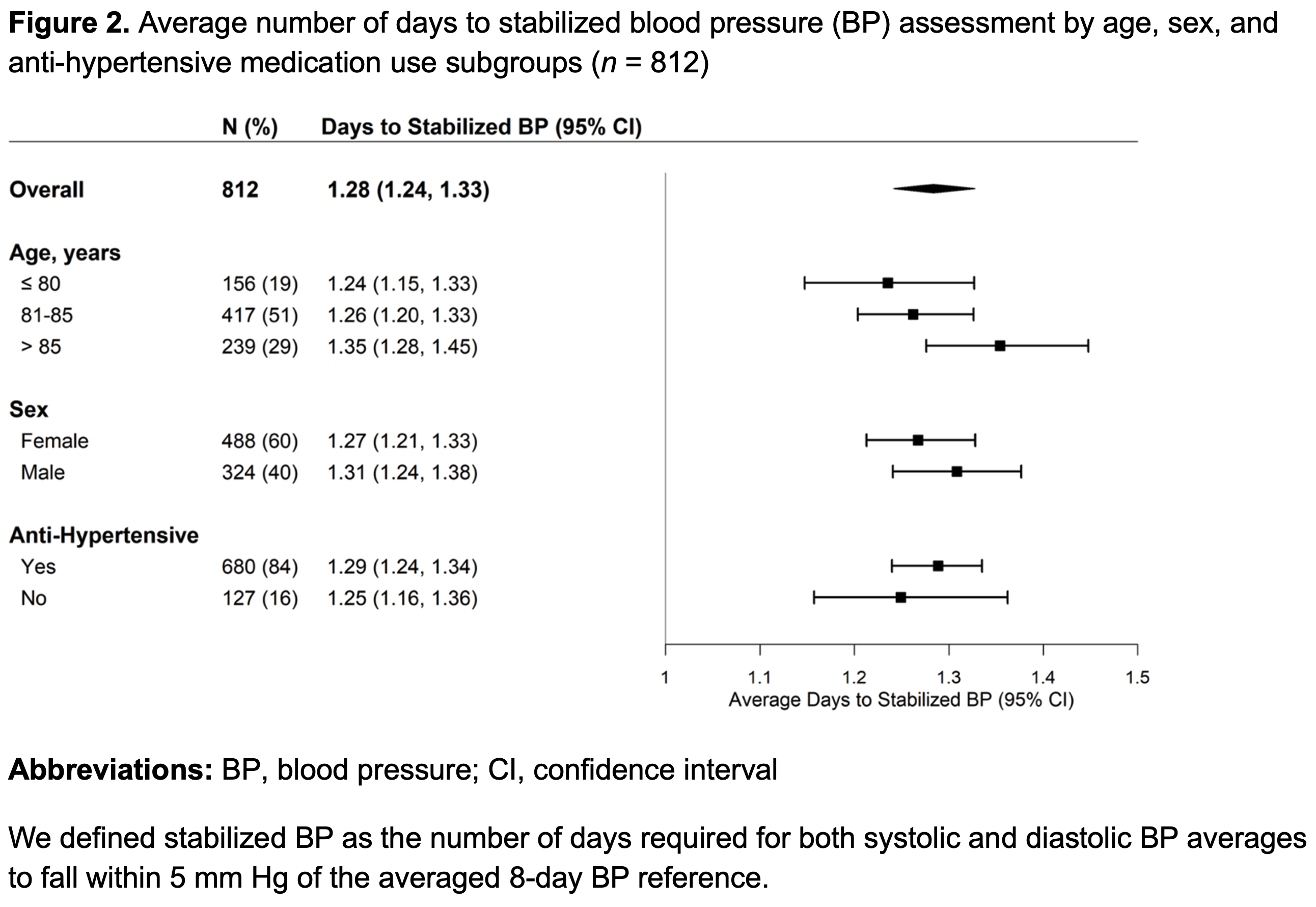
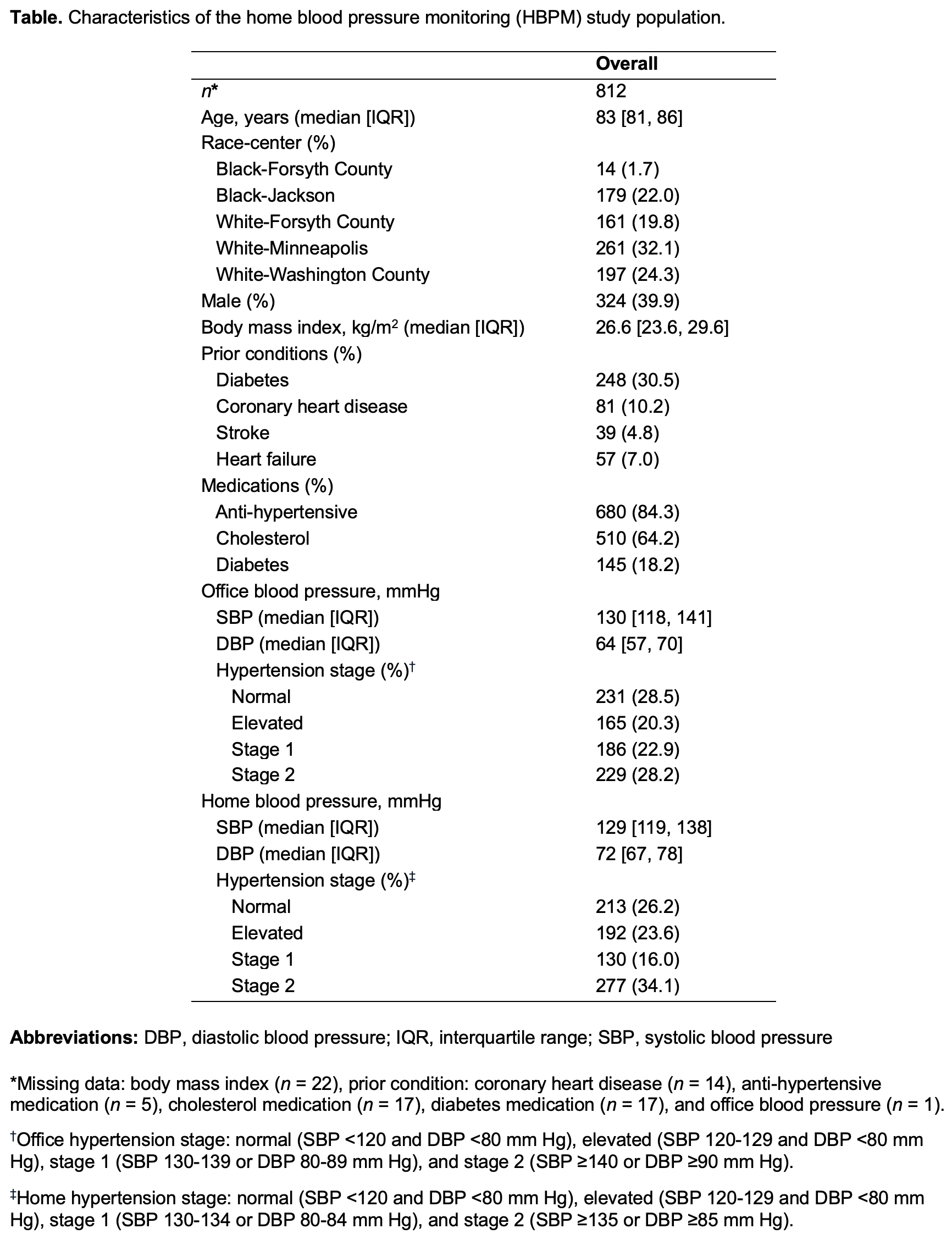
Results: Among 812 participants (median age 83 years, 24% Black adults, 40% male), 29% had normal BP during the study visit, and 84% were on anti-hypertensive medications (Table). Median SBP and DBP remained within a 2 mm Hg range across each day of the 8-day protocol. Using cumulative averages, the largest improvement in agreement occurred when extending the averaging window from 1 to 2 days, with the CCC increasing for SBP from 0.856 (95% CI: 0.837, 0.873) to 0.929 (0.919, 0.937) and for DBP from 0.846 (0.826, 0.864) to 0.929 (0.919, 0.938) (Figure 1). With 3 days of HBPM, the CCC exceeded 0.95 and the proportion of participants within 10 mm Hg difference achieved ≥97% for both SBP and DBP. Beyond 4 days, agreement metrics plateaued. Averaging ≥2 readings per session, including both morning and evening measurements, yielded better agreement than using a single reading or only one timepoint per day. On average, using 3 readings per session, BP stabilized in 1.28 (1.24, 1.33) days, with results similar within subgroups (Figure 2).

Conclusions: In this community-based cohort of very old adults, HBPM provided stable BP estimates within 2-3 days (morning and evening sessions with 2-3 readings each). These findings support shorter HBPM protocols to guide hypertension management while reducing burden in older adults.
  • Wang, Frances  ( Beth Israel Deaconess Med Center , Diamond Bar , California , United States )
  • Col, Hannah  ( Beth Israel Deaconess Med Center , Diamond Bar , California , United States )
  • Larbi, Fredrick  ( Beth Israel Deaconess Med Center , Diamond Bar , California , United States )
  • Patil, Dhrumil  ( Beth Israel Deaconess Med Center , Diamond Bar , California , United States )
  • Khan, Md Marufuzzaman  ( Beth Israel Deaconess Med Center , Diamond Bar , California , United States )
  • Ngo, Long  ( Harvard Medical School , Boston , Massachusetts , United States )
  • Cluett, Jennifer  ( BIDMC-Harvard Medical School , Boston , Massachusetts , United States )
  • Selvin, Elizabeth  ( JOHNS HOPKINS UNIVERSITY , Baltimore , Maryland , United States )
  • Wagenknecht, Lynne  ( WAKE FOREST UNIV , Winston Salem , North Carolina , United States )
  • Hughes, Timothy  ( WAKE FOREST UNIV , Winston Salem , North Carolina , United States )
  • Windham, B Gwen  ( UMMC, The MIND Center , Jackson , Mississippi , United States )
  • Mosley, Thomas  ( UNIV MS MEDICAL CTR , Jackson , Mississippi , United States )
  • Lutsey, Pamela  ( University of Minnesota , Minneapolis , Minnesota , United States )
  • Ring, Kimberly  ( UNC- Chapel Hill , Chapel Hill , North Carolina , United States )
  • Valint, Arielle  ( UNC- Chapel Hill , Chapel Hill , North Carolina , United States )
  • Zhang, Mingyu  ( Harvard Medical School , Boston , Massachusetts , United States )
  • Juraschek, Stephen  ( BIDMC-Harvard Medical School , Boston , Massachusetts , United States )
  • Author Disclosures:
Meeting Info:

EPI-Lifestyle Scientific Sessions 2026

2026

Boston, Massachusetts

Session Info:

Hypertension

Friday, 03/20/2026 , 10:30AM - 12:00PM

Oral Abstract Session

More abstracts on this topic:

A Longitudinal 20-year Analysis Indicates Acceleration of Cardiometabolic Comorbidities on Dementia Risk

Lihua Huang, Danish Muhammad, Auyeung Tw, Jenny Lee, Kwok Timothy, Abrigo Jill, Wei Yingying, Lo Cecilia, Fung Erik

A durable reduction in blood pressure by ultrasound renal denervation: A real-world, single center experience

King Jordan, Gharib Wissam

More abstracts from these authors:
Association of Antihypertensive Medications with Orthostatic Hypotension among Very Old Adults: Findings from the ARIC Study

Khan Md Marufuzzaman, Coresh Joe, Selvin Elizabeth, Wagenknecht Lynne, Hughes Timothy, Windham B Gwen, Mosley Thomas, Lutsey Pamela, Ring Kimberly, Lipsitz Lewis, Valint Arielle, Col Hannah, Juraschek Stephen, Larbi Fredrick, Patil Dhrumil, Zhang Mingyu, Turkson-ocran Ruth-alma, Ngo Long, Cluett Jennifer, Mukamal Kenneth

Orthostatic Blood Pressure Phenotypes are Associated with Night-Time Blood Pressure Non-Dipping in Older Adults: The Atherosclerosis Risk in Communities (ARIC) Study

Patil Dhrumil, Wagenknecht Lynne, Hughes Timothy, Windham B Gwen, Mosley Thomas, Lutsey Pamela, Ring Kimberly, Lipsitz Lewis, Valint Arielle, Juraschek Stephen, Khan Md Marufuzzaman, Col Hannah, Wang Frances, Larbi Fredrick, Zhang Mingyu, Ngo Long, Cluett Jennifer, Selvin Elizabeth

You have to be authorized to contact abstract author. Please, Login
Not Available