Progression and Risk of Type 2 Diabetes Mellitus According to Glycemic Phenotypes
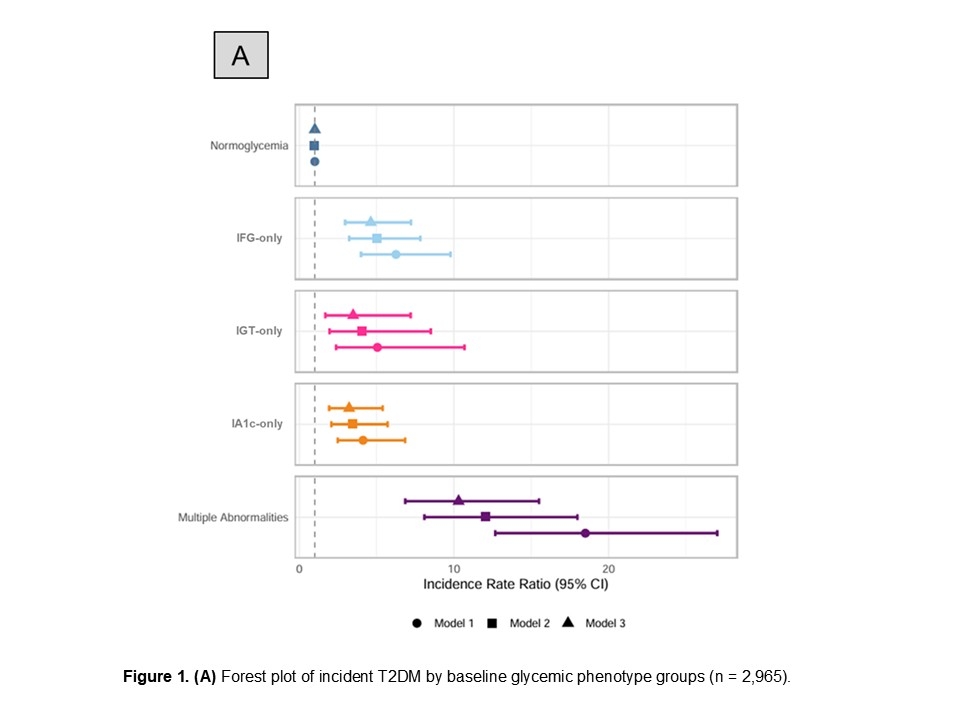
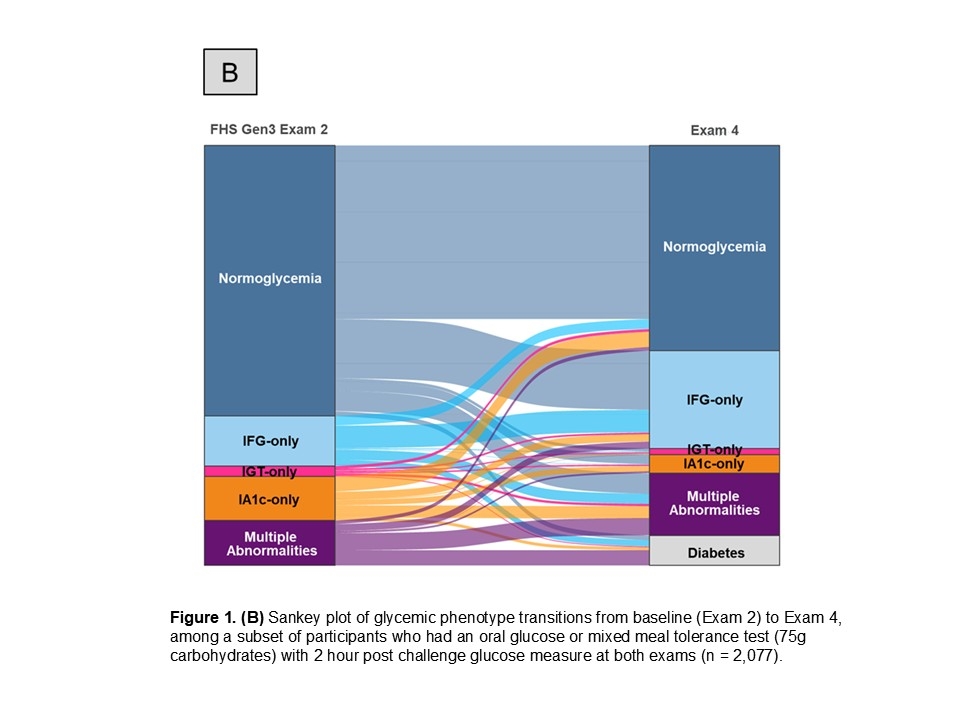
Abstract Body: Background: Heterogeneity in prediabetes (preDM) etiology may influence progression to type 2 diabetes mellitus (T2DM). Despite its clinical importance, longitudinal data on progression to diabetes according to baseline glycemic status remain limited. Methods: We included Framingham Heart Study Generation 3 based cohorts, free of diabetes who participated in an oral glucose tolerance test (OGTT, n=2,965). Participants with preDM were classified into four glycemic phenotype groups: impaired fasting glucose (IFG-only, 100-125 mg/dl), impaired glucose tolerance (IGT-only, 140-199 mg/dl on OGTT), impaired HbA1c (IA1c-only, 5.7-6.4%), and multiple abnormalities (≥2). We used multivariable Poisson regression models to estimate the risk of developing T2DM for each phenotype group, compared to normoglycemia (referent). Model 1 was adjusted for age, sex, smoking, and education. Fully adjusted model further included waist circumference, systolic blood pressure, hypertension and lipid medication use, and non-HDL cholesterol. Progression of preDM phenotype categories was evaluated in participants who completed a mixed meal tolerance test upon follow-up (n=2,077). Results: Among 2,965 FHS participants (Women 54.06%), the average age was 46 years and 26% had only one marker for preDM at baseline (12% IFG, 3% IGT, 11% IA1c); 11% had multiple abnormalities. Over a median follow-up of 14 years, 219 participants (7%) developed T2DM. Having multiple glycemic abnormalities, compared to normoglycemia, was associated with the highest risk of developing T2DM, followed by IFG, IGT, and IA1c (Figure 1A). Individuals with multiple abnormalities had a 19-fold higher incidence rate than normoglycemic participants (IRR [95% CI] = 18.5 [12.7, 27.0], model 1). IFG showed a 6-fold higher risk, IGT a 5-fold higher risk, and IA1c a 4-fold higher risk of developing T2DM compared with normoglycemic participants (p < 0.001). All associations were attenuated but remained significant in the full adjustment model. Progression of preDM phenotypes among a subset of participants with two glycemic challenges in Figure 1B demonstrates substantial instability in glycemic phenotype group membership. Conclusions: Diabetes incidence among middle-aged U.S. adults varied significantly by baseline glycemic phenotypes. These findings suggest that phenotype-specific T2DM prevention strategies may lead to more effective interventions and improved public health outcomes.
Han, Yeji
(
The George Washington University
, Washington , District of Columbia , United States )
Prescott, Brenton
(
Boston University School of Medicine
, Dorchester , Massachusetts , United States )
Bakhshi, Bahar
(
Boston University School of Medicine
, Dorchester , Massachusetts , United States )
Nayor, Matthew
(
Boston Unviersity Medical Center
, Boston , Massachusetts , United States )
Ma, Jiantao
(
Tufts University
, Boston , Massachusetts , United States )
Mitchell, Gary
(
Cardiovascular Engineering Inc
, Boston , Massachusetts , United States )
Spartano, Nicole
(
Boston University
, Boston , Massachusetts , United States )
Walker, Maura
(
Boston University
, Boston , Massachusetts , United States )