Adiponectin and Adiponectin/Leptin Ratio Associate with Cardiometabolic Risk in South Asian Americans: Updates from the MASALA Study
Abstract Body (Do not enter title and authors here): Introduction: South Asian Americans face a disproportionately high burden of atherosclerotic cardiovascular disease (CVD) compared to other racial/ethnic groups. Adipokines, which are cytokines secreted by adipose tissue, may link adiposity to the risk for CVD. However, their role in South Asian CVD risk remains less clear. We investigated associations between the adipokines adiponectin, leptin, and resistin with hypertension, dyslipidemia, and diabetes in South Asian Americans in the Mediators of Atherosclerosis in South Asians Living in America (MASALA) Study.
Methods: This is a cross-sectional analysis of individuals enrolled in the MASALA longitudinal cohort study of South Asian adults without a history of CVD. Baseline fasting plasma specimens, clinical exams, and questionnaires were obtained between 2010 and 2013. The highest vs. lower tertiles of adiponectin, leptin, resistin, and the adiponectin-leptin (A/L) ratio, a marker of adipose tissue inflammation, were evaluated in relation to the odds of prevalent hypertension, dyslipidemia, and diabetes using multivariable logistic regression. Models were adjusted for age, gender, education, BMI, visceral fat, smoking, alcohol use, physical activity, and inflammatory markers (TNF-α, CRP). Interactions with gender were tested, and only gender-stratified odds ratios are reported when significant interactions were found.
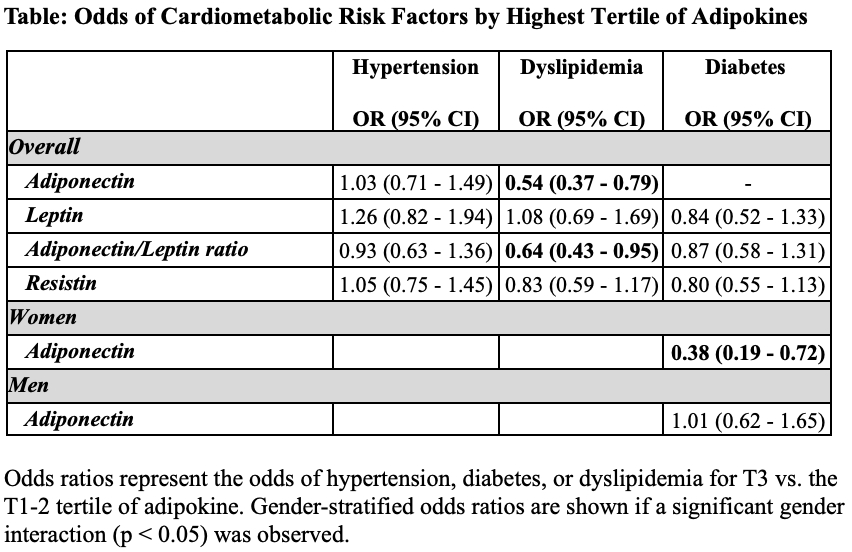
Results: In this sample of 891 adults (mean age 55.3 [SD 9.4] years, 46% female), higher adiponectin tertile was associated with lower odds of dyslipidemia overall (OR: 0.54; 95% CI: 0.37-0.79) and lower odds of diabetes in women (OR: 0.31; 95% CI: 0.19-0.72; p=0.03 for interaction by gender). Higher A/L ratio tertile was inversely associated with dyslipidemia overall (OR: 0.64; 95% CI: 0.43-0.95). Leptin and resistin were not significantly associated with hypertension, diabetes, or dyslipidemia.
Conclusion: Among South Asian American adults, higher adiponectin and A/L ratio levels were associated with a lower likelihood of dyslipidemia and diabetes. This occurred particularly among women for adiponectin, suggesting gender-specific pathways linking it to CVD risk. In contrast, leptin and resistin were not associated with cardiometabolic outcomes. These findings underscore a potential role for adiponectin in CVD risk stratification among South Asians.
Uttarwar, Salil
(
UCSF
, San Francisco , California , United States )
Shah, Nilay
(
Northwestern University
, Chicago , Illinois , United States )
Kanaya, Alka
(
UCSF
, San Francisco , California , United States )
Gadgil, Meghana
(
UCSF
, San Francisco , California , United States )
Author Disclosures:
SALIL UTTARWAR:DO have relevant financial relationships
;
Employee:Genentech Inc.:Past (completed)
| Nilay Shah:DO NOT have relevant financial relationships
| Alka Kanaya:DO NOT have relevant financial relationships
| Meghana Gadgil:DO have relevant financial relationships
;
Research Funding (PI or named investigator):NIH:Active (exists now)
; Other (please indicate in the box next to the company name):American Diabetes Association - Associate Editor:Active (exists now)
; Advisor:LumosFit:Active (exists now)