CGM-derived dynamic measures of glycemia in relation to hepatic steatosis in adults without diabetes
Abstract Body: Background: Prediabetes and type 2 diabetes are associated with increased risk for hepatic steatosis. Yet, the associations between dynamic measures of glycemia and hepatic steatosis among individuals without diabetes remains understudied.
Methods: We included 1571 participants from the Framingham Heart Study (FHS) Third Generation based cohorts without diabetes who underwent assessment for hepatic steatosis using vibration-controlled transient elastography (2016-2019), had ≥3 days of continuous glucose monitor data (Dexcom G6 Pro CGM, 2022-2025) and completed a mixed meal tolerance test (MMTT, 2022-2025). The MMTT involved drinking a standardized nutritional beverage (600 kcal; 75 g carbohydrate, 21 g fat, 29 g protein). Hepatic steatosis was determined using controlled attenuation parameter (CAP). We performed multivariable linear and logistic regression to investigate the associations of standardized CGM-derived measures, fasting glucose, HbA1c, and 2-h post-MMT glucose with CAP as a continuous outcome and hepatic steatosis as a dichotomous outcome (CAP≥274dB/m). We adjusted all models for age, sex, smoking status, cholesterol-lowering medication, body mass index (BMI), and fasting blood glucose (except for when fasting glucose was used as a predictor). We also examined stratifying by glycemic status (normoglycemia and prediabetes).
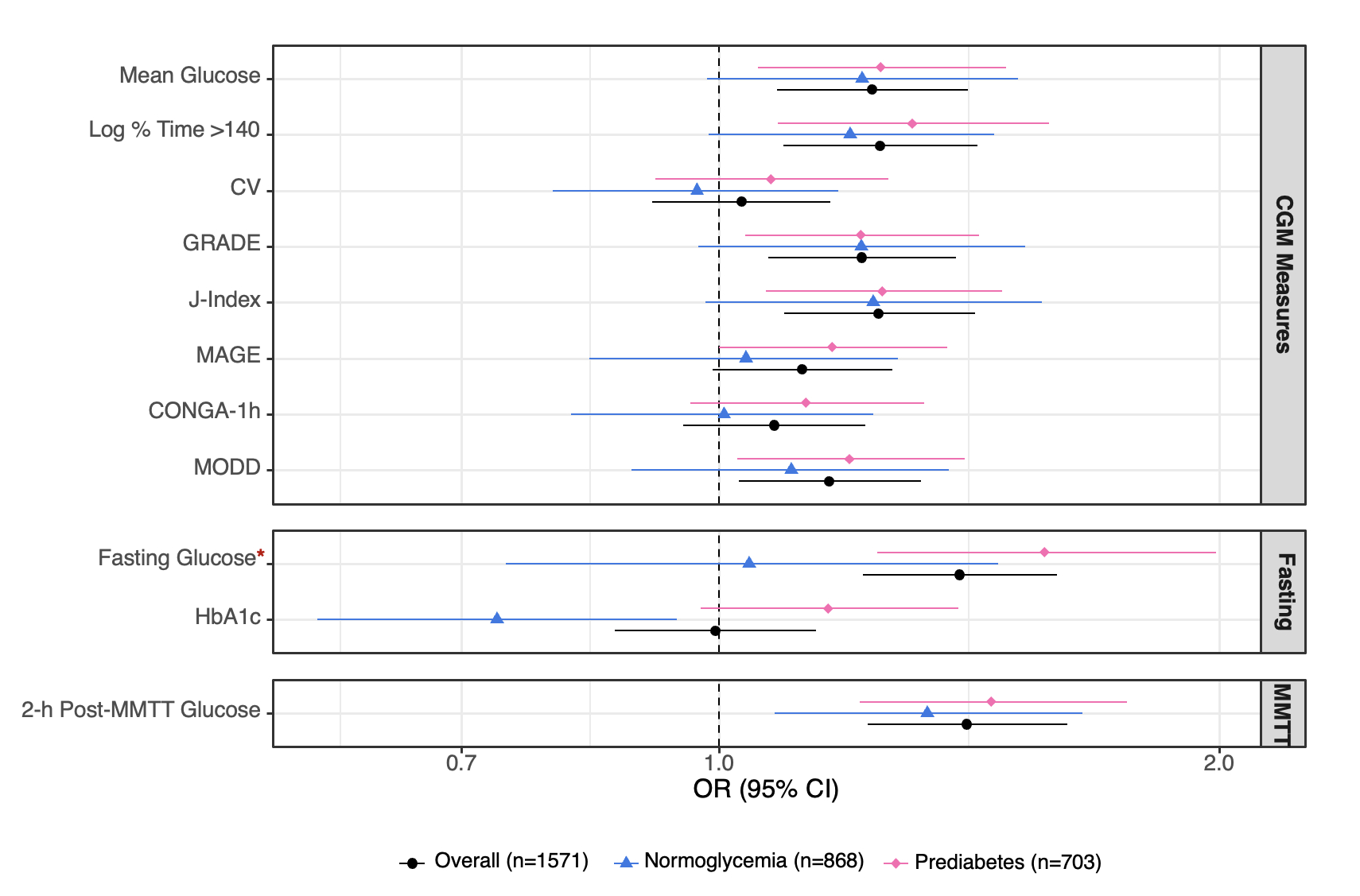
Results: In 1571 FHS participants (56.5% female, 55.3% normoglycemia), average age was 59.8y and BMI 28.2kg/m2. Steatosis prevalence was 21.4% among those with normoglycemia and 43.8% among those with prediabetes. Higher CGM measures of glycemic burden (e.g., %time above range [TAR] 140mg/dL) and 2-h post-MMTT glucose were positively associated with CAP (per 1 SD increase; β: 2.6 and 6.1, respectively, all p-value <0.05). Similarly, higher CGM measures and 2-h post-MMTT glucose were also associated with higher odds of hepatic steatosis (TAR 140; OR:1.25 [95% CI: 1.09–1.43], 2-h post-MMTT glucose; OR:1.41 [95% CI:1.23–1.62]). These associations appeared to be stronger among individuals with prediabetes and remained significant even after adjusting for BMI and fasting blood glucose.
Conclusion: Glycemic burden and variability were associated with hepatic steatosis. CGM and MMTT may offer incremental value in identifying early metabolic dysregulation, beyond traditional measures of glycemia, particularly in those with prediabetes.
Bakhshi, Bahar
(
Boston University School of Medicine
, Dorchester , Massachusetts , United States )
Sultana, Naznin
(
Boston University
, Boston , Massachusetts , United States )
Yiannakou, Ioanna
(
Boston University
, Boston , Massachusetts , United States )
Nayor, Matthew
(
Boston Unviersity Medical Center
, Boston , Massachusetts , United States )
Lin, Honghuang
(
UMass Chan Medical school
, Worcester , Massachusetts , United States )
Steenkamp, Devin
(
Boston University Medical Center
, Boston , Massachusetts , United States )
Long, Michelle
(
Novo Nordisk
, Søborg , Denmark )
Walker, Maura
(
Boston University
, Boston , Massachusetts , United States )
Spartano, Nicole
(
Boston University
, Boston , Massachusetts , United States )