Rural-Urban Differences in Accelerometer-Measured Physical Activity Among Older U.S. Adults: Findings from the REGARDS Study
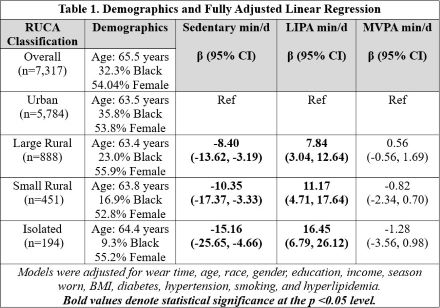
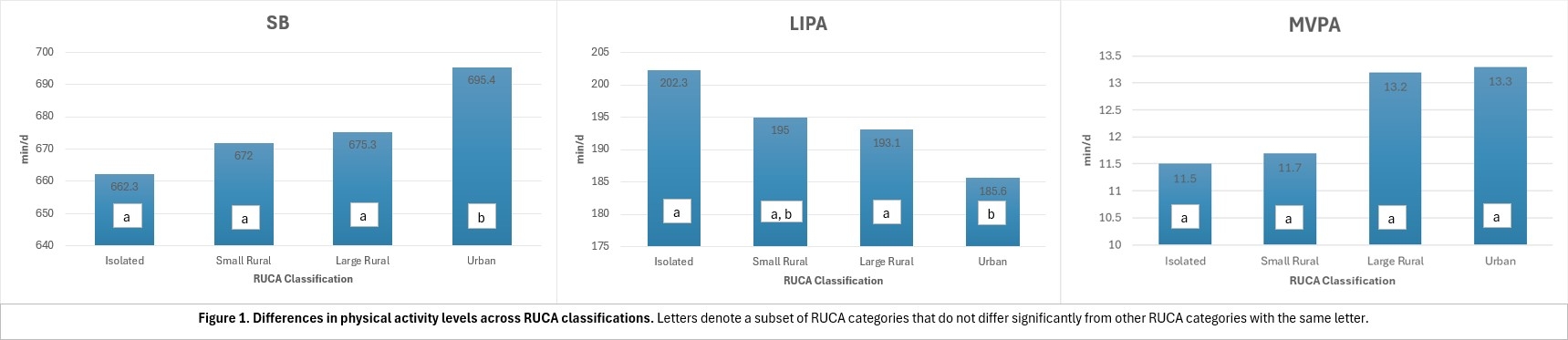
Abstract Body: Introduction: Older adults in rural areas face elevated chronic disease risk and greater barriers to physical activity (PA). We determined how PA patterns vary across the rural-urban spectrum using the Rural Urban Commuting Area (RUCA) 4-category system, incorporating a broad set of demographic and health variables. Hypothesis: Rural residents would engage in less moderate-to-vigorous physical activity (MVPA) and sedentary behavior (SB), but more light-intensity physical activity (LIPA) compared to urban residents. Methods: Accelerometer data (Actical™) from REGARDS participants collected between 2009 and 2013 were analyzed across RUCA category: isolated, small rural, large rural, and urban. PA was categorized into three intensity domains based on activity counts per minute (CPM): SB (<50), LIPA (50–1064), and MVPA (≥1065). Multivariable general linear models identified education and income as significant PA determinants, which were retained in fully adjusted linear regression models. Models were sequentially adjusted for wear time, demographic and socioeconomic factors, and health-related covariates. Interaction terms were tested for effect modification of covariates on rurality and SB, LIPA, and MVPA. Results: Of the 30,239 Black and White adults aged ≥45 years enrolled in REGARDS between 2003 and 2007, 8,098 had accelerometer data, and 7,317 had valid RUCA Classification (Table). Urban residents engaged in the most SB (691 min/d) and least LIPA (188 min/d) (Figure). Compared to urban residents, those in isolated and small rural areas engaged in significantly more LIPA and less SB (Table). MVPA levels were low across all RUCA groups (avg 13.1 min/d), with no statistically significant group differences. A significant interaction was observed between education and RUCA category for LIPA (p= 0.03). Individuals in small rural areas with less than a high school education engaged in significantly more LIPA than urban residents with a college education (estimate = 46.65 min/d, p=0.0014). Conclusions: We observed uniformly low levels of MVPA across all RUCA categories. Rural–urban differences in overall PA were more strongly influenced by variations in LIPA and SB. These patterns underscore the role of income, education, and environmental context in shaping physical activity disparities. It remains unclear whether shared barriers contribute to low MVPA across RUCA classes or whether distinct factors promote higher LIPA in certain rural populations.
Hankes, Michael
(
University of Alabama at Birmingham
, Birmingham , Alabama , United States )
Dooley, Erin
(
University of Alabama at Birmingham
, Birmingham , Alabama , United States )
Clarkson, Stephen
(
University of Alabama at Birmingham
, Birmingham , Alabama , United States )
Singh, Harshvardhan
(
Oklahoma State University
, Stillwater , Oklahoma , United States )
Dodds, Fitzgerald
(
University of Alabama at Birmingham
, Birmingham , Alabama , United States )
Tharpe, Mckenna
(
University of Alabama at Birmingham
, Birmingham , Alabama , United States )
Sint Jago, Silvienne
(
University of Alabama at Birmingham
, Birmingham , Alabama , United States )
Bagley, Tyler
(
University of Alabama at Birmingham
, Birmingham , Alabama , United States )
Howard, Virginia
(
University of Alabama at Birmingham
, Birmingham , Alabama , United States )
Judd, Suzanne
(
University of Alabama at Birmingham
, Birmingham , Alabama , United States )
Jones, Raymond
(
University of Alabama at Birmingham
, Birmingham , Alabama , United States )
Bhargava Pranav, Jackson Elizabeth, Loop Matthew, Jones Raymond, Kamin Mukaz Debora, Yuan Ya, Howard Virginia, Judd Suzanne, Cushman Mary, Howard George
4427259_File000000.jpg
4427259_File000001.jpg
You have to be authorized to contact abstract author. Please, Login