Urban-Rural Differences in Life’s Essential 8: Results from the REasons for Geographic And Racial Differences in Stroke (REGARDS) Study
Abstract Body (Do not enter title and authors here): Background: Rural populations in the United States face shorter life expectancies and higher cardiovascular mortality compared to urban populations. Understanding how the American Heart Association’s Life’s Essential 8 (LE8) metrics vary across urban and rural populations may assist in designing interventions to address cardiovascular health (CVH) among rural adults.
Hypothesis: We hypothesized rural adults would have worse CVH, as measured by LE8, compared to urban and suburban adults.
Methods: REGARDS is a national cohort of Black and White adults age 45 and older, enrolled from 2003-7. Data from participants who completed the home visit (2013–2016) and were not missing data on LE8 metrics were used for the present analysis. LE8 metrics were assessed through questionnaires, physical measurements, and lab data. The 2010 Rural-Urban Commuting Area (RUCA-7) codes were used to classify population density. Mean LE8 scores and individual metrics were examined across 7 RUCA classes (isolated rural, other small rural, small rural core, other large rural, large rural core, other urban, and urban core), using general linear modeling, adjusting for demographic characteristics, income, and education.
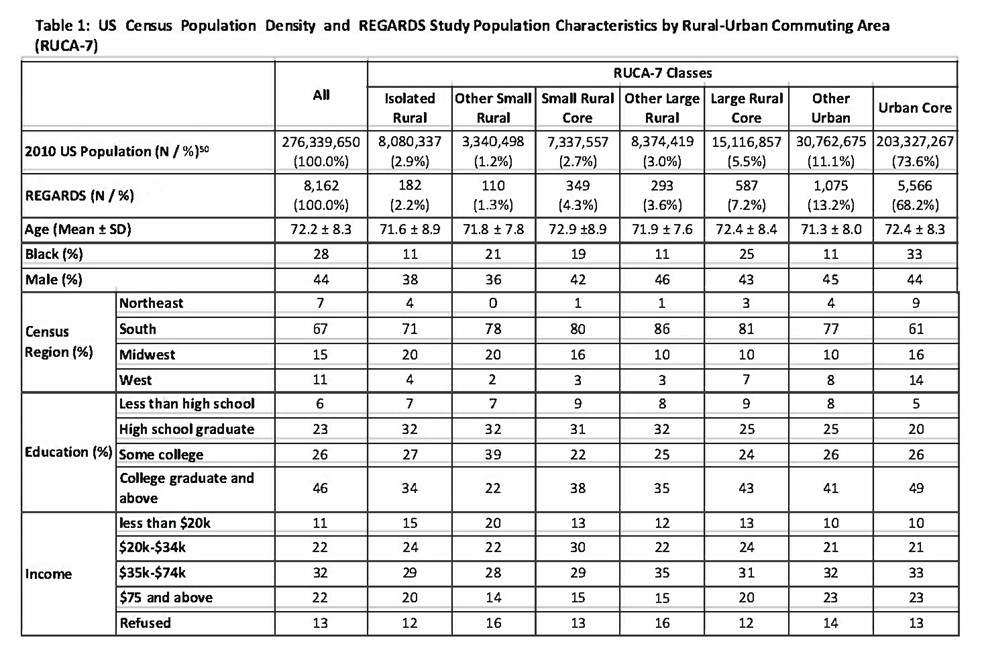
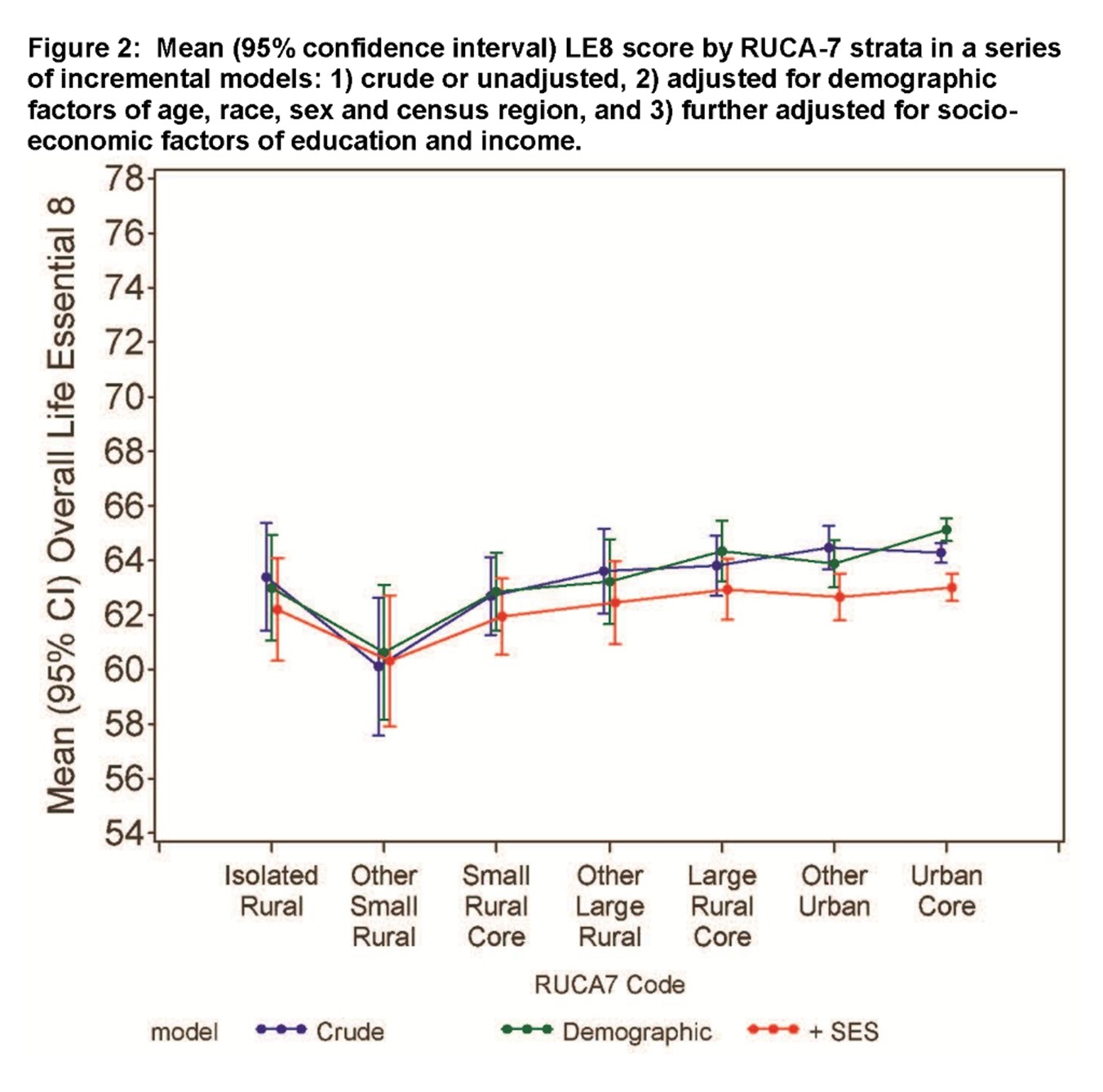
Results: A total of 8,162 REGARDS participants were included in the present analysis. The majority resided in Urban Core areas (73.6%). REGARDS participants' distribution across the RUCA class was similar to the US Census data. (Table 1) Adjusting for demographic factors, LE8 scores increased with increasing urbanicity, with Other Small Rural and Isolated Rural areas having the lowest LE8 scores. Modest attenuation was observed after further adjustment for education and income. (Figure 1) No interactions by race or sex were observed. Individual LE8 metrics for diet, blood pressure, and blood glucose demonstrated similar trends across RUCA class, with improved metrics associated with increased urbanicity. Metrics for lipids, sleep, and smoking metrics did not differ by RUCA class.
Conclusion: In this large cohort of adults from 48 contiguous US states, higher urbanicity was associated with higher mean LE8 scores, reflecting better CVH. This association with improved CVH was driven by better diet, blood pressure, and blood glucose scores. Understanding population-level differences in CVH across the country will inform the development of interventions to address poor CVH in rural populations.
Bhargava, Pranav
(
University of Alabama Birmingham
, Homewood , Alabama , United States )
Loop, Matthew
(
Auburn University
, Auburn , Alabama , United States )
Jones, Raymond
(
University of Alabama at Birmingham
, Birmiham , Alabama , United States )
Kamin Mukaz, Debora
(
University of Vermont
, Colchester , Vermont , United States )
Yuan, Ya
(
UNIVERSITY ALABAMA BIRMINGHAM
, Vestavia , Alabama , United States )
Howard, Virginia
(
UNIVERSITY OF ALABAMA-BIRMINGH
, Birmingham , Alabama , United States )
Judd, Suzanne
(
UAB
, Birmiham , Alabama , United States )
Cushman, Mary
(
UNIVERSITY VERMONT
, Colchester , Vermont , United States )
Howard, George
(
SCHOOL PUBLIC HEALTH
, Birmingham , Alabama , United States )
Jackson, Elizabeth
(
University of Alabama at Birmingham
, Birmiham , Alabama , United States )
Author Disclosures:
Pranav Bhargava:DO NOT have relevant financial relationships
| Elizabeth Jackson:DO NOT have relevant financial relationships
| Matthew Loop:DO have relevant financial relationships
;
Consultant:Roman Health Ventures:Active (exists now)
; Consultant:Mountain Valley Silver:Past (completed)
| Raymond Jones:No Answer
| Debora Kamin Mukaz:DO NOT have relevant financial relationships
| Ya Yuan:No Answer
| Virginia Howard:DO NOT have relevant financial relationships
| Suzanne Judd:DO NOT have relevant financial relationships
| Mary Cushman:DO NOT have relevant financial relationships
| George Howard:No Answer