EPI-Lifestyle Scientific Sessions 2026
/
Sleep
/
Equivalence of Algorithm- and Log-guided Sleep Estimates within GGIR: The REasons for Geographic and Racial Differences in Stroke 24-hour Activity Cycles (REGARDS 24H-ACT) Study
American Heart Association
87
0
Final ID: 33
Equivalence of Algorithm- and Log-guided Sleep Estimates within GGIR: The REasons for Geographic and Racial Differences in Stroke 24-hour Activity Cycles (REGARDS 24H-ACT) Study
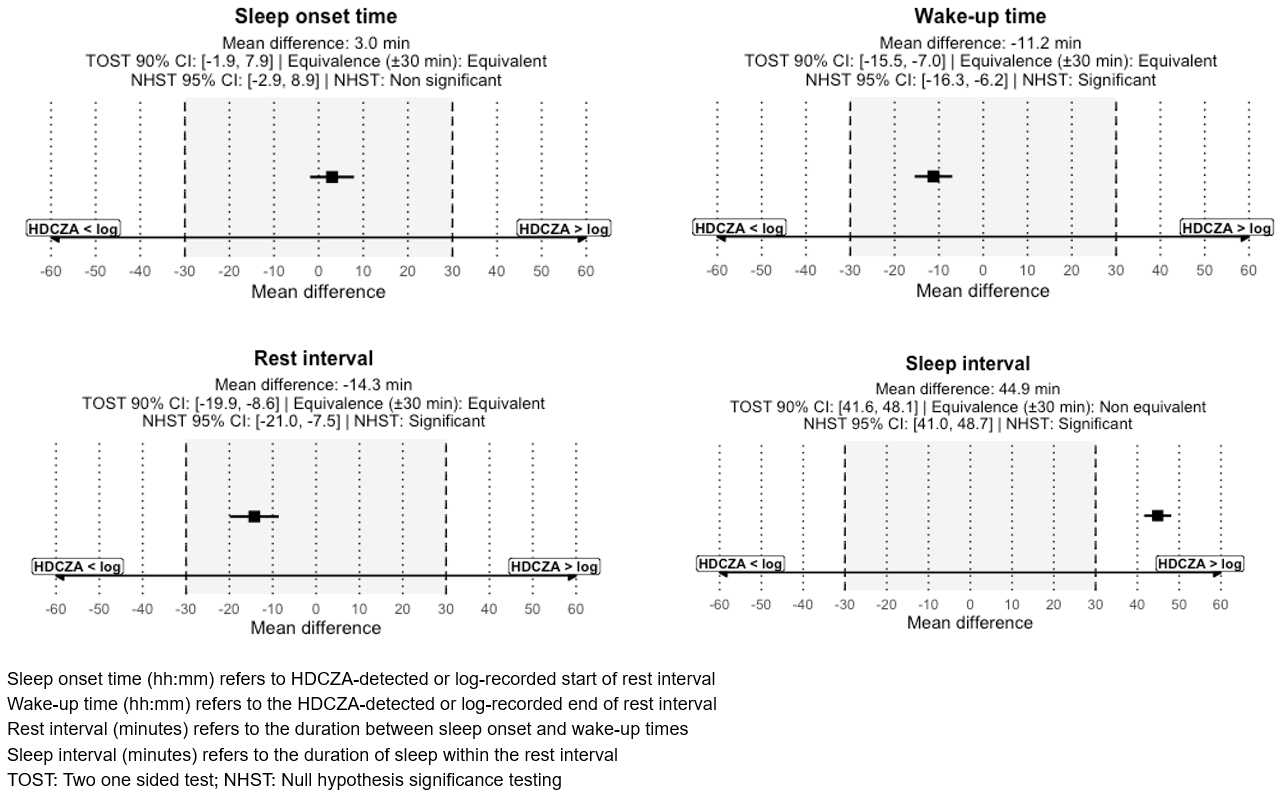
Abstract Body: Introduction: A best practice for sleep actigraphy assessment includes concurrent participant completion of a daily sleep log, which poses additional burden on both the participant (~3 minutes [min]/day) and research staff (~30 min/participant for data entry and verification steps). The Heuristic algorithm looking at the Distribution of Change in Z-angle (HDCZA), the default GGIR algorithm in R, estimates the rest interval by detecting sleep onset and wake-up times from raw acceleration data, without a sleep log. This study examined equivalence in HDCZA versus log-guided sleep parameters. Methods: Data are from an initial sub-set of 1,059 REGARDS 24H-ACT ancillary study participants (aged 77.7 + 6.9 years, 56.9% female, 23.2% Black, and 52.6% from the Stroke Belt region). Participants were asked to wear a GENEActiv device (Activinsights Ltd.; Kimbolton, UK) on their non-dominant wrist for 24 hours/day over 8 consecutive days. Raw acceleration data were processed in GGIR using HDCZA- and log-guided approaches. A set of primary sleep parameters, including sleep onset and wake-up times (hh:mm ± min; 24H time) and rest and sleep intervals (min), were averaged across nights and compared between the two scoring methods using paired t-tests and two one-sided equivalence tests with + 30 min equivalent zones. Results: The (mean ± standard deviation) sleep onset time was (HDCZA: 22:54 + 106.5 min vs log: 22:50 + 94.0 min), wake-up time was (HDCZA: 7:07 + 103.4 min vs log: 7:18 + 91.9 min), rest interval was (HDCZA: 493.5 + 101.2 min vs log: 507.7 + 88.6 min), and sleep interval was (HDCZA: 411.6 + 91.7 min vs log: 366.8 + 79.5 min). The mean difference in sleep onset time was statistically null; however, wake-up time, rest, and sleep interval durations significantly differed between the scoring methods (all p<0.001). The sleep interval duration was not statistically equivalent between scoring methods; however, the remaining sleep parameters were statistically equivalent within + 30 min (Figure). Conclusion: While statistical equivalence was found with some sleep parameters, the HDCZA method did not yield precise estimates for the sleep interval. Given the importance of accurate sleep interval estimation for public health recommendations and analytic techniques based on sleep duration (e.g., compositional data analysis), using only the HDCZA-detected method may lead to misclassification of overall sleep health.
Funding: RF1AG077707 and R01AG077707 (to KMD, KPG, and PP)
Hasan, Mehedi
(
University of Alabama at Birmingham
, Birmingham, Alabama , Alabama , United States )
Hornikel, Bjoern
(
University of Alabama at Birmingham
, Birmingham , Alabama , United States )
Dooley, Erin
(
University of Alabama at Birmingham
, Birmingham , Alabama , United States )
Boudreaux, Benjamin
(
Columbia University Irving Medical Center
, New York , New York , United States )
Howard, Virginia
(
University of Alabama at Birmingham
, Birmingham , Alabama , United States )
Judd, Suzanne
(
University of Alabama at Birmingham
, Birmingham , Alabama , United States )
Shechter, Ari
(
Columbia University Irving Medical Center
, New York , New York , United States )
Tiwari, Hemant
(
University of Alabama at Birmingham
, Birmingham , Alabama , United States )
Xu, Chang
(
Columbia University Irving Medical Center
, New York , New York , United States )
Palta, Priya
(
UNC Chapel Hill
, Chapel Hill , North Carolina , United States )
Diaz, Keith
(
Columbia University Irving Medical Center
, New York , New York , United States )
Gabriel, Kelley
(
University of Alabama at Birmingham
, Birmingham , Alabama , United States )