Potential overtreatment of older adults with diabetes and dementia: a real-world study
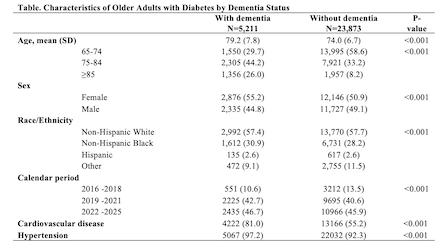
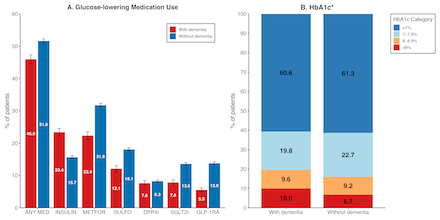
Abstract Body: Background Older adults with diabetes and dementia are at increased risk of hypoglycemia due to challenges in diabetes self-management, such as glucose monitoring and insulin dose adjustment. Clinical guidelines emphasize hypoglycemia prevention in this population including less stringent glycemic goals (e.g. hemoglobin A1c [HbA1c] <8%) and avoidance of high hypoglycemia risk medications (sulfonylureas and insulin). Understanding real-word patterns of glucose-lowering medication use and glycemic control among older adults with dementia can inform safe and effective care. Methods We conducted a cross-sectional study using electronic health record data from the Johns Hopkins Health System from July 2016 to February 2025. We included adults with diabetes who were newly diagnosed with dementia at age ≥65 years and a comparison group of adults aged ≥65 years with diabetes but without dementia. Using chi-squared test, we compared glucose-lowering medication use (any, insulin, metformin, sulfonylureas, dipeptidyl peptidase-4 inhibitors [DPP4i], sodium-glucose cotransporter 2 inhibitors [SGLT2i], and GLP-1 receptor agonists [GLP-1RA]) and HbA1c levels between people with and without dementia. Results Compared to those without dementia, patients with an incident dementia diagnosis were older (mean age 79.2 vs. 74.0 years) and more likely to have cardiovascular disease (81.0% vs. 55.2%) (Table). Patients with dementia were slightly less frequently on any glucose-lowering medication (46.0% vs. 51.6%, p<0.001) but more frequently on insulin (23.4% vs. 15.7%, p<0.001; Figure A). The use of metformin, sulfonylureas, SGLT2i and GLP1-RA was less common among patients with dementia. However, 22.4% of patients with dementia were on sulfonylureas. Overall, patients with dementia were more frequently on any high hypoglycemia risk medication (31.4% vs. 29.4%, p<0.001). Among patients with available HbA1c measurements (n=18,547; 63.7% of cohort), 60.6% patients with dementia and 61.3% of patients without dementia had HbA1c <7% (Figure B). Conclusions In this single health system study, many older adults with dementia were treated with glucose-lowering medications with a high risk for hypoglycemia and had stringent glycemic control. This pattern of care is inconsistent with clinical guidelines that recommend individualized, less stringent glycemic goals for this vulnerable population, highlighting the need to deintensify therapy and adopt less stringent glycemic goals.
He, Zixuan
(
Johns Hopkins University
, Baltimore , Maryland , United States )
Dun, Chen
(
Johns Hopkins University
, Baltimore , Maryland , United States )
Fang, Michael
(
Johns Hopkins University
, Baltimore , Maryland , United States )
Pilla, Scott
(
Johns Hopkins University
, Baltimore , Maryland , United States )
Echouffo, Justin
(
Johns Hopkins Hospital
, Baltimore , Maryland , United States )
Selvin, Elizabeth
(
Johns Hopkins University
, Baltimore , Maryland , United States )
Shin, Jung-im
(
Johns Hopkins University
, Baltimore , Maryland , United States )