
Logo

American Heart Association

  4
  0


Final ID: MPTU01

Utilization of Long-Term Ambulatory Continuous Electrocardiographic Monitoring Has Increased between 2009 and 2022 in the United States

Abstract Body: Introduction: Ambulatory continuous electrocardiographic (ECG) monitoring is commonly used to diagnose cardiac arrhythmias, assess arrhythmia burden, and evaluate cardiovascular therapeutic effectiveness. Novel ‘patch’ ECG monitors and mobile cardiac telemetry (MCT) facilitate long-term monitoring for 3 to 14 and 30 days respectively with greater user convenience compared to traditional lead-based Holter devices (<72 hours), although it is debated whether longer monitoring is cost-effective and improves health outcomes in different patients. We aimed to describe temporal trends and patterns of ambulatory continuous ECG monitor use in the United States.

Methods: We conducted a retrospective cohort study with integrated longitudinal electronic health record data from individuals in the general population who received health care across 340 sites in the All of Us Research Program in the United States. We examined trends in the utilization of ambulatory continuous ECG monitors and characteristics of incident users by device type between 2009 and 2022.

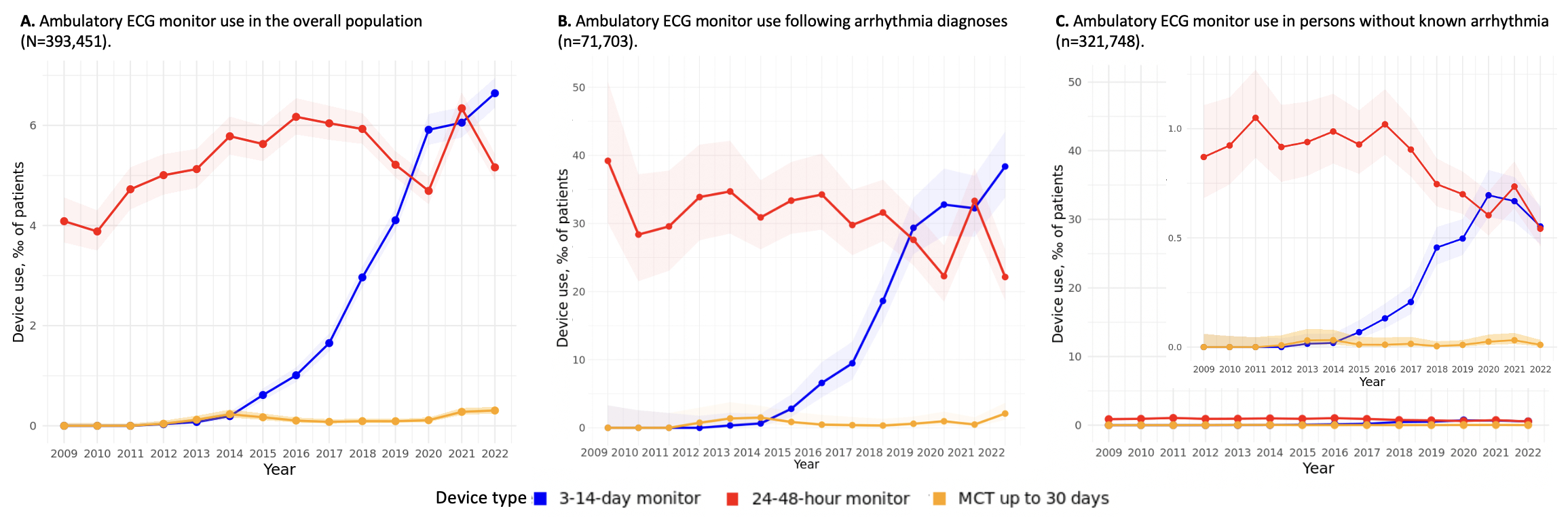
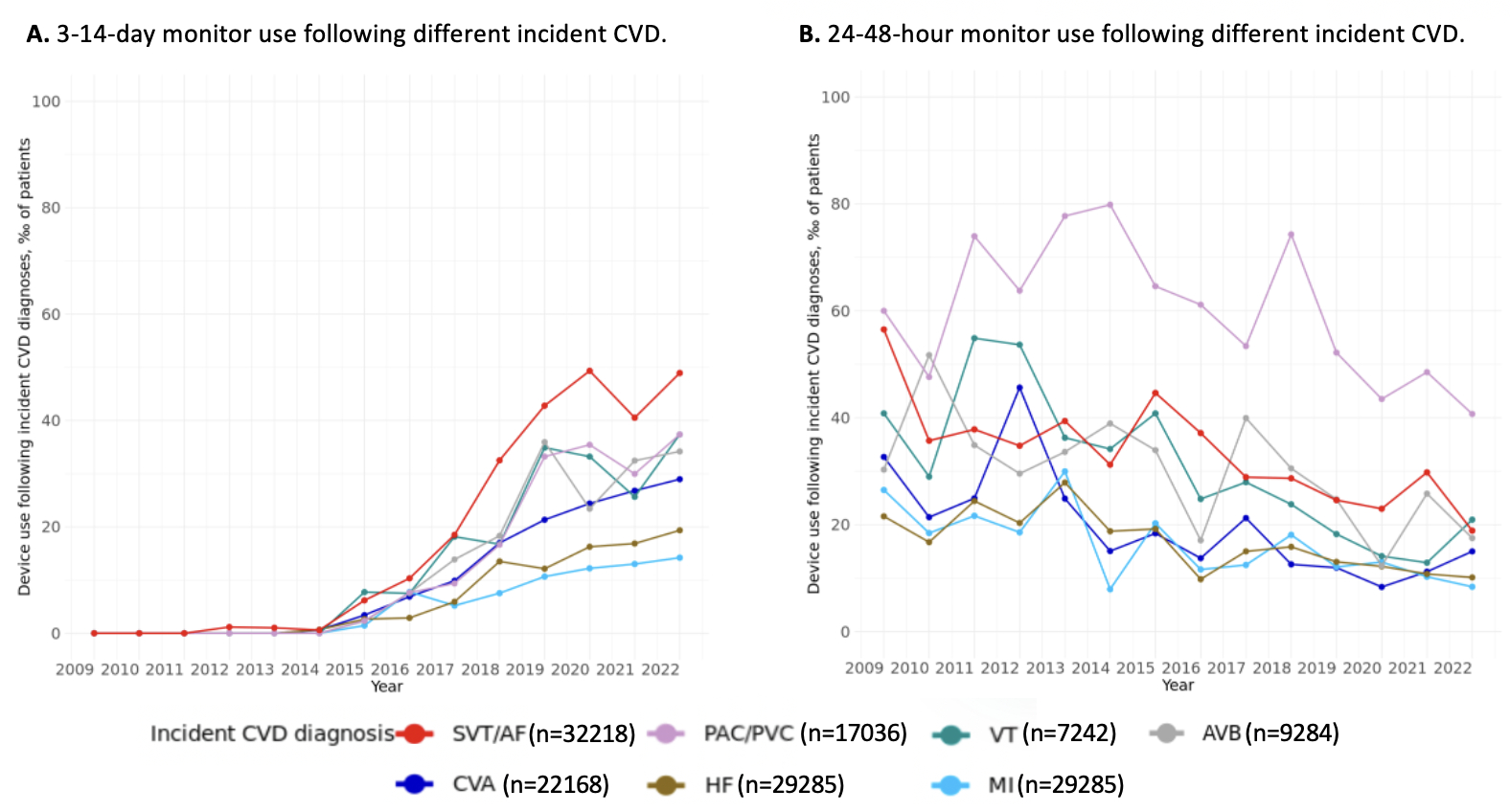
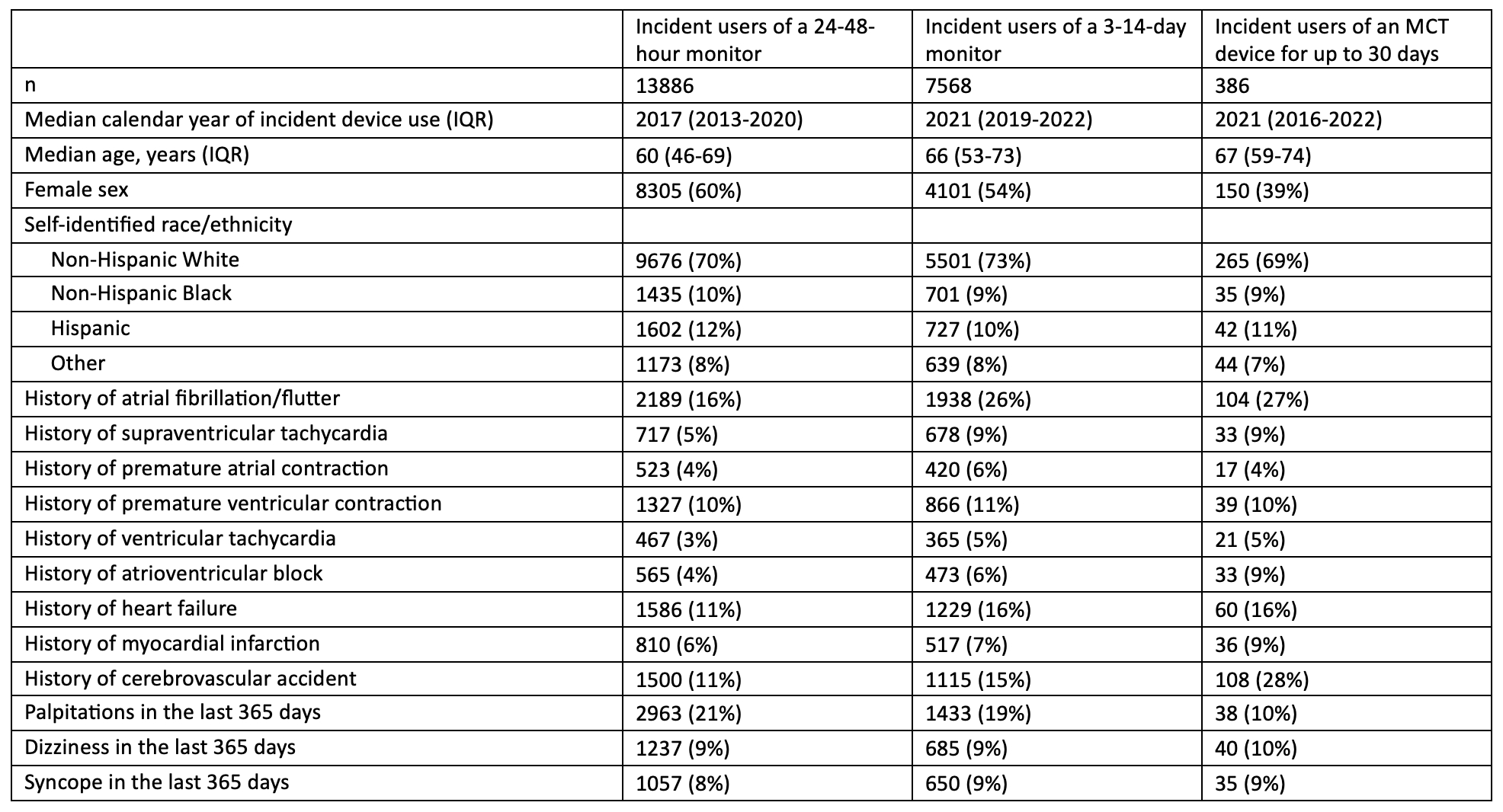
Results: Among 393,451 persons (mean age 52 years, 61% female, 53% White adults), the proportion with long-term 3-14-day monitor use following a clinical visit occurrence increased from 0 in 2009 to 6.6‰ in 2022 (ptrend<0.001), a trend that was consistent but more pronounced in those following incident arrhythmia diagnoses (up to 38‰ in 2022; n=71,703) compared to those without (Figure 1). The use of 24-48-hour monitors and MCTs was relatively unchanged during this time. Comparing between 13,886, 7,568, and 386 incident users of 24-48-hour, 3-14-day, and MCT monitors, respectively, 24-48-hour and 3-14-day monitor users more frequently had preceding palpitations, while MCT users more frequently had a history of cerebrovascular accident (Table 1). In subsets of patients with specific cardiovascular diseases, the increase in 3-14-day monitor use was most substantial following diagnoses of supraventricular tachyarrhythmias (up to 48‰ in 2022; Figure 2A). The use of 24-48-hour monitors decreased but was most common following diagnoses of premature beats (66‰ in 2009 to 41‰ in 2022; Figure 2B).

Conclusions: Long-term ambulatory ECG monitor use increased substantially from 0 in 2009 to 6.6‰ in 2022 in the United States general population due to the growth of 3-14-day monitoring likely from patch ECG device use. These findings highlight the importance of studies to further optimize long-term ambulatory ECG monitor use.
  • Luo, Shengyuan  ( Johns Hopkins University , Baltimore , Maryland , United States )
  • Minhas, Anum  ( Johns Hopkins University , Baltimore , Maryland , United States )
  • Fang, Michael  ( Johns Hopkins University , Baltimore , Maryland , United States )
  • Zeger, Scott  ( Johns Hopkins University , Baltimore , Maryland , United States )
  • Chen, Lin Yee  ( UNIVERSITY OF MINNESOTA , Minneapolis , Minnesota , United States )
  • Selvin, Elizabeth  ( Johns Hopkins University , Baltimore , Maryland , United States )
  • Shin, Jung-im  ( Johns Hopkins University , Baltimore , Maryland , United States )
  • Author Disclosures:
Meeting Info:

EPI-Lifestyle Scientific Sessions 2026

2026

Boston, Massachusetts

Session Info:

Heath Tech/Big Data/Machine Learning/AI + Mobile Health Tech and Wearables

Tuesday, 03/17/2026 , 05:00PM - 07:00PM

Moderated Poster Session

More abstracts on this topic:
A Novel ECG Time-Frequency Eyeball Method for Robust Detection of Myocardial Infarction from Single-Channel ECG: A Preclinical Study

Alavi Rashid, Li Jiajun, Dai Wangde, Matthews Ray, Pahlevan Niema, Kloner Robert, Gharib Morteza

Association Between Prescription Fill Rates and Adverse Outcomes within an mHealth Clinical Trial Designed to Improve Medication Adherence

Asmuth Mallette, Orlando Steven, Saseen Joseph, Blankenhorn Richard, Bull Sheana, Ho Michael, Hosokawa Patrick, Allen Larry, Peterson Pamela, Plomondon Mary, Caputo Sandy Lisa, Vaughn Shawni, Waughtal Joy, Marrs Joel

More abstracts from these authors:
Trends and Disparities in Self-Reported Health Among US Adults with Diabetes: NHANES 2001-2018

Ali Ibrahim, Fang Michael, Selvin Elizabeth, Shin Jung-im

Episodes of Higher Glucose Are Associated with Paroxysmal Atrial Fibrillation Occurrences During Continuous Glucose and Heart Rhythm Monitoring in Older Adults with Diabetes: the Atherosclerosis Risk in Communities (ARIC) Study

Luo Shengyuan, Echouffo Justin, Zeger Scott, Chen Lin Yee, Selvin Elizabeth, Sartini Joseph, Wang Dan, Rooney Mary, Shin Jung-im, Wallace Amelia, Minhas Anum, Soliman Elsayed, Lutsey Pamela

You have to be authorized to contact abstract author. Please, Login
Not Available