Assessment of the Sarcopenia Index for Detecting Sarcopenia in the REasons for Geographic And Racial Differences in Stroke (REGARDS) Study
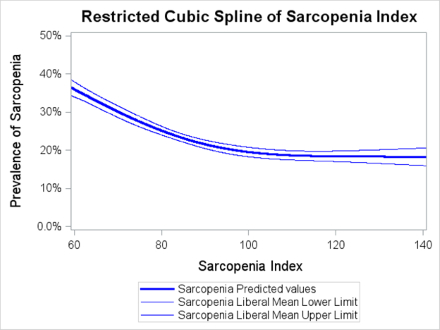
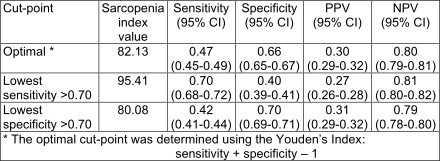
Abstract Body: Introduction: Sarcopenia is the age-related loss of muscle mass, strength, and function, and is a risk factor for cardiovascular disease, all-cause mortality, and reduced quality of life. The Sarcopenia Index (serum creatinine/cystatin C × 100) is a proposed biomarker for diagnosis and severity assessment, with lower values indicating a greater likelihood of sarcopenia. However, most studies on the Sarcopenia Index investigated hospitalized patients, with limited data from the general population. Research Question: What is the performance of the Sarcopenia Index for identifying sarcopenia among adults aged ≥50 in the general population? Methods: We analyzed Black and white REGARDS study participants aged ≥50 years without stroke, leg amputation, and not on dialysis. Sarcopenia was defined according to the 2016 Sarcopenia Definition on Outcome Consortium recommendation: low muscle strength (5-repetition chair stand test <15 sec) and low physical function (4-meter gait speed <0.8 m/s). We estimated the Sarcopenia Index’s c-index, and the sensitivity, specificity, positive predictive value (PPV), and negative predictive value (NPV) at three cut-points: optimal (Youden’s Index), lowest sensitivity >0.70, and lowest specificity >0.70. Results: Among 11,000 participants (mean age 78±8), 34% were Black and 55% were women. Sarcopenia prevalence was 24% overall, increasing with age (50–65: 16%, 66–79: 23%, ≥80: 36%), and was 33% in Black women, 27% in Black men, 23% in White women, and 18% in White men. The median (25th–75th percentile) Sarcopenia Index was 89 (76 –104). A spline analysis showed that sarcopenia’s prevalence was flat above Sarcopenia Index values of 100 but increased as values declined below this threshold (Figure 1). The c-index for identifying sarcopenia was 0.58 (95% CI: 0.57–0.59). Table 1 shows performance metrics at the three cut-points. In race-gender subgroups, the c-index ranged from 0.57 (Black men) to 0.61 (White women). In a sensitivity analysis of participants aged ≥65 years with Medicare and no claims for osteoarthrosis (n=2,201), the c-index was 0.58 (95% CI: 0.55–0.61). Limitation: Muscle mass measurements are unavailable in REGARDS. Conclusion: The Sarcopenia Index showed modest ability to distinguish between individuals with and without sarcopenia, defined by muscle strength and physical function. While limited for clinical use, it may be useful in epidemiologic studies where direct measures are unavailable.
Alanaeme, Chibuike
(
The University of Alabama at Birmingham
, Birmingham , Alabama , United States )
Huang, Lei
(
The University of Alabama at Birmingham
, Birmingham , Alabama , United States )
Levitan, Emily
(
UNIVERSITY ALABAMA AT BIRMINGHAM
, Birmingham , Alabama , United States )
Bowling, Barrett
(
Durham Veterans Affairs Medical Center (VAMC)
, Durham , North Carolina , United States )
Buford, Thomas
(
University of Alabama at Birmingham
, Birmingham , Alabama , United States )
Gutierrez, Orlando
(
UNIVERSITY OF ALABAMA AT BIRMINGHAM
, Hoover , Alabama , United States )
Safford, Monika
(
WEILL CORNELL MEDICINE
, New York , New York , United States )
Potok, O. Alison
(
UC San Diego
, San Diego , California , United States )
Colantonio, Lisandro
(
UNIVERSITY OF ALABAMA AT BIRMINGHAM
, Birmingham , Alabama , United States )