
Logo

American Heart Association

  4
  0


Final ID: MPWE25

Clinical Predictors of Future Cardiovascular Disease at the Initiation of Prenatal Care

Abstract Body: Introduction: Identifying cardiovascular disease (CVD) risk in adults under age 50 remains an unmet need. Pregnancy offers a unique opportunity to identify CVD risk given high health care engagement and frequent medical follow-up. We aimed to develop a prediction model for long-term CVD risk using clinical factors that can be ascertained at prenatal care initiation.
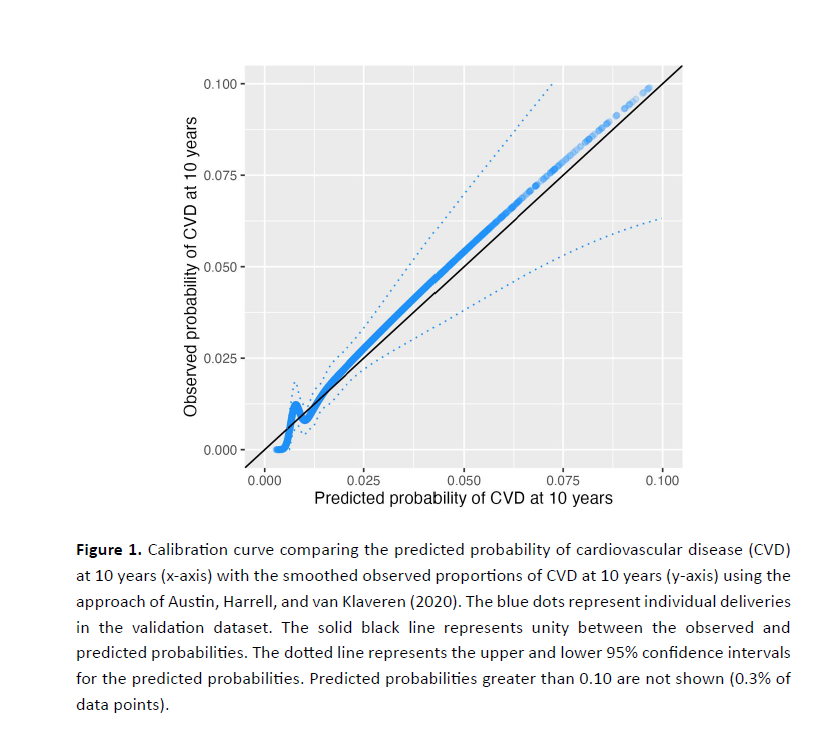
Methods: We conducted a retrospective study in an electronic health record-based pregnancy cohort from a single institution. We included singleton pregnancies from individuals aged ≥18 years who delivered between 1998 and 2016, had ≥3 months of postpartum follow-up data, and were free of CVD before pregnancy. We split the cohort into training (60%) and validation (40%) sets. We used Cox regression to model time from delivery to diagnosis of CVD, with censoring at the last non-obstetric encounter, the next delivery, or 12/31/2024. We identified CVD using diagnostic codes for atherosclerotic CVD and heart failure. Predictors were adapted from the PREVENT equations and included universally available factors at initiation of prenatal care: age (years), pre-pregnancy diabetes, pre-pregnancy hypertension (HTN), pre-pregnancy smoking, 1st trimester body mass index (kg/m2) and systolic blood pressure (mmHg), and the social deprivation index. We used time-varying predictors to account for multiple pregnancies per individual. We assessed model performance using the C-statistic, smoothed calibration curves and the integrated calibration index (an index = 0 indicates perfect calibration) at 10 years.
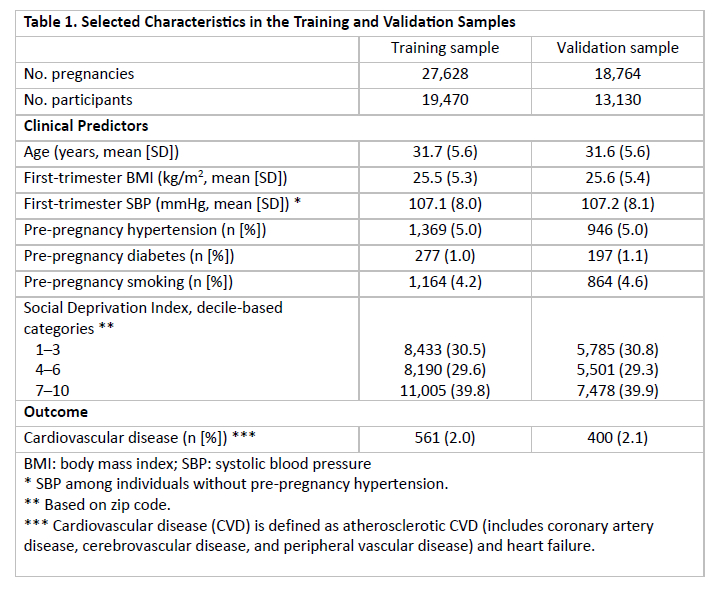
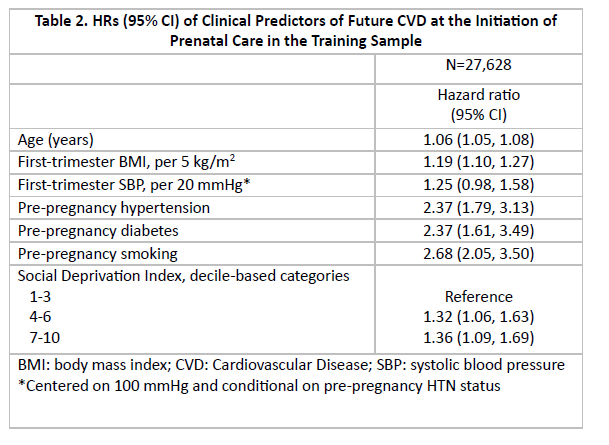
Results: We included 46,392 pregnancies from 32,600 individuals (Table 1). Participants had a mean (SD) age at delivery of 31.6 (5.6) years. Over a median (IQR) of 7.3 (2.4, 13.6) years, 2.1% of individuals overall (n=561 [training], n=400 [validation]) experienced CVD. Hazard ratios for CVD for each of the predictors are given in Table 2. In the validation dataset, the model had a C-statistic of 0.668, indicating moderate discrimination. The model demonstrated excellent calibration, with an integrated calibration index of 0.00197 (Figure 1).
Conclusions: A prediction model based on clinical factors routinely available at the initiation of prenatal care demonstrated moderate discrimination and excellent calibration in predicting 10-year CVD risk.
  • Soria-contreras, Diana  ( Massachusetts General Hospital , Boston , Massachusetts , United States )
  • Thaweethai, Tanayott  ( Massachusetts General Hospital , Boston , Massachusetts , United States )
  • Pant, Deepti  ( Massachusetts General Hospital , Boston , Massachusetts , United States )
  • Hsu, Sarah  ( Massachusetts General Hospital , Boston , Massachusetts , United States )
  • Chambers, Brianna  ( Massachusetts General Hospital , Boston , Massachusetts , United States )
  • Escobar-tomlienovich, Carla  ( Massachusetts General Hospital , Boston , Massachusetts , United States )
  • James, Kaitlyn  ( Massachusetts General Hospital , Boston , Massachusetts , United States )
  • Honigberg, Michael  ( Massachusetts General Hospital , Boston , Massachusetts , United States )
  • Powe, Camille  ( Massachusetts General Hospital , Boston , Massachusetts , United States )
  • Author Disclosures:
Meeting Info:

EPI-Lifestyle Scientific Sessions 2026

2026

Boston, Massachusetts

Session Info:

Pregnancy and Women's Health

Wednesday, 03/18/2026 , 05:00PM - 07:00PM

Moderated Poster Session

More abstracts on this topic:
Adverse Pregnancy Outcomes and Cardiovascular Disease Risk: Insights from the All of Us Research Program

Renedo Daniela, Schwamm Lee, Kamel Hooman, Matouk Charles, Tal Reshef, Sheth Kevin, Falcone Guido, Chaves-rivera Maria Natalia, Rivier Cyprien, Koo Andrew, Clocchiatti-tuozzo Santiago, Huo Shufan, Sujijantarat Nanthiya, Torres Lopez Victor, Hebert Ryan

A Machine Learning Approach to Simplify Risk Stratification of Patients with Atherosclerotic Cardiovascular Disease

Li Hsin Fang, Gluckman Ty, Nute Andrew, Weerasinghe Roshanthi, Wendt Staci, Wilson Eleni, Sidelnikov Eduard, Kathe Niranjan, Swihart Charissa, Jones Laney

More abstracts from these authors:
Higher Gestational Weight Gain Is Associated With A Lower Risk Of Incident Diabetes

Chambers Brianna, Soria-contreras Diana, Pant Deepti, Hsu Sarah, Maya Jacqueline, Thaweethai Tanayott, Powe Camille

The Impact of Glucose Intolerance in Pregnancy

Powe Camille, Venkatesh Karthik, Michos Erin

You have to be authorized to contact abstract author. Please, Login
Not Available