Age-stratified Monogenic and Polygenic Contributions for Atrial Fibrillation in the All of Us Research Program
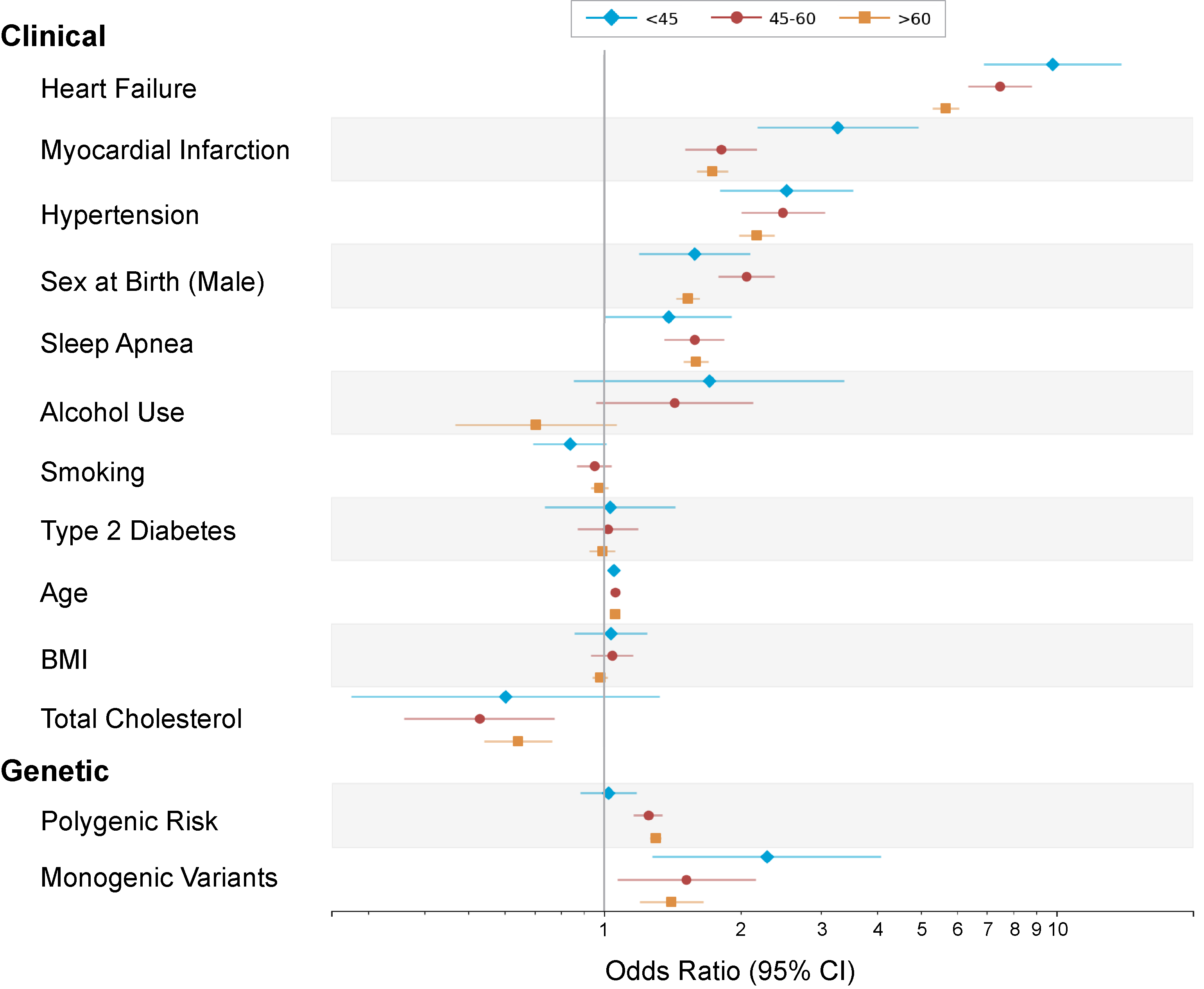
Abstract Body (Do not enter title and authors here): Background: Rare and common genetic variation both contribute to atrial fibrillation (AF), but the effects may not be uniform across ages. The All of Us Research Program contains whole-genome sequencing of 100,574 adult participants with electronic health records. Hypothesis: Rare genetic variants are associated with early-onset AF; common genetic variants are associated with late-onset AF. Aims: To quantify the diagnostic yield provided by rare and common genetic variation in AF across age. Methods: The clinical, monogenic, and polygenic contributions to AF were assessed in a cross-sectional group of participants in the NIH-funded All of Us Research Program, stratified by three age groups: <45 years (n=22,290), 45-60 years (n= 26,805), >60 years (n=51,659). Variant discovery was performed for pathogenic or likely pathogenic (P/LP) variants among 145 candidate cardiac genes with dominant inheritance for cardiomyopathy and arrhythmia. A previously established polygenic risk score (PRS) was calculated. After adjusting for known clinical factors, multivariable analysis quantified the associations between monogenic and polygenic factors versus AF status in each age group. Results: There were 100,574 participants: 7,811 with AF and 92,763 without AF. The presence of ≥1 P/LP variant(s) were associated with AF across all age groups, with stronger associations in the age <45 group (OR 2.3 [95% CI 1.4-4.1]) compared older groups (OR 1.5 [95% CI 1.1-2.1] in age 45-60, and OR 1.4 [95% CI 1.2-1.7] in age >60). In contrast, PRS was not associated with AF in participants <45 years (OR 1.02 [95% CI 0.88-1.17]) but was associated with AF in the older groups: OR 1.54 [95% CI 1.31-1.80] in age 45-60 and OR 1.49 [95% CI 1.40-1.59] for age >60. Overall, clinical risk factors are highly associated with AF (AUC 0.84 [0.83-0.85]); adding polygenic and monogenic factors contribute only marginal improvement (AUC 0.86 [0.85-0.87]). Conclusion: In this cross-sectional dataset, monogenic and polygenic factors have opposite associations with AF. Monogenic variants are associated with early-onset AF, whereas PRS has no association with AF at younger ages. Clinical risk factors continue to explain the majority of the variation in AF status.
Chen, Zhanlin
(
Northwestern University Feinberg School of Medicine
, Chicago , Illinois , United States )
Gordon, Adam
(
Northwestern University Feinberg School of Medicine
, Chicago , Illinois , United States )
Webster, Gregory
(
Northwestern University Feinberg School of Medicine
, Chicago , Illinois , United States )
Author Disclosures:
Zhanlin Chen:DO NOT have relevant financial relationships
| Adam Gordon:No Answer
| Gregory Webster:DO NOT have relevant financial relationships