A multi-state Causal Framework to Estimate the Effects of Treatment Regimes over the Course of Heart Disease
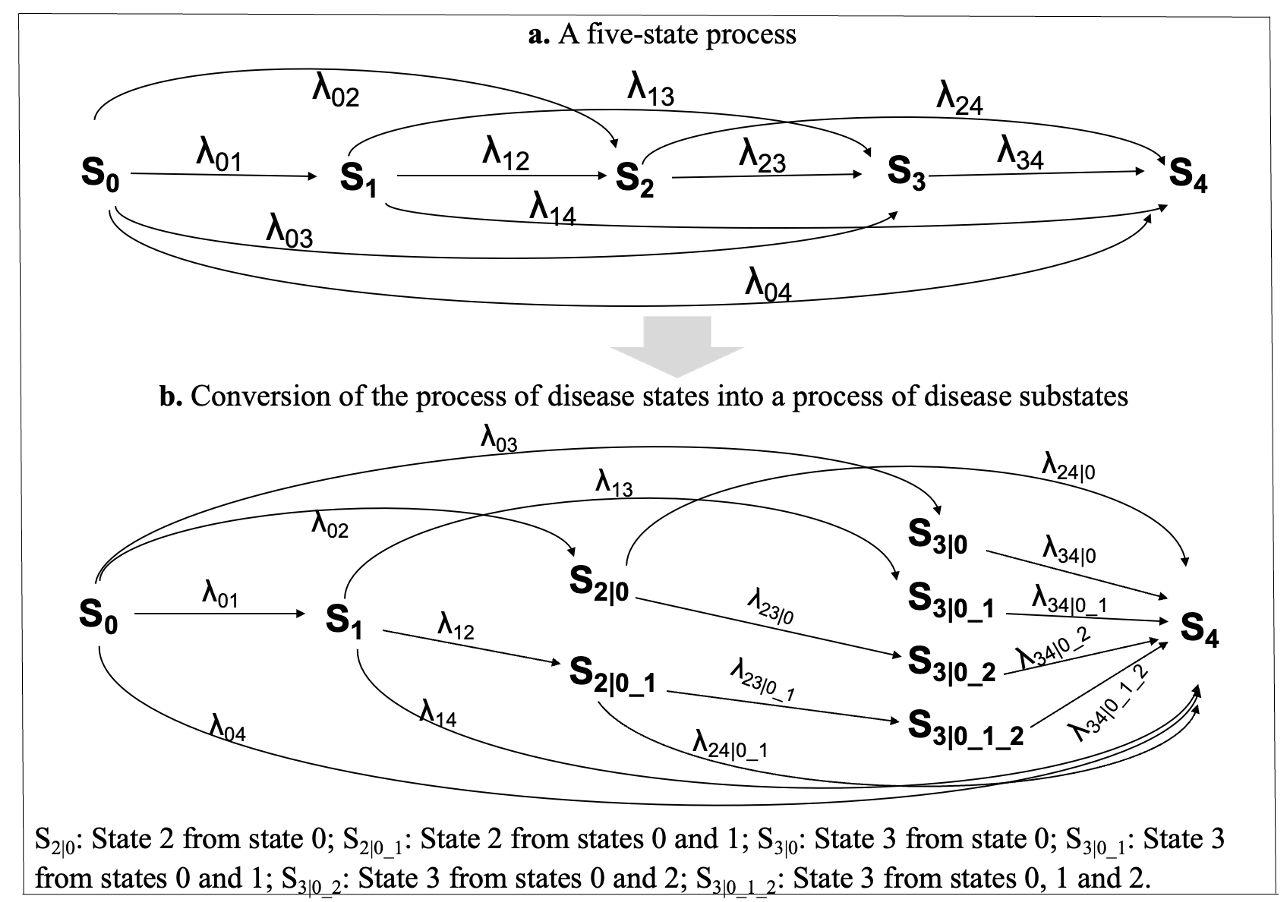
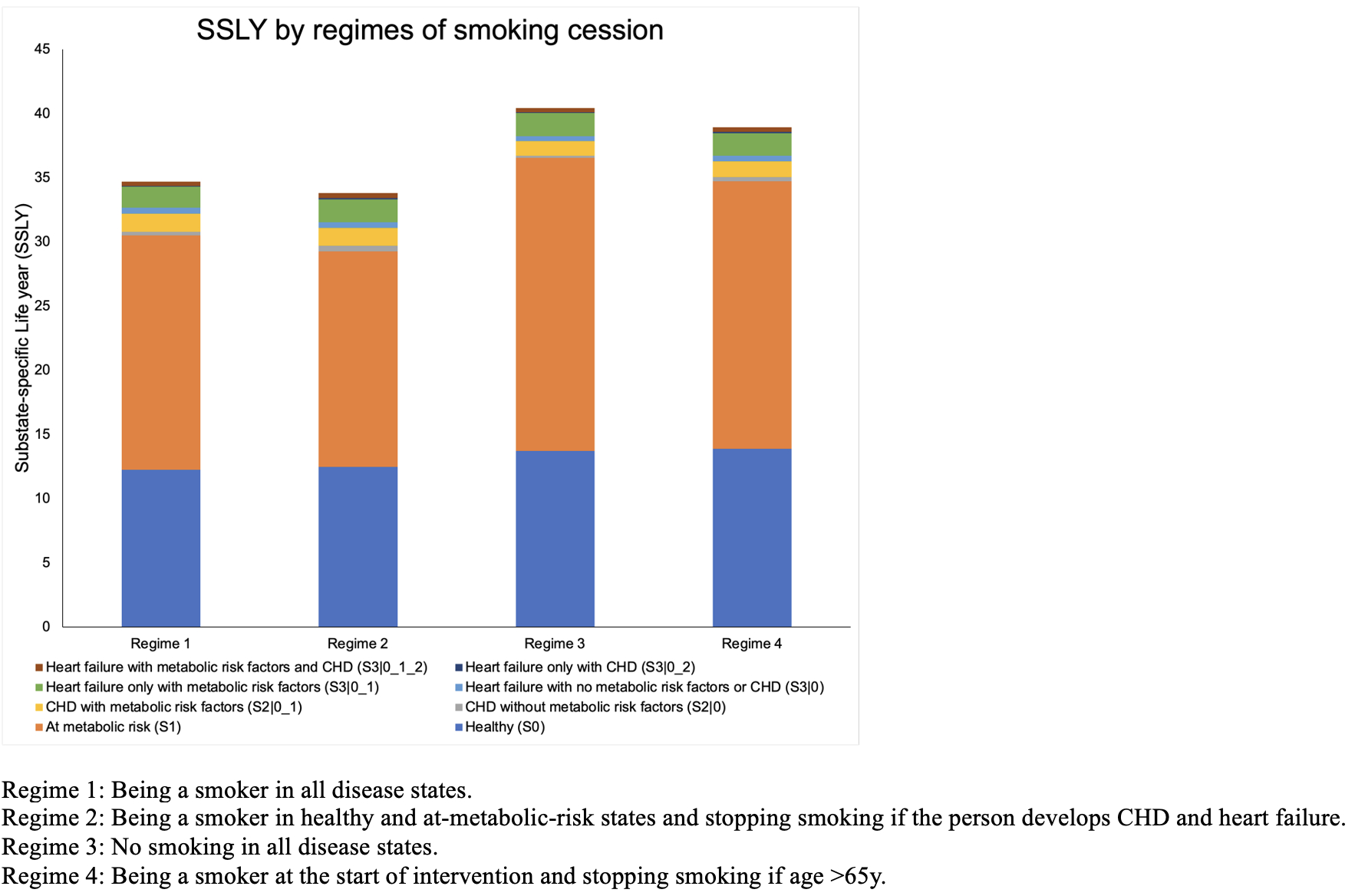
Abstract Body: The development of chronic disease is a long-term process that involves multiple endpoints, and limited methods can assess the health benefits of a treatment regime over the disease course. Existing multi-state Cox models estimate survival risks by state over time, which are difficult to use when comparing the effectiveness of treatment regimes. We have proposed a discrete-time split-state framework [1], which divides disease states into substates by conditioning on past history. As this framework is both “memoryless” and “memorable”, the time-specific transition parameters can be synthesized into summary measures, substate-specific life year (SSLY), multimorbidity-adjusted life year (MALY), and disease path [2]. In this abstract, based on this framework, we propose to investigate the causal effects of static and dynamic treatment regimes on health benefits over the entire disease course, under the assumptions of constant confounders from baseline and instantaneous effects of interventions on transition rates. Our method can identify the optimal treatment regime that generates the most benefits using MALY, and illustrate the mechanisms of treatment regimes affecting disease progression using SSLY and disease path.
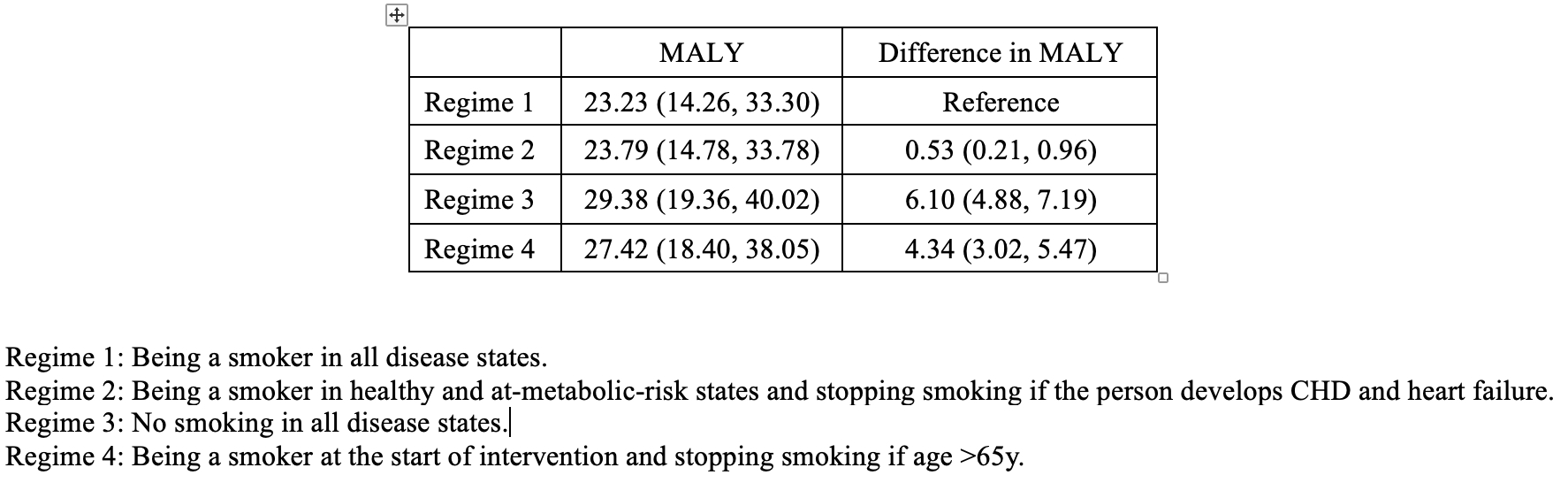
In the application, we evaluated the cardiovascular benefits of smoking cessation, where the course of heart disease was modeled in healthy (S0), at metabolic risk (S1), coronary heart disease (S2), heart failure (S3), and mortality states (S4). Compared to the regime “being a smoker in S0-S4”, the MALY was 0.53 (95% CI: 0.21, 0.96), 6.10 (4.88, 7.19), and 4.34 (3.02, 5.47) years higher for the regimes “being a smoker in S0 and S1 and stop smoking if a person develops S2, S3, or S4”, “no smoking in S0-S4”, and “being a smoker at the start of intervention and stop smoking if age>65y”, respectively. In summary, our method can evaluate the health benefits of treatment regimes over the disease course, and has the potential to improve the precision prevention of chronic disease. A preprint of this manuscript can be found online [3].
[1] Ding, Chen, Lin. BMC Med Res Methodol. 2025;25(1):54. [2] Ding, Lin, Meyer. doi: https://doi.org/10.1101/2024.09.18.24313882 (BMC Med Res Methodol. In revision) [3] Ding. medRxiv. doi: https://doi.org/10.1101/2025.07.25.25332203 (Stat Methods Med Res. In revision)
Ding, Ming
(
University of North Carolina
, Chapel Hill , North Carolina , United States )
Jiang Chao, Dong Jianzeng, Cai Jun, Anderson Craig, Du Xin, Tang Yangyang, Han Rong, Song Yanna, Wang Chi, Lin Xiaolei, Yi Yang, Rodgers Anthony, Ma Changsheng