Logo

American Heart Association

  6
  0


Final ID: TU118

Longitudinal Trajectories of Kidney Function in Heart Failure: A community study

Abstract Body: Introduction
Chronic kidney disease affects nearly half of heart failure (HF) patients, underscoring the importance of regular kidney function monitoring. However, longitudinal trajectories of kidney function in HF are not well characterized. Identifying clinical factors linked to long-term changes is critical for improving monitoring and informing early clinical decisions.
Hypothesis
We hypothesized that longitudinal kidney function and its associations with clinical variables in HF patients differ from that of demographically similar comparators from the same community.
Methods
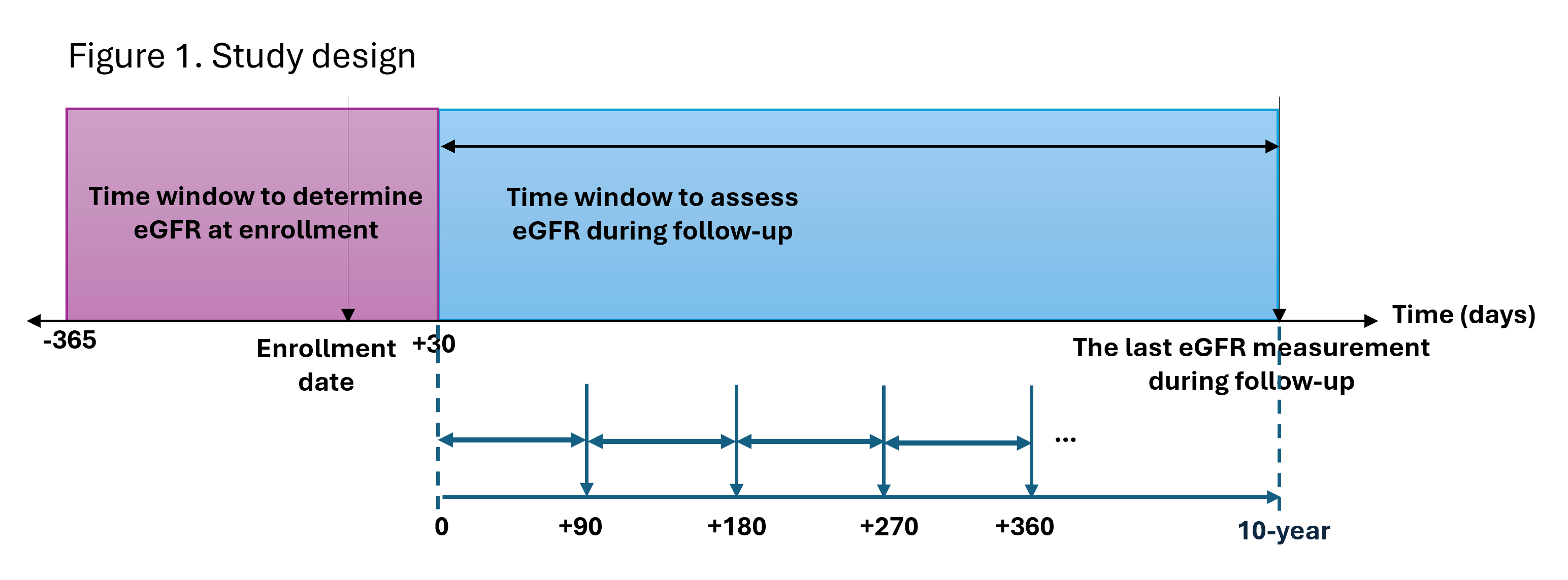
We analyzed patients with validated HF from a community-based cohort and comparators individually matched to age and sex selected from participants in the Mayo Clinic Biobank cohort. Individuals with end-stage kidney disease, dialysis or kidney transplantation prior to enrollment were excluded. Serum creatinine-based estimated glomerular filtration rate (eGFR) from outpatient and inpatient visits was assessed from enrollment for up to 10 years of follow-up. The median of eGFR for 90-day intervals was used to estimate the follow-up eGFR (Figure 1). We modeled percentage change from baseline and fit linear mixed-effect models with time, HF status, and their interaction to test whether the eGFR trajectories differed between the two groups. In addition, we examined the association between eGFR trajectories and clinical variables.
Results
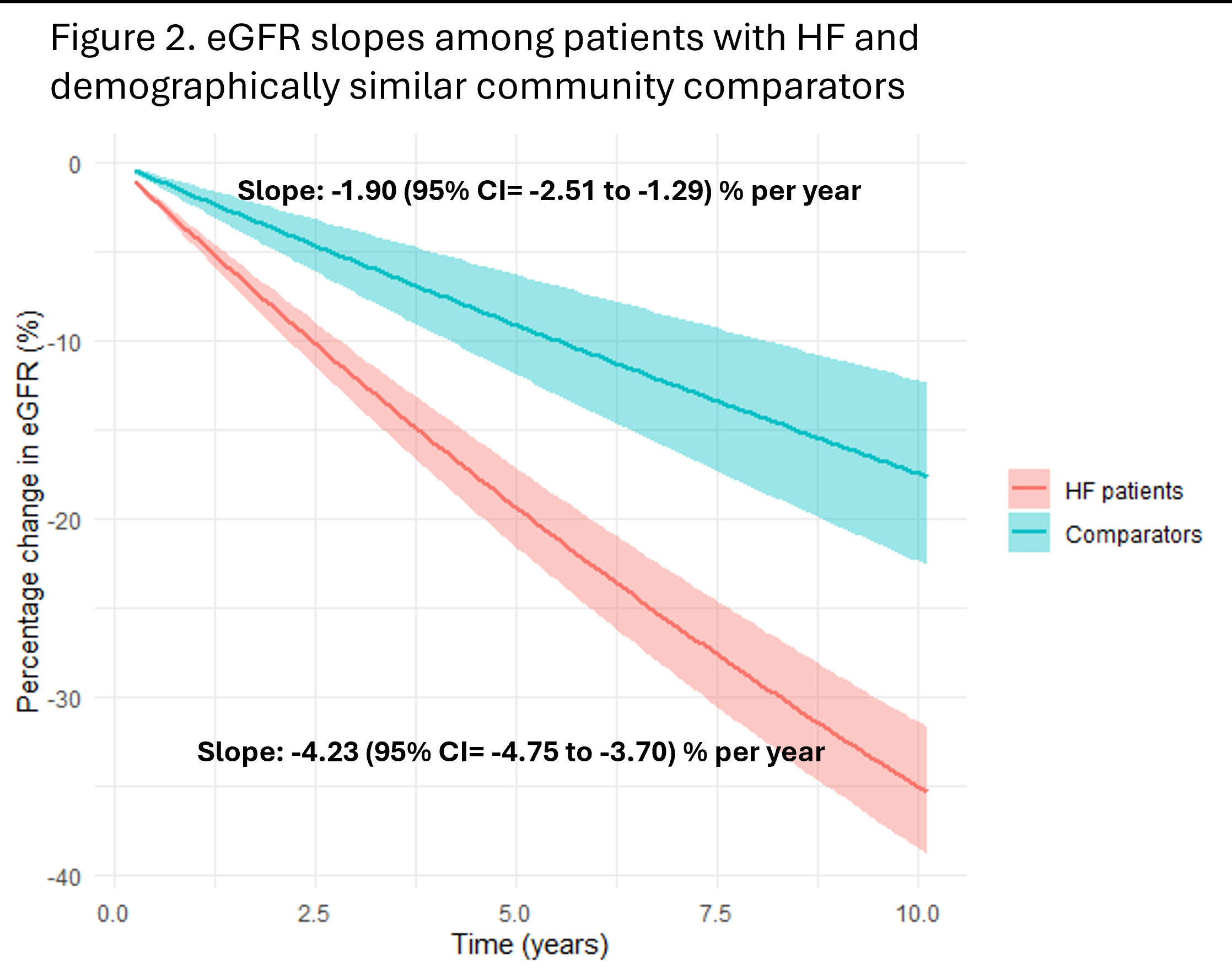
We studied 1182 HF patients and 825 comparators with at least three eGFR measurements. Median follow-up was 5 years (IQR: 3-10) for HF patients and 8 years (6-9) for comparators. In total, 16245 serum creatinine measurements from HF patients and 9858 from comparators were analyzed. Median age at enrollment was 76 years (67-84) for HF patients and 78 years (70-83) for comparators. A greater decline in percentage change in eGFR was observed in HF patients (-4.23%, 95% CI: -4.75 to -3.70% per year) than in comparators (-1.90%, 95% CI: -2.51 to -1.29% per year; P<0.001, Figure 2). Among HF patients, the decline in percentage change in eGFR was greater in the presence of diabetes, hyperlipidemia, or a higher comorbidity burden.
Conclusions
In this community study, HF patients exhibited a greater percentage decline in eGFR compared to community comparators. Among HF patients, eGFR decline was more strongly associated with comorbidities—particularly metabolic risk factors—highlighting the relevance of the cardiovascular-kidney-metabolic syndrome in HF.
  • Kim, Ji-eun  ( NIH , Bethesda , Maryland , United States )
  • Joo, Jungnam  ( National Institutes of Health , Rockville , Maryland , United States )
  • Ganguli, Anirban  ( NIH , Bethesda , Maryland , United States )
  • Bielinski, Suzette  ( MAYO CLINIC , Rochester , Minnesota , United States )
  • Chamberlain, Alanna  ( MAYO CLINIC , Rochester , Minnesota , United States )
  • Shearer, Joe  ( NHLBI , Bethesda , Maryland , United States )
  • Roger, Veronique  ( NIH , Bethesda , Maryland , United States )
  • Author Disclosures:
Meeting Info:

EPI-Lifestyle Scientific Sessions 2026

2026

Boston, Massachusetts

Session Info:

Poster Session 1

Tuesday, 03/17/2026 , 05:00PM - 07:00PM

Poster Session

More abstracts from these authors:
A Scoping Review Exploring Cardiovascular Risk and Health Metrics and Cancer Prediction

Kim Ji-eun, Henriquez Santos Gretell, Kumar Sant, Livinski Alicia, Vo Jacqueline, Joo Jungnam, Shearer Joe, Hashemian Maryam, Roger Veronique

Unsupervised clustering analysis of large-scale proteomics data identifies molecular phenogroups of heart failure in a population-based cohort

Downie Carolina, Shearer Joe, Kuku Kayode, Hashemian Maryam, Bielinski Suzette, Joo Jungnam, Roger Veronique

You have to be authorized to contact abstract author. Please, Login
Not Available