
A soluble guanylate cyclase stimulator improves survival in a rat model of heart failure with reduced ejection fraction and chronic kidney disease induced by aorto-caval fistula and 5/6 nephrectomy
Abstract Body: Background New therapeutic strategies for heart failure (HF) combined with chronic kidney disease (CKD) are needed, and the current knowledge suggests that targeting the NO/sGC/cGMP pathway could be a promising approach.
Purpose We hypothesised that chronic soluble guanylate cyclase (sGC) stimulation would attenuate the course of rodent HFrEF induced by volume overload due to aorto-caval fistula (ACF) combined with CKD caused by 5/6 nephrectomy (5/6 Nx).
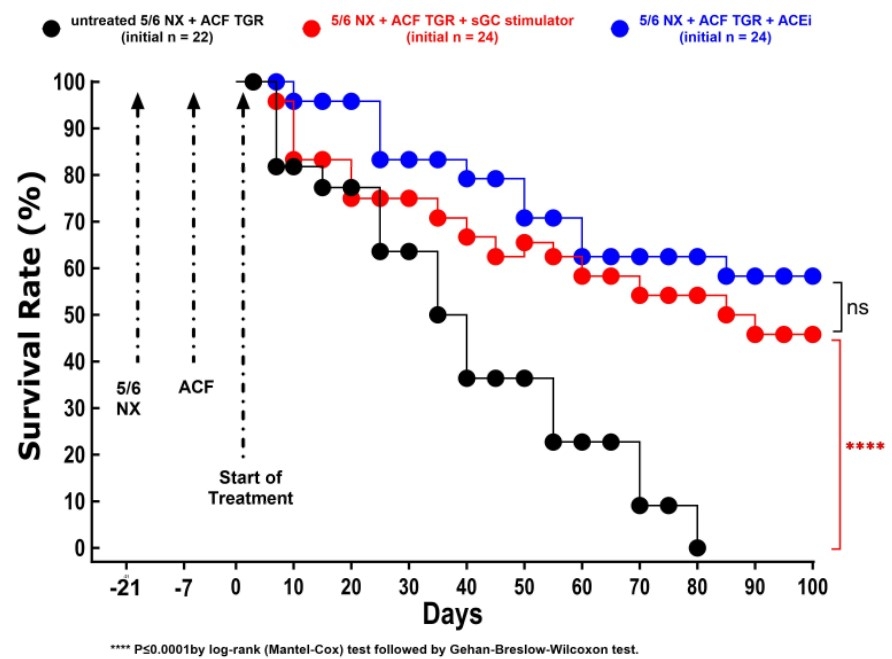
Methods 5/6 Nx was performed in Ren-2 transgenic rats (TGR), a model of angiotensin II-dependent hypertension, at the animal age of 8 weeks. One week later, ACF was created; another two weeks later, the animals were randomly divided into three groups, and the therapy was started: sGC stimulation with BAY-41-8543 (sGC stim.) (3 mg.kg-1.day-1 in food, n = 24), angiotensin-converting enzyme inhibitor (ACEi) (trandolapril, 2 mg.L-1 in drinking water, n = 24), or placebo (n = 22). Sham-operated TGR represented a control group (n = 8). The follow-up period was 20 weeks. GraphPad Prism 10 was used for statistical analysis with a log-rank (Mantel-Cox) test to analyse survival data. Results All sham-operated rats survived till the end of the study. On the contrary, all untreated HF+CKD rats died by week 12. The treatment with the sGC stim. or with ACEi similarly improved the survival rate: 46 % in sGC stim. group (p < 0,0001 vs. placebo) and 58 % in the ACEi group (p < 0,0001 vs. placebo) (Figure 1). Conclusion(s) Our results indicate that in the ACF-5/6Nx TGR animal model of combined heart failure (HF) and chronic kidney disease (CKD), treatment with an sGC stimulator reduces mortality to a similar extent as ACE inhibitor (ACEi) monotherapy compared to placebo. Further preclinical research is needed to better understand the NO/sGC/cGMP pathway in HF with concurrent CKD.
Kala, Petr
( IKEM - Center of Experimental Med
, Prague
, Czechia
)
Miklovic, Matus
( IKEM - Center of Experimental Med
, Prague
, Czechia
)
Molnar, Matej
( IKEM - Center of Experimental Med
, Prague
, Czechia
)
Mikula, Jan
( IKEM - Center of Experimental Med
, Prague
, Czechia
)
Skaroupkova, Petra
( IKEM - Center of Experimental Med
, Prague
, Czechia
)
Gawrys, Olga
( IKEM - Center of Experimental Med
, Prague
, Czechia
)
Ostadal, Petr
( University Hospital Motol
, Prague
, Czechia
)
Melenovsky, Vojtech
( IKEM - Center of Experimental Med
, Prague
, Czechia
)
Cervenka, Ludek
( IKEM - Center of Experimental Med
, Prague
, Czechia
)
Author Disclosures:
Petr Kala:DO NOT have relevant financial relationships
| Matus Miklovic:DO NOT have relevant financial relationships
| Matej Molnar:No Answer
| Jan Mikula:DO NOT have relevant financial relationships
| Petra Skaroupkova:No Answer
| Olga Gawrys:No Answer
| Petr Ostadal:DO have relevant financial relationships
;
Speaker:Abiomed:Active (exists now)
; Speaker:Zentiva:Past (completed)
; Speaker:Pfizer:Active (exists now)
; Speaker:Bayer:Active (exists now)
; Speaker:Sevier:Active (exists now)
; Speaker:Novartis:Active (exists now)
; Speaker:AstraZeneca:Active (exists now)
; Speaker:Sanofi:Active (exists now)
; Speaker:Amgen:Active (exists now)
; Speaker:Boehringer Ingelheim:Active (exists now)
; Speaker:Fresenius:Active (exists now)
; Speaker:Getinge:Active (exists now)
; Speaker:Edwards:Active (exists now)
; Speaker:AOP:Past (completed)
| Vojtech Melenovsky:No Answer
| Ludek Cervenka:No Answer