
Logo

American Heart Association

  146
  0


Final ID: MDP788

Unsupervised clustering analysis of large-scale proteomics data identifies molecular phenogroups of heart failure in a population-based cohort

Abstract Body (Do not enter title and authors here): Background: Heart failure (HF) is a heterogeneous syndrome with high mortality. Previous work characterizing HF subgroups primarily relied on clinical data to cluster patients, an approach constrained by the boundaries of documented clinical features. Clustering based on biomarker data, such as proteomics, may provide insights into underlying molecular processes. However, few studies have used this approach, and all used targeted cardiovascular proteomics panels and a restricted HF ejection fraction group.
Hypothesis: We used unsupervised clustering analysis to characterize molecular phenogroups in a population-based HF cohort using a large-scale array of circulating plasma proteins. We hypothesized that distinct proteomic-defined phenogroups would exhibit differences in clinical characteristics, mortality, and protein expression.
Methods: We measured 7151 SOMAmers (Slow off-rate modified aptamers) targeting human proteins via the SomaLogic 7K SomaScan assay in 1351 HF patients. After feature selection, 831 SOMAmers were used in k-means clustering of patients via R package “ConsensusClusterPlus.” Phenogroups were compared for clinical characteristics, all-cause mortality, and protein expression.
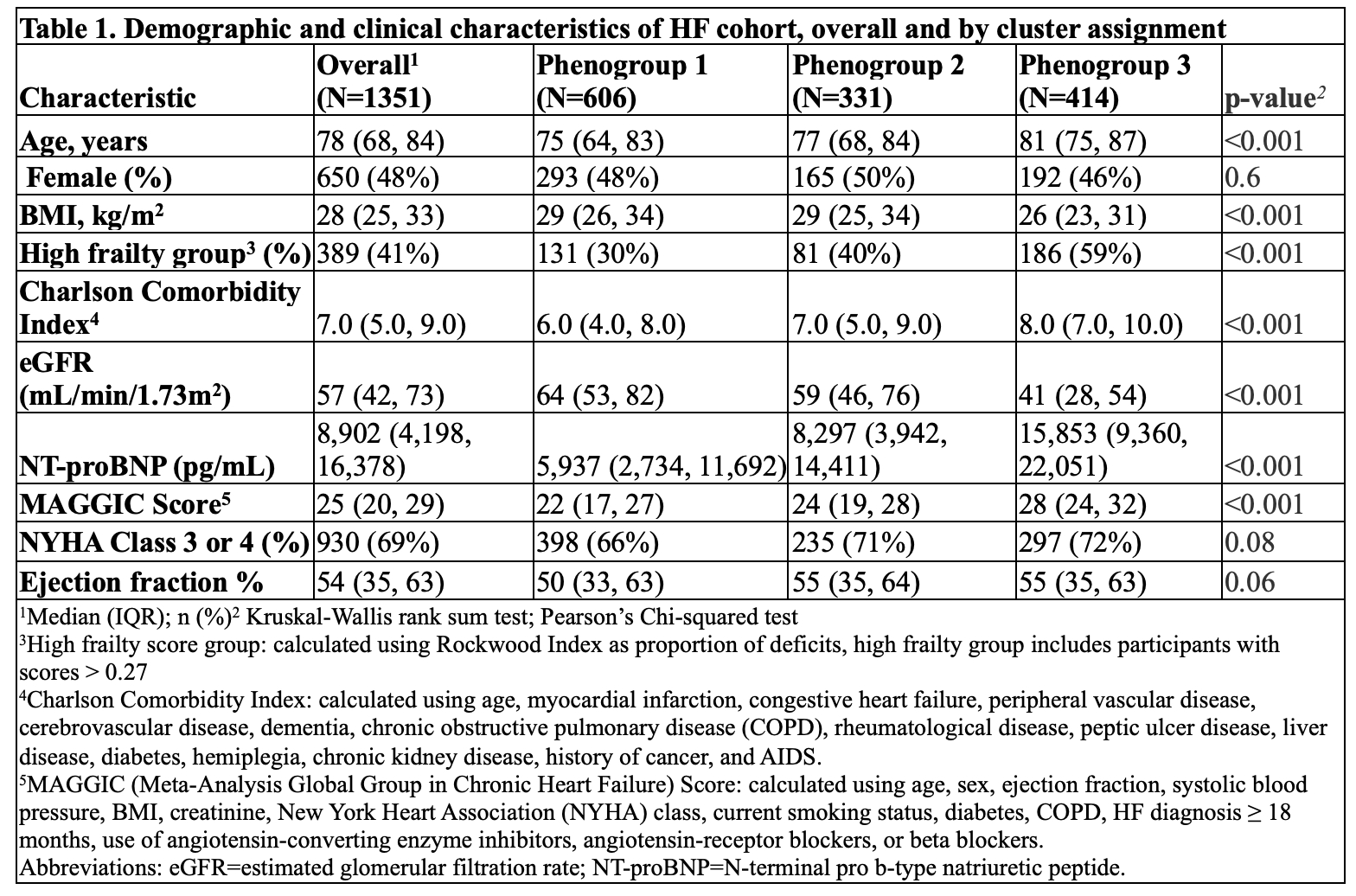
Results: Three phenogroups were identified, exhibiting different clinical characteristics (Table 1) and survival probabilities (5-year survival probability in phenogroup 1: 65% [61%, 68%], phenogroup 2: 45% [40%, 51%], and phenogroup 3: 26% [22%, 30%]). In covariate-adjusted Cox models, membership in phenogroups 2 and 3 was significantly associated with increased rate of mortality compared to phenogroup 1. Phenogroups did not differ by ejection fraction or New York Heart Association class. Pathway overrepresentation analysis of differentially expressed SOMAmers identified pathways associated with inflammatory response and immune cell trafficking.
Conclusions: Unsupervised clustering analysis using large-scale proteomics data identified three HF phenogroups with different proteomic signatures, clinical characteristics, and outcomes. Future work is necessary to elucidate how molecular differences contribute to heterogeneity in HF to improve risk stratification beyond current recommended clinical guidelines.
  • Downie, Carolina  ( National Heart, Lung, and Blood Institute , Bethesda , Maryland , United States )
  • Shearer, Joe  ( National Heart, Lung, and Blood Institute , Bethesda , Maryland , United States )
  • Kuku, Kayode  ( National Heart, Lung, and Blood Institute , Bethesda , Maryland , United States )
  • Hashemian, Maryam  ( National Heart, Lung, and Blood Institute , Bethesda , Maryland , United States )
  • Bielinski, Suzette  ( Mayo Clinic College of Medicine and Science , Rochester , Minnesota , United States )
  • Joo, Jungnam  ( National Heart, Lung, and Blood Institute , Bethesda , Maryland , United States )
  • Roger, Veronique  ( National Heart, Lung, and Blood Institute , Bethesda , Maryland , United States )
  • Author Disclosures:
    Carolina Downie: DO NOT have relevant financial relationships | Joe Shearer: DO NOT have relevant financial relationships | Kayode Kuku: DO NOT have relevant financial relationships | Maryam Hashemian: No Answer | Suzette Bielinski: DO have relevant financial relationships ; Consultant:Novartis:Active (exists now) | Jungnam Joo: DO NOT have relevant financial relationships | Veronique Roger: DO NOT have relevant financial relationships
Meeting Info:

Scientific Sessions 2024

2024

Chicago, Illinois

Session Info:

Genomics and Informatics

Sunday, 11/17/2024 , 09:30AM - 10:35AM

Moderated Digital Poster Session

More abstracts on this topic:
A Quarter Century of Cardiovascular Risk: National Mortality Trends in Hypertension and Arrhythmias Among U.S. Adults Aged 55 and Older

Ahmad Husnain, Khan Muhammad, Sharif Aleena, Hossain Mohammad, Eltawansy Sherif, Faizan Muhammad, Ali Muhammad Faizan, Ahmed Ashraf, Abdul Malik Mohammad Hamza Bin, Pahwani Ritesh, Patel Rahul, Mehdi Hassan

ADP-Ribosylation In a Mouse Model of Atherosclerosis: a Potential Novel Link Between Dyslipidemia and Inflammation in Cardiovascular Disease

Delwarde Constance, Mlynarchik Andrew, Perez Katelyn, Campedelli Alesandra, Sonawane Abhijeet, Aikawa Elena, Singh Sasha, Aikawa Masanori, Santinelli Pestana Diego, Kasai Taku, Kuraoka Shiori, Nakamura Yuto, Okada Takeshi, Decano Julius, Chelvanambi Sarvesh, Ge Rile

More abstracts from these authors:
Concordance Between Household and Area-Level Food Security Among People with Pre-Clinical Heart Failure

Hernandez-rubio Sheila, Linton Elizabeth, Joo Jungnam, Henriquez-santos Gretell, Shearer Joe, Hashemian Maryam, Roger Veronique

Longitudinal Trajectories of Kidney Function in Heart Failure: A community study

Kim Ji-eun, Joo Jungnam, Ganguli Anirban, Bielinski Suzette, Chamberlain Alanna, Shearer Joe, Roger Veronique

You have to be authorized to contact abstract author. Please, Login
Not Available