Proteomic Signature of the Dietary Approaches to Stop Hypertension (DASH) Diet by Diabetes Status
Abstract Body: Introduction: The Dietary Approaches to Stop Hypertension (DASH) diet has recently been shown to improve glycemia in individuals with type 2 diabetes. Yet, the proteomic mechanisms related to DASH diet adherence, and if they differ by diabetes status, remain unclear.
Objectives: To evaluate associations between the DASH diet adherence and plasma proteins among individuals with and without diabetes, and to examine whether diabetes status modifies these associations in the full sample.
Methods: In the Atherosclerosis Risk in Communities (ARIC) study, we included participants from visit 3 (1993-95) with dietary and proteomics data. DASH diet adherence was assessed by the DASH score from a 66-item food frequency questionnaire. Participants were stratified by diabetes status, and each group was randomly divided into discovery (2/3) and replication (1/3) sets. In discovery, associations between DASH score and 4955 plasma proteins were evaluated using multivariable-adjusted linear regression with a false discovery rate of 0.05. Proteins significant in discovery were further examined in replication. In the full sample, models additionally adjusted for diabetes status, and we tested interactions by diabetes status.
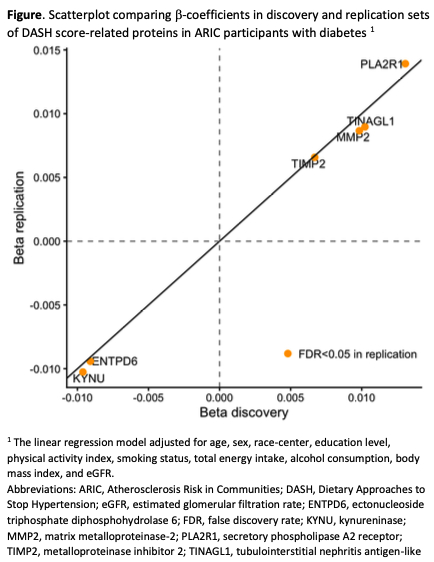
Results: In 1643 participants with diabetes, 27 DASH score-related proteins were identified in discovery (n=1101), of which 6 (4 positive, 2 negative) identified in replication (n=542; Figure). In 8918 participants without diabetes, 397 proteins were identified in discovery (n=5975), of which 142 (75 positive, 67 negative) identified in replication (n=2943). Four proteins were identified in common in people with and without diabetes, and the association between DASH score and matrix metalloproteinase-2 was significantly stronger in those with diabetes (Pinteraction=0.003). Secretory phospholipase A2 receptor and metalloproteinase inhibitor 2 were identified only in people with diabetes, both with significant interactions. In contrast, 138 DASH score-related proteins were identified only in people without diabetes, such as neurogenic locus notch homolog protein 1, of which 21 showed interactions with diabetes status.
Conclusions: We identified DASH diet-related proteins that differed by diabetes status, involving extracellular matrix homeostasis and immune signaling in people with diabetes, and cholesterol metabolism and glucose regulation in people without diabetes. These findings highlight the importance of tailoring dietary strategies by diabetes status.
Yang, Jiaqi
( Johns Hopkins Bloomberg School of Public Health
, Baltimore
, Maryland
, United States
)
Chen, Jingsha
( Johns Hopkins Bloomberg School of Public Health
, Baltimore
, Maryland
, United States
)
Sullivan, Valerie
( Johns Hopkins Bloomberg School of Public Health
, Baltimore
, Maryland
, United States
)
Rooney, Mary
( Johns Hopkins Bloomberg School of Public Health
, Baltimore
, Maryland
, United States
)
Selvin, Elizabeth
( Johns Hopkins Bloomberg School of Public Health
, Baltimore
, Maryland
, United States
)
Rebholz, Casey
( Johns Hopkins Bloomberg School of Public Health
, Baltimore
, Maryland
, United States
)