
Logo

American Heart Association

  12
  0


Final ID: WE516

Ultra-processed food consumption and risk of obesity: The Atherosclerosis Risk in Communities (ARIC) Study

Abstract Body: Background: Small, short-term feeding trials show that ultra-processed food consumption promotes moderate weight gain. However, the long-term consequences of ultra-processed food consumption on obesity risk in the general population are not well characterized.

Methods: We conducted a prospective cohort analysis in middle-aged adults without obesity in the Atherosclerosis Risk in Communities study. Body mass index (BMI) was assessed at baseline (1987-1989) and 3 subsequent visits (1990-1992, 1993-1995, and 1996-1998). Ultra-processed food was defined according to the Nova classification from a 66-item self-reported food frequency questionnaire. We used complementary log-log models to examine the association between ultra-processed food consumption (modeled as residual-adjusted quartiles and as continuous linear exposure) and incident obesity (BMI ≧ 30 kg/m2). We also used a restricted cubic spline to more flexibly model the association between ultra-processed food and obesity.

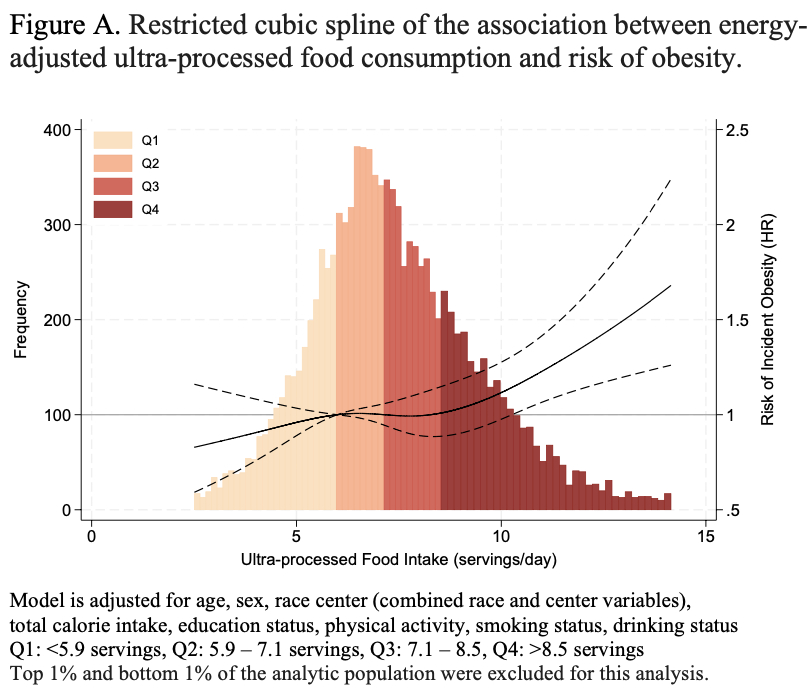
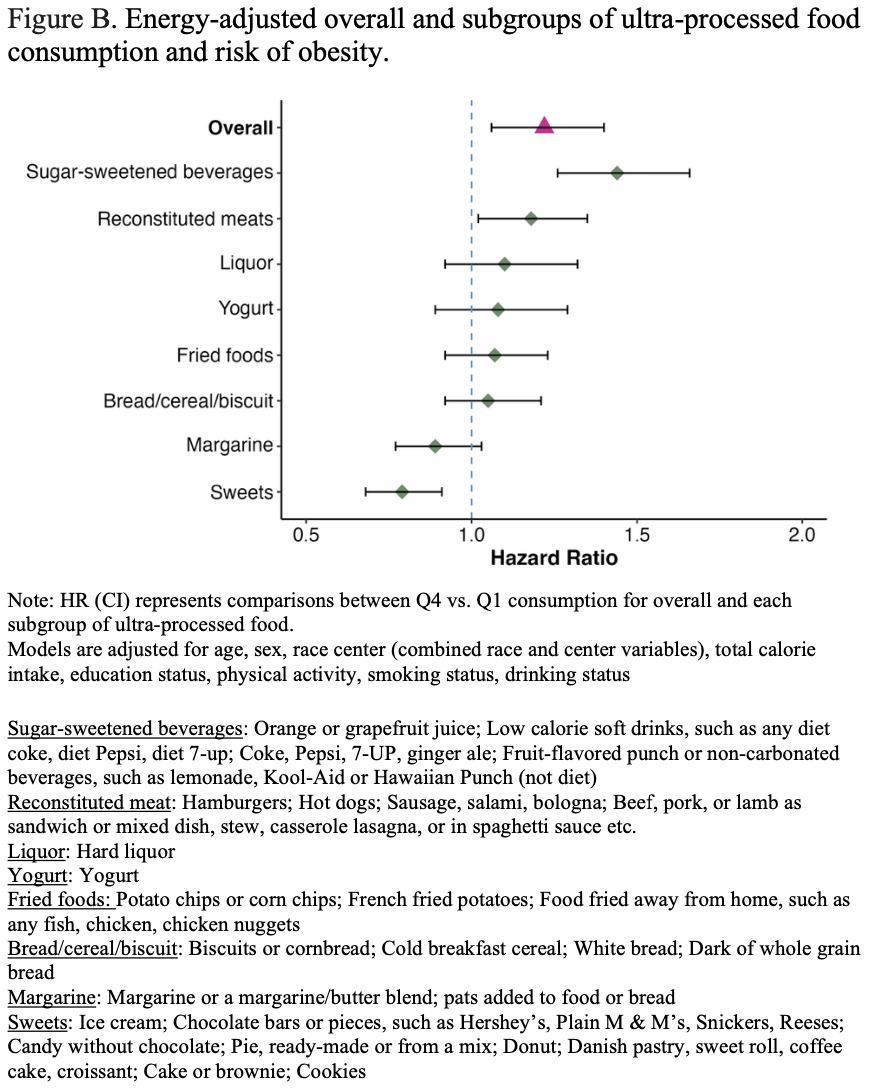
Results: Among 10,171 participants (mean age of 54 years, 17% Black adults, 53% female), there were 1,716 cases of incident obesity over a median follow-up of 9 years. Greater ultra-processed food consumption was associated with a higher risk of obesity (Figure A). Each additional serving of ultra-processed food was associated with 4% higher risk of incident obesity (HR = 1.04, 95% CI: 1.01 – 1.06). After adjustment for covariates, individuals in the highest quartile of ultra-processed food consumption had a 22% higher risk of obesity compared to those in the lowest quartile (HR = 1.22, 95% CI: 1.06 – 1.40, p-trend=0.01). Associations between subgroups of ultra-processed food and obesity were strongest for sugar-sweetened beverages followed by reconstituted meat (Figure B).

Conclusion: Excess ultra-processed food consumption, particularly sugar-sweetened beverages and reconstituted meat, was associated with a substantially higher risk of obesity. Policies and strategies aimed at limiting consumption of harmful ultra-processed food are critical for obesity prevention.
  • Guo, Zijing  ( Johns Hopkins University , Baltimore , Maryland , United States )
  • Du, Shutong  ( Johns Hopkins University , Baltimore , Maryland , United States )
  • Rooney, Mary  ( Johns Hopkins University , Baltimore , Maryland , United States )
  • Sullivan, Valerie  ( Johns Hopkins University , Baltimore , Maryland , United States )
  • Selvin, Elizabeth  ( JOHNS HOPKINS UNIVERSITY , Baltimore , Maryland , United States )
  • Rebholz, Casey  ( JOHNS HOPKINS UNIVERSITY , Baltimore , Maryland , United States )
  • Fang, Michael  ( Johns Hopkins University , Baltimore , Maryland , United States )
  • Author Disclosures:
Meeting Info:

EPI-Lifestyle Scientific Sessions 2026

2026

Boston, Massachusetts

Session Info:

Poster Session 2

Wednesday, 03/18/2026 , 05:00PM - 07:00PM

Poster Session

More abstracts on this topic:
More abstracts from these authors:
Proteomic Signature of the Dietary Approaches to Stop Hypertension (DASH) Diet by Diabetes Status

Yang Jiaqi, Chen Jingsha, Sullivan Valerie, Rooney Mary, Selvin Elizabeth, Rebholz Casey

Consumption of Ultra-processed Food and Risk of Major Complications in Adults with Type 2 Diabetes: The Atherosclerosis Risk in Communities Study

Guo Zijing, Du Shutong, Rooney Mary, Sullivan Valerie, Grams Morgan, Rebholz Casey, Selvin Elizabeth, Fang Michael

You have to be authorized to contact abstract author. Please, Login
Not Available