The Roles of Major Life Stressors in The Development of Cardiovascular Disease: Findings from the Jackson Heart Study
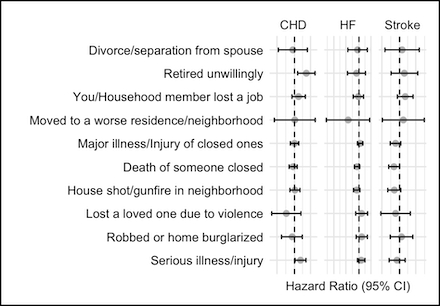
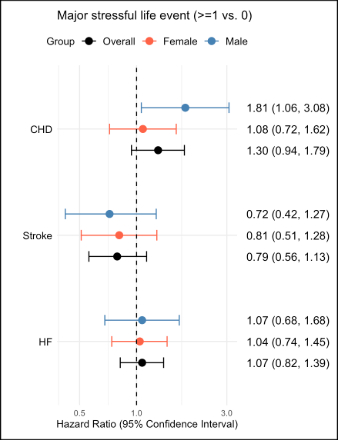
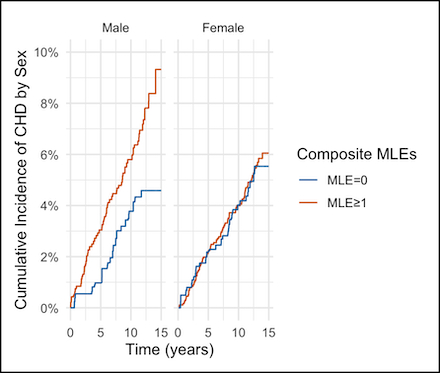
Abstract Body: Background: Major life stressors, defined as dramatic and severely taxing situations, may have traumatic and cumulative impacts on cardiovascular disease (CVD). Black adults experience a high burden of CVD and elevated exposure of psychosocial stressors. This study aims to investigate the associations between major life stressors and three CVD subtypes, coronary heart disease (CHD), stroke and heart failure (HF) over 15 years of follow-up in the Jackson Heart Study (JHS), a cohort of Black adults. Methods: Major life events (MLEs) were assessed at the first annual follow up call after exam 1 (2000-2004). JHS participants were asked about the occurrence of 11 different major life stressors in the past 12 months, such as death of someone close, violence, and divorce. CVD events were monitored from MLE assessment through 2016, except HF, which was monitored from 2005. Participants with missing MLEs and a history of CVD before or at the first year were excluded. Missing covariates were imputed using Multiple Imputation by Chained Equation. Cox proportional hazard model estimated the hazard ratios (HRs) and 95% confidence intervals (CIs) of incident CVD events. Models were adjusted for demographics, socioeconomic status, CVD risk factors and baseline perceived stress. Informative censoring was addressed using inverse probability of censoring weights. Results: Among the 4,424 included Black participants (age 53.7 ± 12.7 years; 65% female), 71% reported at least one MLE. During a median follow-up of 12 years, 210 CHD events, 146 stroke events and 282 HF events occurred. We found serious illness or injury (HR: 1.51, 95% CI: 1.04, 2.19) and unwilling retirement (HR: 2.25, 95% CI: 1.24, 4.09) were associated with a higher hazard of CHD, but not stroke or HF (Figure 1). We didn’t find statistically significant associations of composite MLEs (≥1 vs. 0) in the overall samples (Figure 2). Sex-stratified analyses (Figure 2&3) suggest MLEs (≥ 1 vs. 0) were associated with CHD among males (HR: 1.81, 95% CI: 1.06, 3.08) but not females, and the effect modification of sex was not statistically significant (p-value=0.19). Modelling MLEs continuously, we found a significant dose-response relationship between MLEs and CHD among males (HR: 1.21, 95% CI: 1.02, 1.42). Conclusion: Some major life stressors were associated with higher hazards of CHD among Black adults. The associations of MLEs with CHD appeared stronger among males than females.
Zhang, Shuqi
(
University of North Carolina at Chapel Hill
, Chapel Hill , North Carolina , United States )
Jones, Sara
(
University of North Carolina at Chapel Hill
, Chapel Hill , North Carolina , United States )
Pence, Brian
(
University of North Carolina at Chapel Hill
, Chapel Hill , North Carolina , United States )
Rowland, Bryce
(
University of North Carolina at Chapel Hill
, Chapel Hill , North Carolina , United States )
Hardy, Shakia
(
University of North Carolina at Chapel Hill
, Chapel Hill , North Carolina , United States )
Norwood, Arnita
(
University of Mississippi Medical Center
, Jackson , Mississippi , United States )
Rosamond, Wayne
(
University of North Carolina at Chapel Hill
, Chapel Hill , North Carolina , United States )