
Logo

American Heart Association

  17
  0


Final ID: MP632

Added Value of Clinical Data Over Claims Data in Controlling for Confounding by Indication: A Case Example Assessing the Effectiveness of Community-Based Rehabilitation Therapy After Stroke

Abstract Body (Do not enter title and authors here): Background: Observational studies that examine the comparative effectiveness of healthcare services often face challenges in controlling for confounding by indication. This study examines whether clinical data adds value over claims data alone in addressing this bias when evaluating the effectiveness of community-based physical or occupational therapy (PT/OT) after stroke.
Methods: Medicare claims data from the 6 months prior to and including the index hospitalization were linked to clinical data of 5,244 stroke survivors discharged home from 40 North Carolina hospitals. Measures of stroke severity, comorbidities, and previous healthcare utilization were derived from the claims. Clinical measures included the National Institutes of Health Stroke Scale, stroke diagnosis categories, ambulatory status, comorbidities, and therapy need. We estimated the effectiveness of any PT/OT use versus no use within 30 days of discharge. The primary outcome was 90-day functional status after discharge. We used Targeted Maximum Likelihood Estimation (TMLE) with SuperLearner and Inverse Probability of Treatment Weighting (IPTW) respectively to control for confounding across claims-only, clinical-only, and two joint models, claims-based with unique clinical elements and clinical-based with unique claims elements.
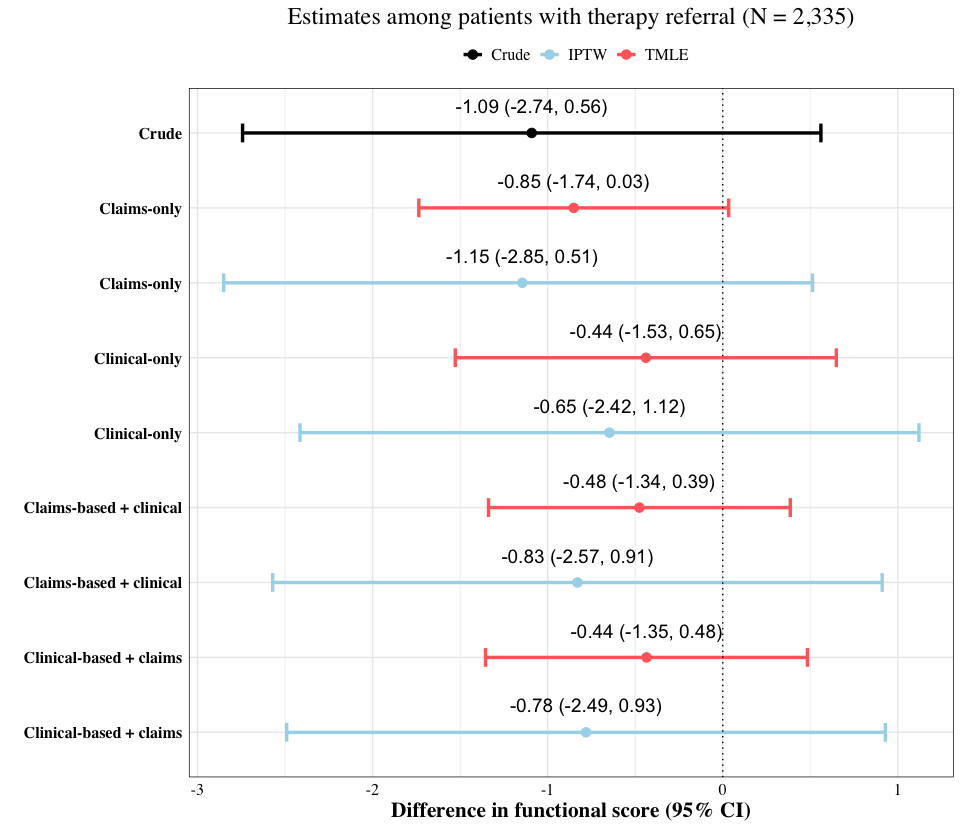
Results: Across all models in the full population (mean age, 74; 53% female; 78% Whites), receipt of any therapy within 30 days was unexpectedly associated with lower 90-day functional score (Figure 1). Models incorporating clinical data yielded more attenuated and consistent estimates closer to the hypothesized beneficial effect of therapy, while the addition of unique claims data elements did not change the estimates of clinical-only models (Figure 1). When the analysis was restricted to the 2,335 patients who needed therapy at discharge, there was no significant association between PT/OT use and functional score (Figure 2). Among the estimation approaches, TMLE models yielded more theory-consistent and precise estimates than IPTW models.
Conclusions: Clinical data outperformed claims data in controlling for confounding by indication. Restricting to individuals who needed therapy reduced confounding by indication. The unexpected, non-significant effect may be explained by residual confounding and/or the imprecision of PT/OT measure. Incorporating clinical measures and robust analytic approaches is essential for valid estimates in comparative effectiveness research.
  • Zhang, Shuqi  ( University of North Carolina at Chapell Hill , Chapel Hill , North Carolina , United States )
  • Freburger, Janet  ( University of Pittsburgh , Pittsburgh , Pennsylvania , United States )
  • Trogdon, Justin  ( University of North Carolina at Chapell Hill , Chapel Hill , North Carolina , United States )
  • Patterson, Charity  ( University of Pittsburgh , Pittsburgh , Pennsylvania , United States )
  • Wen, Molly  ( University of North Carolina at Chapell Hill , Chapel Hill , North Carolina , United States )
  • Jones, Sara  ( University of North Carolina at Chapell Hill , Chapel Hill , North Carolina , United States )
  • Author Disclosures:
    Shuqi Zhang: DO NOT have relevant financial relationships | Janet Freburger: DO NOT have relevant financial relationships | Justin Trogdon: No Answer | Charity Patterson: DO NOT have relevant financial relationships | Molly Wen: DO NOT have relevant financial relationships | Sara Jones: No Answer
Meeting Info:

Scientific Sessions 2025

2025

New Orleans, Louisiana

Session Info:

Cutting-Edge Insights in Cardiovascular Care: From Precision Therapies to System-Level Outcomes

Saturday, 11/08/2025 , 01:45PM - 03:00PM

Moderated Digital Poster Session

More abstracts on this topic:
A Risk Prediction Score for Shockable Sudden Cardiac Arrest: Validation in the Framingham Heart Study

Truyen Thien Tan Tri Tai, Lin Honghuang, Mathias Marco, Chugh Harpriya, Reinier Kyndaron, Benjamin Emelia, Chugh Sumeet

An Evaluation of Vascular Neurology Fellowship Websites: How Informed an Applicant Could Be?

Sivakumar Milan, Degen Nathaniel, Varkey Thomas, Alexandrov Andrei, Singh Savdeep

More abstracts from these authors:
Patients Hospitalized for Acute Coronary Syndrome Can Self-Acquire an Electrocardiogram for Early Disease Detection and Response

Zegre-hemsey Jessica, Kitzmiller Rebecca, Crandell Jamie, Chronowski Kevin, Gehi Anil, Johnson Anna, Shi Ziyuan, Zhang Shuqi, Albert David, Barnett Kim

You have to be authorized to contact abstract author. Please, Login
Not Available