
Temporal Changes in High-Sensitivity C-Reactive Protein and Risk of Atrial Fibrillation in African Americans: The Jackson Heart Study
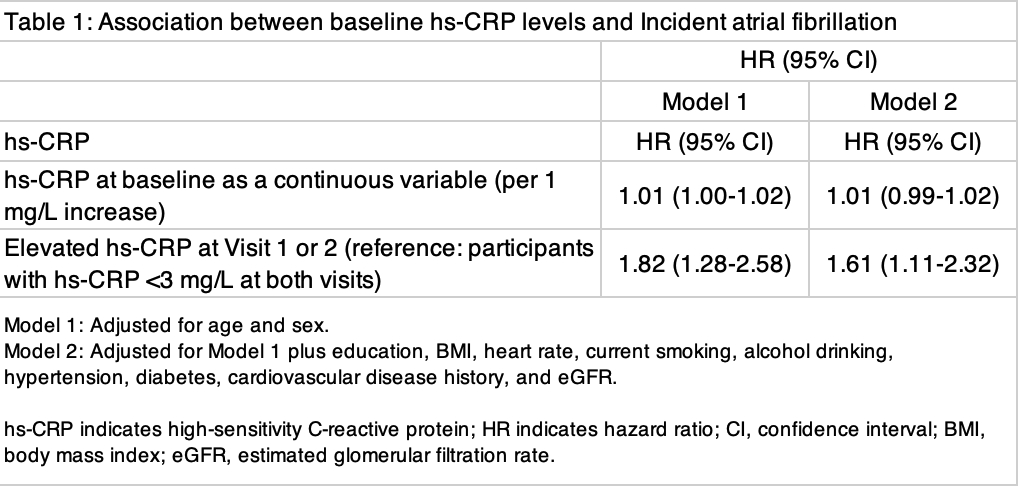
Abstract Body: Background: Atrial fibrillation (AF) is associated with significant morbidity and mortality. Inflammation plays an important role in AF pathogenesis. The relationship between high-sensitivity C-reactive protein (hs-CRP), a key biomarker of chronic inflammation, and incident AF in African Americans (AAs), remains unclear. This study aimed to examine the association between baseline and serial hs-CRP levels and incident AF in AAs in the Jackson Heart Study (JHS). Methods: Participants of the JHS with hs-CRP assessment and without previous AF at baseline were included in the study. hs-CRP measurement at Visit 1 (baseline) and Visit 2 were used. Elevated hs-CRP was defined as 3 mg/L per guidelines. Incident AF was defined as having 12 lead electrocardiogram evidence at a subsequent follow up, or a documented diagnosis code at the time of hospital discharge from 2000 to 2016. Cox proportional hazards models were used to evaluate the association between baseline hs-CRP as a continuous variable and AF risk (t0=Visit 1), and the risk of AF in those with elevated hs-CRP at Visit 1 or 2, compared to those who had never had elevated hs-CRP (t0=Visit 2). Results: Of the 4,169 participants followed for a median of 13.7 years, 351 participants developed AF (6.7 cases per 1,000 person-years). 1,089 participants (44.1%) never had elevated hs-CRP, while 1,379 (55.9%) had elevated hs-CRP at Visit 1 or 2. hs-CRP at baseline was significantly associated with incident AF in Model 1 (age and sex-adjusted), but not in Model 2 (further adjusted) (Table). Elevated hs-CRP at Visit 1or 2 was associated with higher risk of AF incidence in both Model 1 (HR 1.81, 95% CI 1.28-2.58, P < 0.005) and Model 2 (HR 1.61, 95% CI 1.11-2.32, p<0.05). Conclusion: In a community AA cohort, baseline hs-CRP was not associated with incident AF. On the other hand, individuals with elevated hs-CRP at Visit 1 or 2 had a higher risk of AF incidence. This might suggest usefulness of serial hs-CRP measurements to identify those with lower AF risk.
Yagasaki, Hiroto
( Indiana University School of Medicine
, Indianapolis
, Indiana
, United States
)
Suzuki, Takeki
( Indiana University School of Medicine
, Indianapolis
, Indiana
, United States
)
Yimer, Wondwosen
( University of Mississippi School of Parmacy
, Oxford
, Mississippi
, United States
)
Kamimura, Daisuke
( Yokohama City University Hospital
, Yokohama
, Japan
)
Min, Nancy
( University of Mississippi Medical Center
, Jackson
, Mississippi
, United States
)
Floyd, James
( University of Washington
, Seattle
, Washington
, United States
)
Bhattacharya, Kaustuv
( University of Mississippi School of Parmacy
, Oxford
, Mississippi
, United States
)
Heckbert, Susan
( University of Washington
, Seattle
, Washington
, United States
)
Hall, Michael And Jo Alice
( University of Mississippi Medical Center
, Jackson
, Mississippi
, United States
)
Correa, Adolfo
( University of Mississippi Medical Center
, Jackson
, Mississippi
, United States
)
Author Disclosures:
Hiroto Yagasaki:DO have relevant financial relationships
;
Speaker:Abbott Medical Japan LCC:Active (exists now)
| Takeki Suzuki:No Answer
| Wondwosen Yimer:DO NOT have relevant financial relationships
| Daisuke Kamimura:DO NOT have relevant financial relationships
| Nancy Min:No Answer
| James Floyd:DO NOT have relevant financial relationships
| Kaustuv Bhattacharya:DO NOT have relevant financial relationships
| Susan Heckbert:DO NOT have relevant financial relationships
| Michael and Jo Alice Hall:DO have relevant financial relationships
;
Consultant:Artivion:Active (exists now)
; Consultant:OrthoQuidel:Active (exists now)
| Adolfo Correa:DO NOT have relevant financial relationships