Lipoprotein(a), High Sensitivity C-reactive Protein and Risk of Atrial Fibrillation in African Americans: The Jackson Heart Study
Abstract Body (Do not enter title and authors here): Background: African Americans (AAs) have higher levels of lipoprotein(a) (Lp(a)), a proinflammatory particle, and high-sensitivity C-reactive protein (hs-CRP) but a lower rate of atrial fibrillation (AF) than White Americans. While it is known that Lp(a) is associates associated with various cardiovascular diseases and that inflammation plays a crucial role in AF pathogenesis, the relationship between Lp(a) and AF remains unclear especially in AAs. This study investigated the association between Lp(a) levels and incident AF in AAs, focusing on the potential interaction with inflammatory status assessed by hs-CRP.
Methods: From the Jackson Heart Study, 3,865 AAs without AF or missing variables at baseline (mean age 53.6±12.7, women 64%) were included in the study. Participants were stratified by Lp(a) levels (<30, 30-49, 50-99, and ≥100 mg/dL) and hs-CRP levels (<3 mg/L (low) vs ≥3 mg/L (high)) based on current guidelines and studies. Cox proportional hazards models were used to evaluate the association between Lp(a) categories and incident AF, adjusting for demographic, clinical, and laboratory variables.
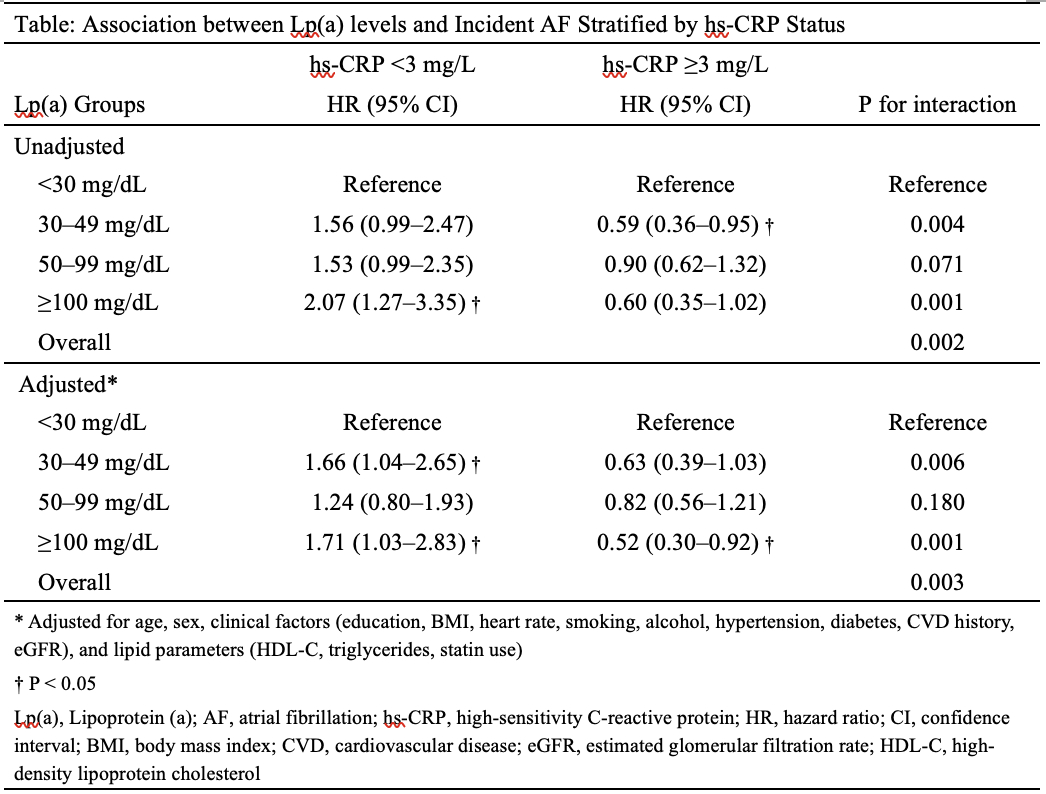
Results: During a median follow-up of 13.7 years, 304 participants developed AF (incidence rate 6.3/1,000 person-years). Kaplan-Meier survival analysis showed no significant association between Lp(a) levels and AF risk in the overall cohort (p = 0.60). When stratified by hs-CRP levels, divergent relationships were observed: in the low hs-CRP group, elevated Lp(a) was associated with increased AF risk (HR: 1.71, 95% CI: 1.03–2.83, for Lp(a) ≥100 vs <30 mg/dL, Table). Conversely, in the high hs-CRP group, elevated Lp(a) was associated with decreased AF risk (HR: 0.52, 95% CI: 0.30–0.92). A significant interaction was observed between hs-CRP and Lp(a) levels (p < 0.004 across models).
Conclusion: In this community-based AA cohort, the relationship between Lp(a) and AF risk differed by inflammatory status. The interaction between Lp(a) and inflammation may partially explain the lower AF incidence in AAs.
Yagasaki, Hiroto
(
Gifu Prefectural General Medical Center
, Gifu , Japan )
Kamimura, Daisuke
(
Yokohama City University Medical Center
, Yokohama , Japan )
Yimer, Wondwosen
(
University of Mississippi Medical Center
, Jackson , Mississippi , United States )
Ezemenaka, Christina
(
University of Mississippi Medical Center
, Jackson , Mississippi , United States )
Bhattacharya, Kaustuv
(
University of Mississippi
, University , Mississippi , United States )
Floyd, James
(
UNIVERSITY WASHINGTON
, Seattle , Washington , United States )
Hall, Michael
(
University of Mississippi Medical Center
, Jackson , Mississippi , United States )
Correa, Adolfo
(
University of Mississippi Medical Center
, Jackson , Mississippi , United States )
Suzuki, Takeki
(
Wake Forest University
, Winston-Salem , North Carolina , United States )
Author Disclosures:
Hiroto Yagasaki:DO NOT have relevant financial relationships
| Daisuke Kamimura:DO NOT have relevant financial relationships
| Wondwosen Yimer:DO NOT have relevant financial relationships
| Christina Ezemenaka:DO NOT have relevant financial relationships
| Kaustuv Bhattacharya:No Answer
| James Floyd:DO NOT have relevant financial relationships
| Michael Hall:DO have relevant financial relationships
;
Consultant:OrthoClinical Diagnostics:Active (exists now)
; Consultant:Currax:Active (exists now)
| Adolfo Correa:DO NOT have relevant financial relationships
| Takeki Suzuki:DO NOT have relevant financial relationships
Yagasaki Hiroto, Suzuki Takeki, Yimer Wondwosen, Kamimura Daisuke, Min Nancy, Floyd James, Bhattacharya Kaustuv, Heckbert Susan, Hall Michael And Jo Alice, Correa Adolfo
4365574_File000000.jpg
You have to be authorized to contact abstract author. Please, Login