Temporal Changes in High-Sensitivity C-Reactive Protein and Atherosclerotic Cardiovascular Disease in African Americans: The Jackson Heart Study
Abstract Body (Do not enter title and authors here): Background: African Americans (AAs) face higher mortality from atherosclerotic cardiovascular disease (ASCVD) than Whites. Inflammation plays a central role in atherosclerosis, yet the association between high-sensitivity C-reactive protein (hs-CRP) and ASCVD in AAs remains unclear. This study examined serial hs-CRP measurements and incident ASCVD in the Jackson Heart Study (JHS), a community-based AA cohort.
Methods: JHS Participants without prior ASCVD were analyzed using hs-CRP measurements at Visit 1 (baseline; 2000–2004, "single-visit cohort"), Visits 1 and 2 (2005–2008, "two-visit cohort"), and Visit 1–3 (2009–2013) for joint modeling. hs-CRP was evaluated as both continuous and categorized (≥3 mg/L defined as elevated) variables. In the two-visit cohort, participants were divided by hs-CRP status as: normal at both visits, elevated at Visit 1 or 2 or both. ASCVD was defined as coronary heart disease (CHD; myocardial infarction and fatal CHD) and stroke. Cox proportional hazards models were used to assess the association between hs-CRP and incident ASCVD, adjusted for cardiovascular risk factors. Joint modeling was utilized to examine the time-dependent relationship of hs-CRP with incident ASCVD.
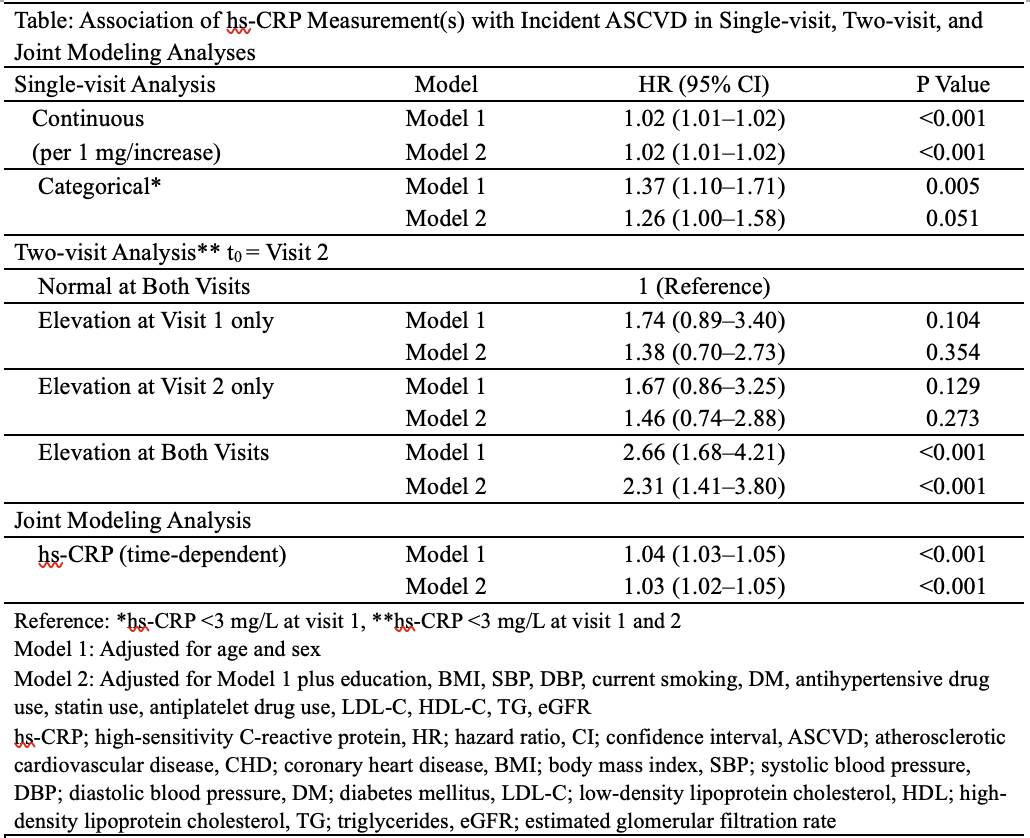
Results: In the single-visit cohort (n = 3,948, mean age (standard deviation) 53.6 (12.8), female 64.3%), 340 participants developed ASCVD (6.9 cases per 1,000 person-years) during median 13.7 years follow-up. Each unit increase in hs-CRP was associated with greater ASCVD risk (adjusted hazard ratio (HR) 1.02, 95% confidence interval (CI) 1.01–1.02, P < 0.001). Elevated hs-CRP showed a trend toward increased risk. In the two-visit cohort (n = 2,324), 110 participants developed ASCVD (5.3 cases per 1,000 person-years) during median 8.9 years follow-up. Those with elevated hs-CRP were found to have a higher risk of ASCVD, with those with elevated hs-CRP at both visits the highest risk (HR 2.31, 95% CI 1.41–3.80, P < 0.001, Table). Joint modeling revealed a significant time-dependent association of hs-CRP trajectory with incident ASCVD (HR 1.03 per 1.0 mg/L increase, 95% CI 1.02–1.05, P < 0.001).
Conclusion: In the AA general cohort, temporal hs-CRP changes were associated with the risk of ASCVD.
Yagasaki, Hiroto
(
Gifu Prefectural General Medical Center
, Gifu , Japan )
Kamimura, Daisuke
(
Yokohama City University Medical Center
, Yokohama , Japan )
Yimer, Wondwosen
(
University of MS Medical Center
, Jackson , Mississippi , United States )
Min, Yuan-i
(
University of MS Medical Center
, Jackson , Mississippi , United States )
Hall, Michael
(
University of MS Medical Center
, Jackson , Mississippi , United States )
Correa, Adolfo
(
University of MS Medical Center
, Jackson , Mississippi , United States )
Suzuki, Takeki
(
Wake Forest University
, Winston-Salem , North Carolina , United States )
Author Disclosures:
Hiroto Yagasaki:DO NOT have relevant financial relationships
| Daisuke Kamimura:DO NOT have relevant financial relationships
| Wondwosen Yimer:DO NOT have relevant financial relationships
| Yuan-I Min:No Answer
| Michael Hall:DO have relevant financial relationships
;
Consultant:OrthoClinical Diagnostics:Active (exists now)
; Consultant:Currax:Active (exists now)
| Adolfo Correa:DO NOT have relevant financial relationships
| Takeki Suzuki:DO NOT have relevant financial relationships
Yagasaki Hiroto, Suzuki Takeki, Yimer Wondwosen, Kamimura Daisuke, Min Nancy, Floyd James, Bhattacharya Kaustuv, Heckbert Susan, Hall Michael And Jo Alice, Correa Adolfo
4364627_File000000.jpg
You have to be authorized to contact abstract author. Please, Login