Human Digital Disease Model Enables Predictive In Silico Gene Perturbation for Precision Cardiovascular Target Discovery
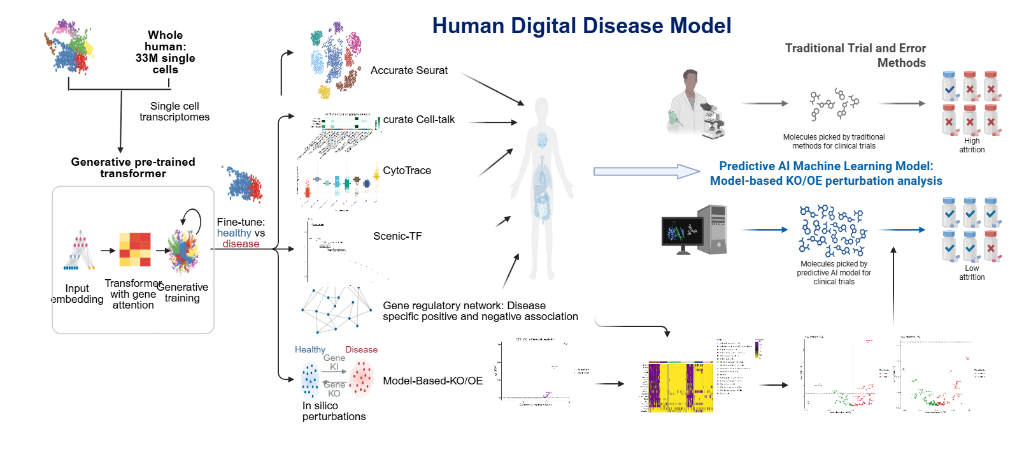
Abstract Body: Cardiovascular diseases arise from complex interactions among genetic variation, cellular heterogeneity, and environmental influences. However, the causal mechanisms linking these factors to disease phenotypes remain incompletely understood, complicating the development of effective therapies. Traditional experimental approaches often struggle to resolve these relationships because human tissues contain diverse cell populations, genetic signals are heterogeneous. To address this challenge, we developed a Human Digital Disease Model (HDDM), an AI-driven computational framework designed to integrate clinical traits, genomic variation, and cell-type–specific molecular networks to better understand disease mechanisms and identify therapeutic targets. This platform integrates genomic and clinical information from ~10 million individuals across diverse populations, together with ~3 million human single-cell transcriptomes and GWAS variants, creating a cross-scale resource that links population genetics with cellular biology. Using a transformer-based generative architecture trained on GWAS and single-cell datasets, the model captures gene and cell identity states, lineage relationships, and regulatory interactions to cardiovascular disease. The system incorporates curated analytical modules that apply Mendelian causal inference and analyses to infer cell–cell communication, reconstruct lineage trajectories, map regulatory networks, and model disease mechanisms. A key innovation of this framework is its ability to perform in silico gene perturbation experiments directly within disease contexts. The model simulates gene knock-out (KO) and overexpression (OE) perturbations and compares predicted responses between healthy and diseased states, enabling identification of genes with risk-promoting or protective effects on cellular function and tissue-level pathology. Importantly, this approach enables the construction of virtual cell disease models capable of predicting gene-therapy and drug-response effects prior to experimental validation. Together, this work establishes a new paradigm that connects population genomics, cell biology, and AI to advance precision cardiovascular medicine. By enabling mechanistic prediction across genetic, cellular, and clinical scales, this platform has the potential to improve disease diagnosis, guide therapeutic target selection, and support the development of next-generation gene and drug therapies for cardiovascular disease.
Zhao, Jianli
(
University of Alabama Birmingham
, Birmingham , Alabama , United States )
Zhang, John
(
UAB
, Birmingham , Alabama , United States )
Tan, Huilan
(
UNIVERSITY OF ALABAMA AT BIRMINGHAM
, Birmingham , Alabama , United States )
Wu, Yalin
(
university of alabama at birmingham
, Birmingham , Alabama , United States )
Young, Martin E
(
University of Alabama Birmingham
, Birmingham , Alabama , United States )
Ma, Xinliang-xin
(
THOMAS JEFFERSON UNIV
, Philadelphia , Pennsylvania , United States )
Wang, Yajing
(
UAB at Birmingham
, Birmingham , Alabama , United States )
Tan Huilan, Young Martin E, Wang Yajing, Wu Yalin, Zhao Jianli, Shila Taslima Akter, Liu Yanwen, Zhang John, Wyatt Kayleigh, Mahmoud Amr, Ma Xinliang-xin
4529158_File000000.jpg
You have to be authorized to contact abstract author. Please, Login