Single-Cell Multi-Omics Analysis Identifies a Th17.1–Fibroblast TGF-β Signaling Axis in Cardiac Sarcoidosis
Abstract Body: Introduction Cardiac sarcoidosis (CS) is an inflammatory disease characterized by non-caseating granulomas in the myocardium, often progressing to fibrosis and heart failure. While transforming growth factor–β (TGF-β) signaling has been implicated in fibrosis, its cellular sources and intercellular dynamics in CS remain unclear. We investigated the cellular landscape of CS using integrative single-cell multi-omics.
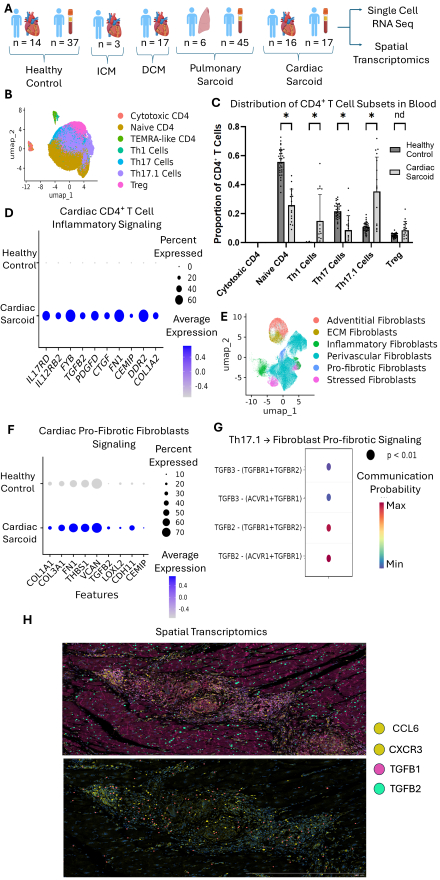
Methods We performed integrative single-cell multi-omics across n = 155 samples (Fig. 1A), including n = 84 sarcoidosis samples (n = 33 CS, n = 51 pulmonary sarcoidosis). Samples included cardiac tissue (n = 50), blood (n = 99), and pulmonary tissue (n = 6). Prospectively collected samples (n = 76) were obtained from Stanford and the Oklahoma Medical Research Foundation, and public datasets (n = 79) were integrated (PMIDs: 37963457, 36111531, 35959412, 33602861, 32971526). Data were integrated using Seurat v5 with quality control, batch correction, and unbiased clustering (Fig. 1A). Spatial transcriptomics was performed using the 10X Genomics Xenium In-Situ 5000 Gene Panel.
Results Single-cell RNA-seq identified seven distinct CD4+ T cell states (Fig. 1B), with expansions of IL17 and IFN-g secreting Th17.1 cells in CS blood (p = 6.75x10⁻⁴; Fig. 1C). In the heart, cardiac CD4+ cells showed upregulation of pro-fibrotic and inflammatory signaling, including IL-17 pathways, known to support fibroblast activation (Fig. 1D). Fibroblasts in CS (Fig. 1E) demonstrated increased expression of pro-fibrotic genes COL1A1, COL3A1, and FN1, consistent with an activated fibroblast phenotype (Fig. 1F). Cell–cell communication analysis with CellChat revealed enhanced TGF-β signaling between Th17.1 cells and pro-fibrotic fibroblasts in CS cardiac tissue (Fig. 1G). Spatial analysis revealed localized CXCR3/CCL6 signaling and TGF-β activity within and surrounding granulomas (Fig. 1H).
Conclusions Our findings identify a Th17.1–fibroblast TGF-β signaling axis as a potential driver of fibrosis in cardiac sarcoidosis. This work highlights a previously underappreciated role of CD4+ T cell–mediated fibroblast activation within the heart during cardiac sarcoidosis, with CD4+ T-cell signatures detectable within the blood, and provides a framework for targeting immune–stromal interactions in CS.
Sundar, Hiranya
(
Stanford University
, Palo Alto , California , United States )
Banga, Natasha
(
Stanford University
, Palo Alto , California , United States )
Franquiz, Miguel
(
Stanford University
, Palo Alto , California , United States )
Chou, Harrison
(
Stanford University
, Palo Alto , California , United States )
Vitale, Maria Rosaria
(
Stanford University
, Palo Alto , California , United States )
Galdos, Francisco
(
Stanford University
, Palo Alto , California , United States )
Sun, Yin
(
Stanford University
, Palo Alto , California , United States )
Huang, Yuhsin
(
Stanford Cardiovascular Institute
, Stanford , California , United States )
Nguyen, Vincent
(
Stanford University
, Palo Alto , California , United States )
Dunn, Christopher
(
Oklahoma Medical Research Foundation
, Oklahoma City , Oklahoma , United States )
Montgomery, Courtney
(
Oklahoma Medical Research Foundation
, Oklahoma City , Oklahoma , United States )
Berry, Gerald
(
Stanford University
, Stanford , California , United States )
Baker, Matthew
(
Stanford University
, Palo Alto , California , United States )
Witteles, Ronald
(
Stanford University
, Palo Alto , California , United States )
Zhu, Han
(
Stanford University
, Palo Alto , California , United States )