Abl1 kinase-deficient mouse hearts exhibit conduction disturbance and arrhythmia vulnerability to oxidative stress that are typically associated with age-related proarrhythmic remodeling
Abstract Body: Background: Abl1 kinase has diverse roles in cell development, proliferation, cytoskeletal reorganization, and aging. Importantly, proarrhythmic complications are noted among cancer patients taking tyrosine kinase inhibitors, including AV block, atrial fibrillation, QTc prolongation, and tachycardia associated with heart failure.
Goals: We investigated the roles of Abl1 kinase in aging and arrhythmias using a cardiac-specific Abl1 knockout (Abl1 CKO) mouse.
Methods: Electrophysiology and arrhythmogenesis were studied using optical mapping with voltage-sensitive dye, di-4 ANEPPS.
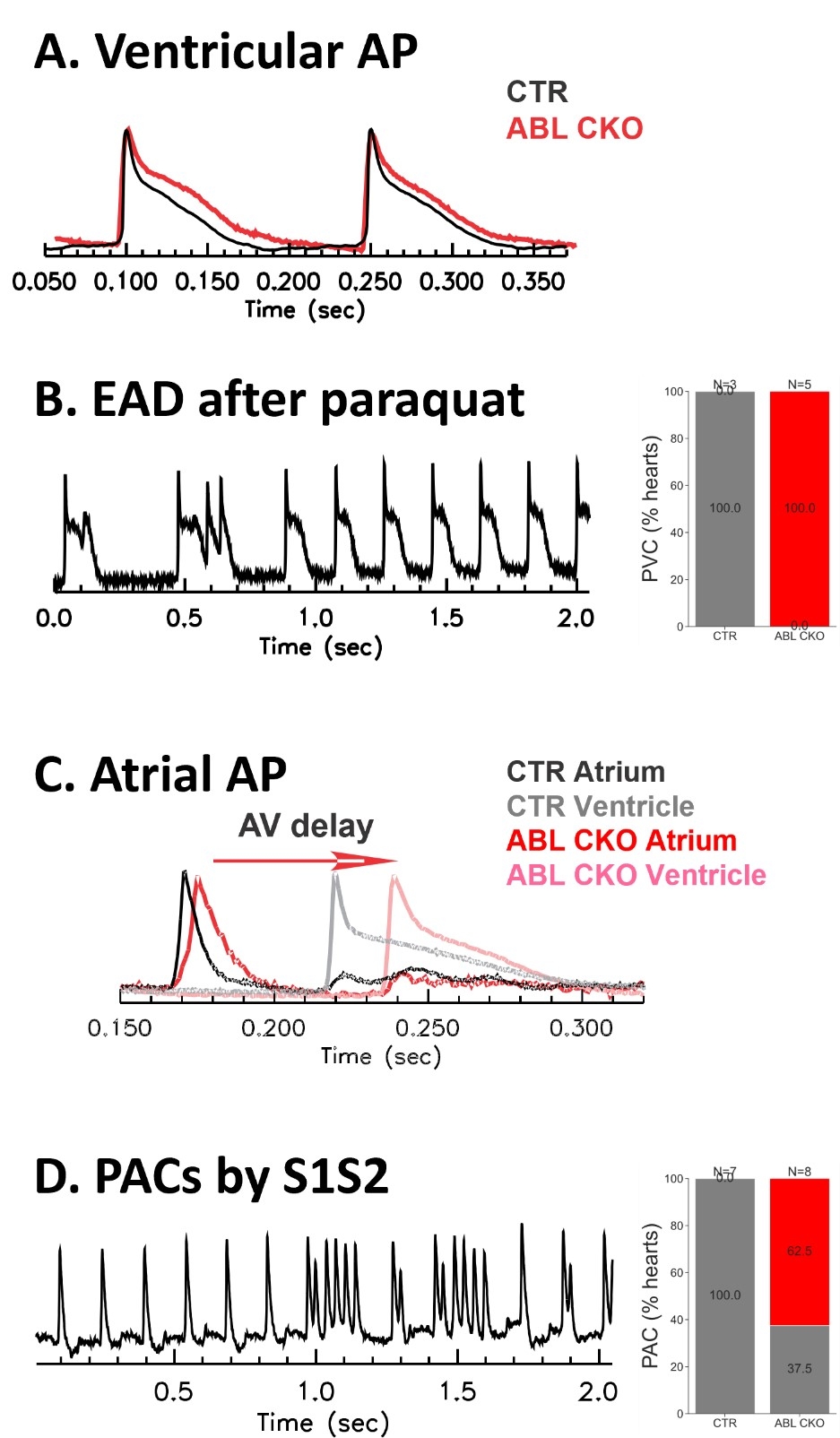
Results: Abl1 CKO resulted in sudden death (median survival 39 weeks, n=31). Abl1 CKO mouse hearts (mean age 31 weeks) showed significant APD prolongation (64±5 vs. 72±4 ms, p=0.001, Figure 1A), increased APD dispersion (14±2 vs. 21±8 ms, p=0.047) but conduction velocity was not changed (longitudinal CV=0.81±0.05 vs. 0.78±0.08 m/s p =0.51, transverse CV=0.5±0.10 vs. 0.5±0.06 m/s p = 0.32). Oxidative stress using perfusion of 10 µM paraquat for 90 minutes caused further APD prolongation (109±23 ms) and triggered frequent premature ventricular contractions (PVC) in Abl1 CKO hearts (Figure 1B). In atria, AV delay was significantly longer (55±3 vs. 63±8 ms, p=0.03, Figure 1C), associated with significantly longer rise time (4.1±0.7 vs. 5.3±0.5 ms, p=0.006) and increased conduction time between right and left atrium (6.3±1.7 vs. 9.2±1.6 ms, p=0.006). S1S2 stimulation caused frequent premature atrial contractions (n=0/7 in control vs. 5/8 hearts, Figure 1D).
Conclusion: Abl1 CKO hearts demonstrate sudden death, APD prolongation, increased vulnerability to oxidative stress, conduction disorders such as increased AV delay and frequent AV block, and arrhythmia induction associated with slow atrial conduction, which are typical features of aging myocardium, suggesting that alteration in Abl1 kinase may be an important factor underlying age-associated electrical remodeling.
Choi, Bum-rak
(
RIH and Brown Medical School
, Providence , Rhode Island , United States )
Bronk, Peter
(
RIH and Brown Medical School
, Providence , Rhode Island , United States )
Li, Xiaofei
(
RIH and Brown Medical School
, Providence , Rhode Island , United States )
Song, Yi
(
RIH and Brown Medical School
, Providence , Rhode Island , United States )
Kim, Tae Yun
(
RIH and Brown Medical School
, Providence , Rhode Island , United States )
Lu, Yichun
(
RIH and Brown Medical School
, Providence , Rhode Island , United States )
Radice, Glenn
(
RIH and Brown Medical School
, Providence , Rhode Island , United States )
Author Disclosures:
Bum-rak Choi:DO NOT have relevant financial relationships
| Peter Bronk:DO NOT have relevant financial relationships
| Xiaofei Li:No Answer
| Yi Song:DO NOT have relevant financial relationships
| Tae Yun Kim:No Answer
| Yichun Lu:No Answer
| Glenn Radice:DO NOT have relevant financial relationships