
Logo

American Heart Association

  70
  0


Final ID: Fri097

Pharmacological enhancement of SK channels increases repolarization reserve in congenital and acquired long QT type 2 syndrome

Abstract Body: Introduction: Long QT syndrome type 2 (LQT2), induced by either genetic variations or drugs blocking the hERG channel, is associated with polymorphic ventricular tachycardia (pVT) and sudden cardiac death. Small conductance Ca2+-activated K+ (SK) channels are directly gated by Ca2+ and provide feedback from Ca2+ to membrane voltage to accelerate cardiac repolarization, which may help mitigate LQT2.
Goal: To show that pharmacological enhancement of SK channels normalizes prolonged action potential duration (APD) in LQT2.
Methods: We used optical mapping of ex vivo hearts from a transgenic rabbit model of LQT2 and human induced pluripotent stem cell-derived ventricular cardiomyocyte (hiPSC-CM) microtissues as well as Ca2+ imaging and patch clamp of isolated hiPSC-CMs. A six state ISK gating model combined with intrinsic rectification and divalent ion block was incorporated into the Mahajan rabbit AP model to investigate potential mechanisms of APD normalization.
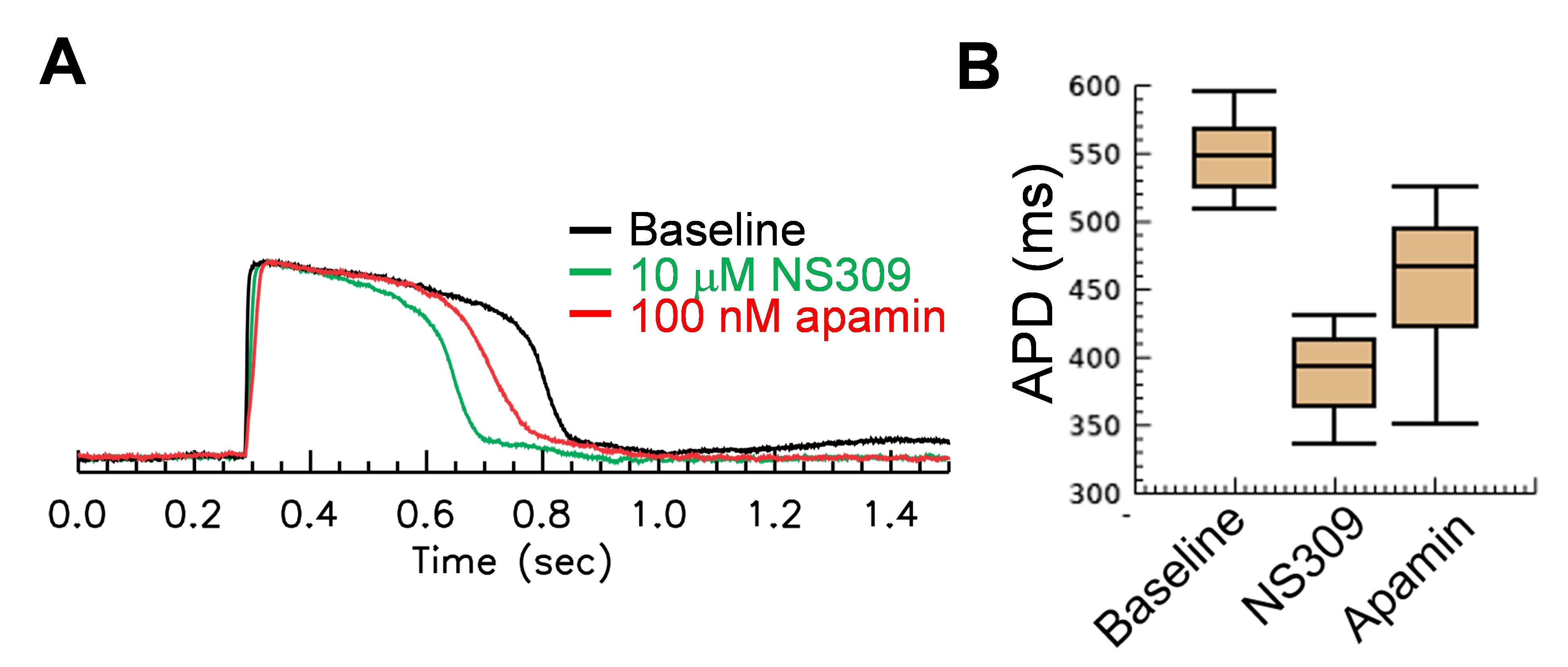
Results: We found that enhancing ISK with NS309 in LQT2 rabbit hearts consistently shortened ventricular APD (224 ± 8 ms vs. 176 ± 3 ms, p=0.007). By computational simulation, we found increasing levels of SK channel conductance (gSK) shortened APD and reduced APD dispersion. Computer modeling indicates that increased Ca2+ duration by prolonged APD augments ISK and lowers plateau Vm to mask IKs heterogeneity. Application of NS309, significantly shortened hiPSC-CM microtissue APD in an apamin-dependent manner (Figure 1) confirming that there were functional SK channels in our line of hiPSCs. The cardiotoxic drug, Cisapride (1 μM), increased hiPSC-CM microtissue APD by a mean of 62 ± 13% which was significantly reduced to 24 ± 7% above baseline APD (p=0.04) by adding 2 μM NS309.
Conclusion: The Ca2+ dependent gating of ISK allows it to directly feedback on the APD especially under reduced repolarization reserve and could be a potential therapeutic target for LQT2 patients.
  • Bronk, Peter  ( Rhode Island Hospital , Providence , Rhode Island , United States )
  • Koren, Gideon  ( Rhode Island Hospital , Providence , Rhode Island , United States )
  • Coulombe, Kareen  ( Brown University , Providence , Rhode Island , United States )
  • Choi, Bum-rak  ( Rhode Island Hospital , Providence , Rhode Island , United States )
  • Kim, Tae Yun  ( Rhode Island Hospital , Providence , Rhode Island , United States )
  • Daley, Mark  ( Brown University , Providence , Rhode Island , United States )
  • Soepriatna, Arvin  ( Brown University , Providence , Rhode Island , United States )
  • Lu, Yichun  ( Rhode Island Hospital , Providence , Rhode Island , United States )
  • Turan, Nilufer  ( Rhode Island Hospital , Providence , Rhode Island , United States )
  • Qu, Zhilin  ( UCLA , Los Angeles , California , United States )
  • Terentyeva, Radmila  ( The Ohio State University , Columbus , Ohio , United States )
  • Terentyev, Dmitry  ( The Ohio State University , Columbus , Ohio , United States )
  • Author Disclosures:
    Peter Bronk: DO NOT have relevant financial relationships | Gideon Koren: No Answer | Kareen Coulombe: DO NOT have relevant financial relationships | Bum-rak Choi: DO NOT have relevant financial relationships | Tae Yun Kim: No Answer | Mark Daley: DO NOT have relevant financial relationships | Arvin Soepriatna: No Answer | Yichun Lu: DO NOT have relevant financial relationships | Nilufer Turan: No Answer | Zhilin Qu: No Answer | Radmila Terentyeva: No Answer | Dmitry Terentyev: No Answer
Meeting Info:

Basic Cardiovascular Sciences 2025

2025

Baltimore, Maryland

Session Info:

Poster Session and Reception 3

Friday, 07/25/2025 , 04:30PM - 07:00PM

Poster Session and Reception

More abstracts on this topic:
Essential Role of KCNQ5 (Kv7.5) Potassium Channels in Vascular Reactivity and Adrenergic Signaling

Weiss-hung Eli, Jepps Thomas, Akbari Yama, Abbott Geoffrey, Baldwin Samuel, Bazrafkhan Afsheen, Yoshimura Ryan, Manville Rian, Han Sangwoo, Yi Justin, Rafi Masih, Khatami Seyed

A novel LMNA mutant (R225X) leads to cardiac conduction disorders

Li Tingting, Chelu Mihail, Wang Xiaolei, Song Jia, Li Luge, Gutierrez Yaqueline, Shinohara Anna, Whitfield William, Adeleye Adeniyi, Li Na

More abstracts from these authors:
You have to be authorized to contact abstract author. Please, Login
Not Available