
Logo

American Heart Association

  16
  0


Final ID: MP1566

Branched Chain Amino Acids Promote Proarrhythmic Electrical Remodeling in hiPSC-derived Cardiac Atrial Microtissues

Abstract Body (Do not enter title and authors here): Introduction: Metabolic syndrome has become a global health crisis affecting 25-35% of adults. Conditions of metabolic syndrome increase the risk of cardiovascular disease, stroke, and diabetes. Branched-chain amino acids (BCAAs) are elevated in metabolic syndrome and play important roles in ATP production and modulation of metabolic processes. The dysregulation of BCAA metabolism has been linked to atrial arrhythmias but the mechanisms underlying this link are not clearly understood.
Goal: To show that BCAA elevation promotes mitochondrial dysfunction and oxidative stress through mTOR activation causing proarrhythmic electrophysiological remodeling using an in vitro human induced pluripotent stem cell (hiPSC)-derived 3D atrial microtissue platform.
Methods: hiPSC-derived 3D atrial microtissues (MTs) were cultured under two conditions for 5 days: 1) control (CTR) media: RPMI 1640 Media+B27+albumin+ antibiotics, 2) BCAA media: control media+7.5 mM Leucine+4.5 mM isoleucine+10 mM valine. Spontaneous or stimulated (1 Hz) atrial microtissue action potentials (APs) were recorded by imaging voltage sensitive dye (3 culture batches, 157~244 MTs/condition). The Seahorse assay was used to assess mitochondrial respiration (2 batches, 21~23 MTs/condition). Mass spectrometry (2 batches, 180~210 MTs/condition) and bioinformatics were used to compare metabolite profiles.
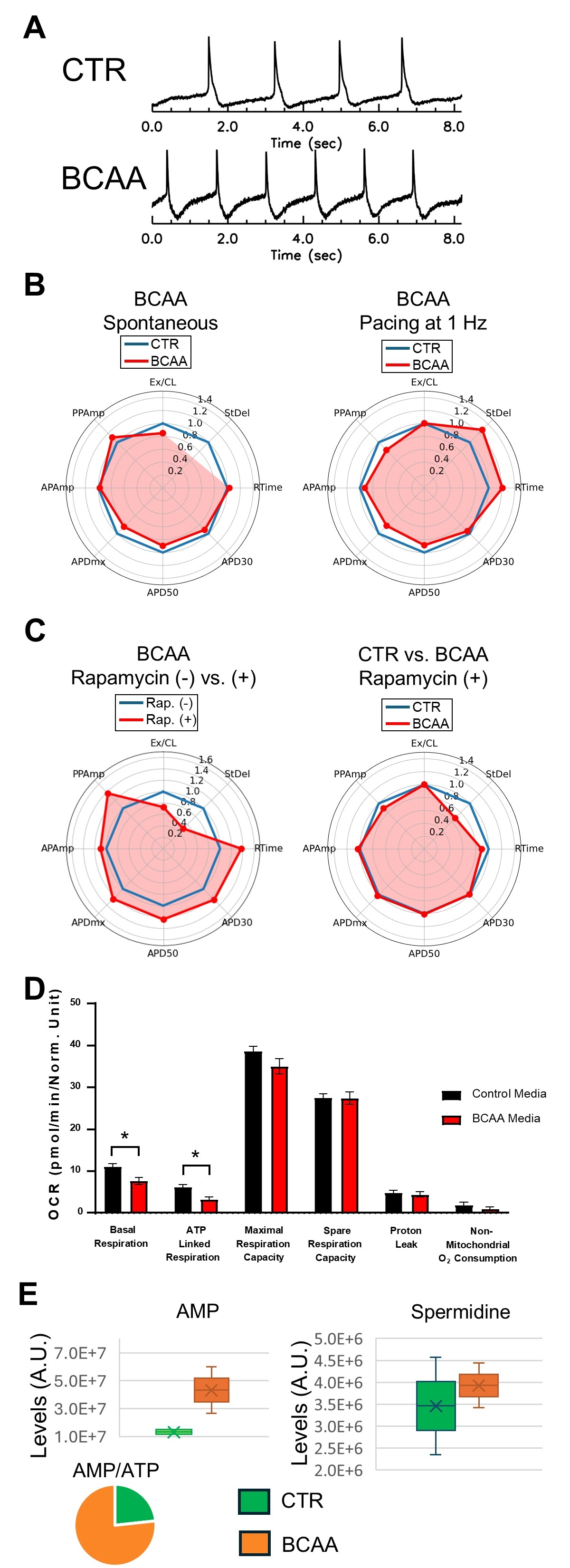
Results: Compared to CTR, BCAA treatment significantly increased (mean ± SD, p<0.05, independent t-test) automaticity (cycle length: BCAA=1360±524 vs CTR=1506±220 ms), increased pacemaker potential amplitude (BCAA=46±26 vs CTR=34±28 mV ), and shortened AP duration (APD: BCAA=200±67 vs CTR=236±64 ms) (panel A&B). Preliminary data indicate that adding the mTOR inhibitor rapamycin to the BCAA media (10 nM, 5 days) can restore the APD in BCAA-treated microtissues (panel C), aligning with the hypothesis that BCAA dysregulation operates via the mTOR pathway to promote atrial arrhythmias. BCAA treatment also reduced basal and ATP linked mitochondrial respiration (panel D). Changes in metabolites associated with excitability and ion channel regulation were detected by mass spectrometry: BCAA increases AMP, AMP/ATP ratio, and spermidine (panel E) and decreases NAD levels.
Conclusion: The observed effects of treating hiPSC atrial microtissues with BCAA on their action potentials, mitochondrial dysfunction, and changes in metabolite profiles favor ectopic activity and reentry in cardiac atrial tissue.
  • Bronk, Peter  ( Rhode Island Hospital and Brown University Medical School , Providence , Rhode Island , United States )
  • Daley, Mark  ( Brown University , Providence , Rhode Island , United States )
  • Yano, Naohiro  ( Ocean State Research Institute, Providence VA , Providence , Rhode Island , United States )
  • Zhang, Peng  ( Ocean State Research Institute, Providence VA and Brown University Medical School , Providence , Rhode Island , United States )
  • Usheva, Anny  ( Rhode Island Hospital and Brown University Medical School , Providence , Rhode Island , United States )
  • Mende, Ulrike  ( Rhode Island Hospital and Brown University Medical School , Providence , Rhode Island , United States )
  • Coulombe, Kareen  ( Brown University , Providence , Rhode Island , United States )
  • Choi, Bum-rak  ( Rhode Island Hospital and Brown University Medical School , Providence , Rhode Island , United States )
  • Author Disclosures:
    Peter Bronk: DO NOT have relevant financial relationships | Mark Daley: DO NOT have relevant financial relationships | Naohiro Yano: No Answer | Peng Zhang: DO NOT have relevant financial relationships | Anny Usheva: No Answer | Ulrike Mende: No Answer | Kareen Coulombe: No Answer | Bum-rak Choi: No Answer
Meeting Info:

Scientific Sessions 2025

2025

New Orleans, Louisiana

Session Info:

Frontiers in Electrophysiology and Arrhythmogenesis: From Cells to Systems

Sunday, 11/09/2025 , 09:15AM - 10:30AM

Moderated Digital Poster Session

More abstracts on this topic:
Association of Eicosanoid Metabolites with Insulin Resistance

Parekh Juhi, Chitsazan Mandana, Roshandelpoor Athar, Alotaibi Mona, Jain Mohit, Cheng Susan, Ho Jennifer

A Systematic Review and Meta-Analysis on the Anesthetic Approaches for Left Atrial Appendage Occlusion: Comparing Conscious Sedation and General Anesthesia

Zaidi Syed Rafay, Ajmal Umna, Rauf Zainab, Maaz Muhammad, Gulzar Sara, Burki Shahid, Nazir Abubakar, Mirza Azka, Hassan Ahmad, Amir Maaz, Jahangir Muhammad Asad, Rasul Minahil, Raza Muhammad, Malik Mohammad

More abstracts from these authors:
Abl1 kinase-deficient mouse hearts exhibit conduction disturbance and arrhythmia vulnerability to oxidative stress that are typically associated with age-related proarrhythmic remodeling

Choi Bum-rak, Bronk Peter, Li Xiaofei, Song Yi, Kim Tae Yun, Lu Yichun, Radice Glenn

Pharmacological enhancement of SK channels increases repolarization reserve in congenital and acquired long QT type 2 syndrome

Bronk Peter, Koren Gideon, Coulombe Kareen, Choi Bum-rak, Kim Tae Yun, Daley Mark, Soepriatna Arvin, Lu Yichun, Turan Nilufer, Qu Zhilin, Terentyeva Radmila, Terentyev Dmitry

You have to be authorized to contact abstract author. Please, Login
Not Available